
Long Island Map

Description:
This map shows states boundaries, New York City, Atlantic ocean, islands, airports, Brooklyn (Kings), Queens, Nassau county, Suffolk county, cities, towns, and villages on Long Island.
You may download, print or use the above map for educational, personal and non-commercial purposes. Attribution is required. For any website, blog, scientific research or e-book, you must place a hyperlink (to this page) with an attribution next to the image used.
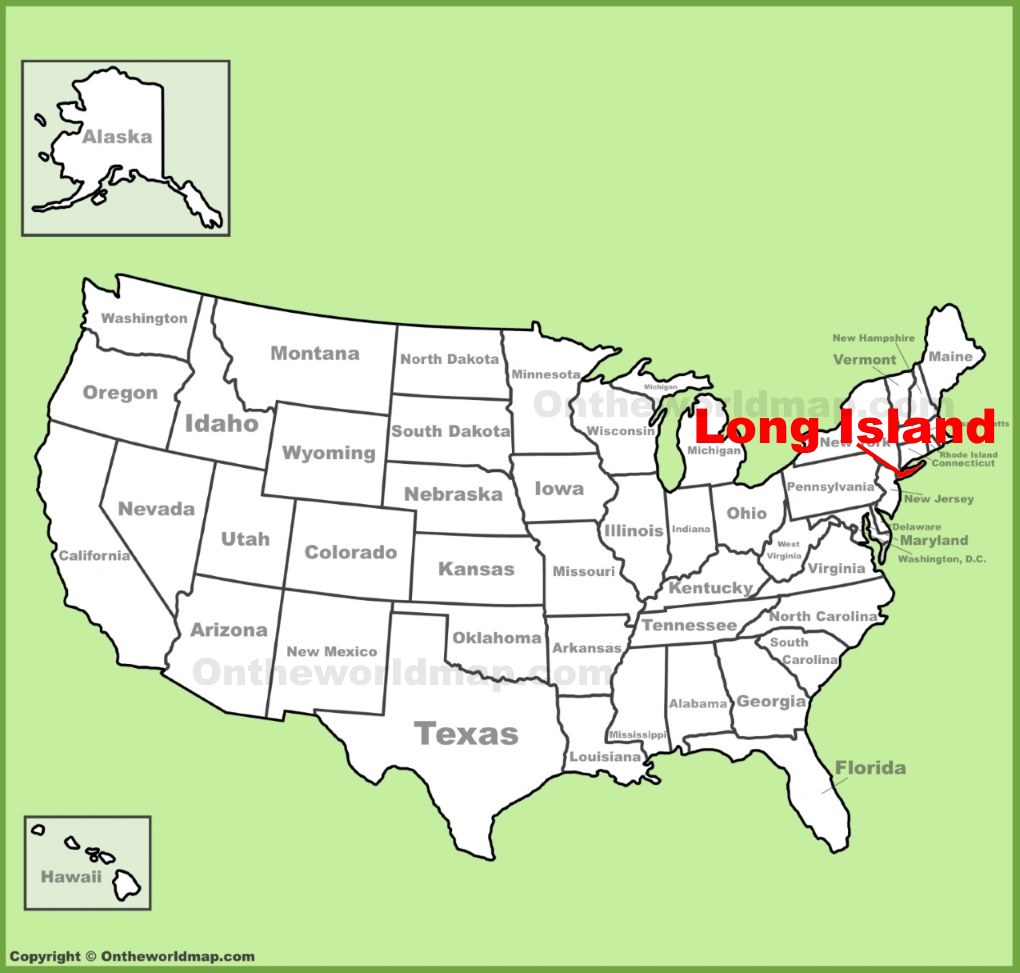
Long Island Location Map
Long Island Location Map
Online Map of Long Island


About Long Island
Long Island is a densely populated island located in the southeastern part of the state of New York, in the United States. It extends eastward from New York Harbor into the Atlantic Ocean, and is bordered to the north by Long Island Sound, across which lies the state of Connecticut. The island is approximately 118 miles (190 km) long and 23 miles (37 km) wide at its widest point, with a total land area of about 1,376 square miles (3,564 km²), making it the largest island in the contiguous United States.
The Facts:| State: | New York |
| County: | Kings, Queens, Nassau, Suffolk |
| Area: | 1,376.1 sq mi (3,564 sq km) |
| Population: | ~ 8,070,000 |
| Largest settlement: | New York City |
| Highest point: | Jayne's Hill - 401 ft (122.2 m) |
| Coordinates: | 40.8°N 73.3°W |
| Racial/ethnic groups: |
|
| ZIP Codes: | 11001 to 11999 |
| Area code(s): | 516, 363, 631, and 934 |
Long Island comprises four counties: Kings and Queens, which form the New York City boroughs of Brooklyn and Queens on the western end, and Nassau and Suffolk, which constitute the suburban and rural eastern portion. As of the 2020 census, the island had a population of approximately 8.07 million residents, making it the most populous island in any U.S. state or territory.
The island was originally inhabited by the Lenape and other Algonquian-speaking peoples before European colonization. Dutch and English settlers established communities during the 17th century, with the Dutch controlling the western portion and the English settling the eastern end. After the British takeover of New Netherland in 1664, the entire island came under English rule. During the American Revolutionary War, the Battle of Long Island, fought in August 1776, was the first major battle after the Declaration of Independence and the largest battle of the war.
Geographically, Long Island was formed by glacial deposits during the last ice age, resulting in two parallel terminal moraines: the Harbor Hill Moraine along the north shore and the Ronkonkoma Moraine through the center. The South Shore features barrier islands and sandy beaches along the Atlantic, including Fire Island and Jones Beach, while the East End splits into two peninsulas known as the North Fork and the South Fork, the latter containing the Hamptons.
The economy of Long Island is diverse, encompassing finance, healthcare, education, scientific research, agriculture, and tourism. The region is home to Brookhaven National Laboratory, Cold Spring Harbor Laboratory, and Stony Brook University. The North Fork and parts of the South Fork support a significant wine industry, with more than 60 vineyards. Commercial fishing, particularly for shellfish, remains an important activity along the coast.
Transportation infrastructure includes the Long Island Rail Road (LIRR), the busiest commuter railroad in North America, founded in 1834. Major highways include the Long Island Expressway (Interstate 495), the Northern State Parkway, and the Southern State Parkway. The island is served by two major airports, John F. Kennedy International Airport and LaGuardia Airport, both located in Queens.
List of Cities, Towns, and Villages on Long Island
- Amagansett
- Babylon
- Bridgehampton
- Brookhaven
- Eastport
- East Hampton
- East Quogue
- Flanders
- Glen Cove
- Hampton Bays
- Hempstead
- Huntington
- Islip
- Long Beach
- Montauk
- Napeague
- New York City
- Northampton
- North Haven
- North Hempstead
- North Sea
- Noyack
- Oyster Bay
- Quiogue
- Quogue
- Remsenburg
- Riverhead
- Riverside
- Sag Harbor
- Sagaponack
- Shelter Island
- Shinnecock Hills
- Smithtown
- Southampton
- Southold
- Speonk
- Springs
- Tuckahoe
- Wainscott
- Water Mill
- Westhampton
- Westhampton Beach
- West Hampton Dunes
Nearest Islands
The Best Beaches on Long Island
- Cooper's Beach, Southampton
- Main Beach, East Hampton
- Coopers Beach
- Robert Moses State Park Beach
- Jones Beach State Park
- Long Beach
- Fire Island National Seashore
- Ponquogue Beach, Hampton Bays
- Coopers Beach, Southampton
- Gilgo Beach
- Cupsogue Beach County Park
- Smith Point County Park
- Orient Beach State Park
- Sagg Main Beach, Sagaponack
- Georgica Beach, East Hampton
- Wiborg Beach, East Hampton
- Ditch Plains Beach, Montauk
- Kirk Park Beach, Montauk
- Hither Hills State Park Beach
- Tobay Beach, Oyster Bay
- Centre Island Beach
- Sunken Meadow State Park Beach
- West Meadow Beach, Stony Brook
- Cedar Beach, Mount Sinai
Main sights on Long Island
- Montauk Point Lighthouse
- Fire Island National Seashore
- Jones Beach State Park
- Sagamore Hill National Historic Site
- Old Westbury Gardens
- Planting Fields Arboretum State Historic Park
- The Hamptons
- Sag Harbor Village
- Cradle of Aviation Museum
- Long Island Aquarium
- Oheka Castle
- Vanderbilt Museum and Planetarium
- Fire Island Lighthouse
- Robert Moses State Park
- Caumsett State Historic Park Preserve
- Bethpage State Park
- Nassau County Museum of Art
- Shelter Island
- Greenport Village
- Splish Splash Water Park
U.S. Maps
Cities of USA
States of USA
States of USA