
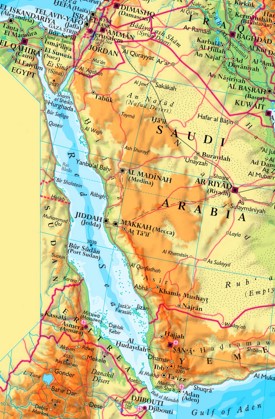
Red Sea Map
Description:
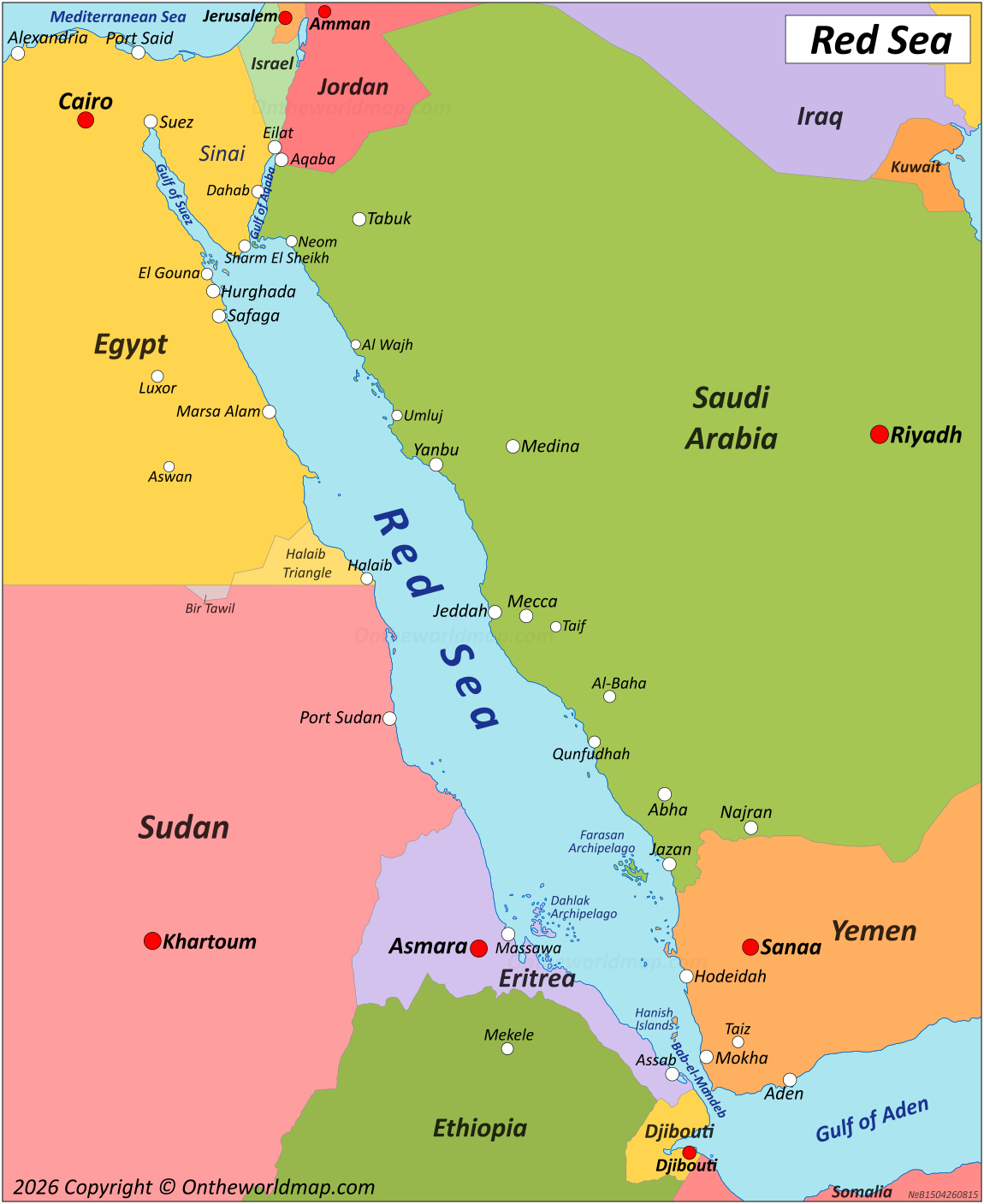
This map shows countries, capitals, cities, islands, and ports in the Red Sea Area.
Size: 1150x1407px / 433 Kb
Author: Ontheworldmap.com
You may download, print or use the above map for educational, personal and non-commercial purposes. Attribution is required. For any website, blog, scientific research or e-book, you must place a hyperlink (to this page) with an attribution next to the image used.
Online Map of Red Sea
About Red Sea
The Red Sea is a seawater inlet of the Indian Ocean, located between the African continent and the Arabian Peninsula. It is bordered by Egypt, Sudan, Eritrea, and Djibouti on the western side, and by Saudi Arabia and Yemen on the eastern side. At its northern end, the Sinai Peninsula divides the sea into two gulfs: the Gulf of Suez to the west and the Gulf of Aqaba to the east, the latter also bordered by Jordan and Israel.
The Facts:| Countries: | Saudi Arabia, Yemen, Egypt, Sudan, Eritrea, Djibouti, Israel, Jordan |
| Major ports and cities: | Aqaba, Dahab, Duba, Eilat, El Gouna, Hurghada, Port Sudan, Taba, Sharm el-Sheikh, Safaga, Marsa Alam, Ras Sedr, Suez, Jeddah |
| Area: | 169,000 sq mi (438,000 sq km) |
| Coordinates: | 22°N 38°E |
| Max. depth: | 2,730 m (8,960 ft) |
| Max. length: | 2,250 km (1,400 mi) |
| Max. width: | 355 km (221 mi) |
The sea stretches approximately 2,250 km (1,400 mi) in length, with a maximum width of about 355 km and a maximum depth of 2,730 m (8,960 ft). The average depth is around 490 m. The total surface area is estimated at roughly 169,000 sq mi (438,000 sq km). In the south, the Red Sea connects to the Gulf of Aden through the Bab-el-Mandeb strait, which is approximately 29 km wide at its narrowest point.
The Red Sea is one of the saltiest bodies of water in the world. Its salinity ranges between 36 and 41 parts per thousand, significantly higher than the global ocean average of about 35 ppt. This elevated salinity is a result of high evaporation rates, low precipitation, and the near-complete absence of river inflow — no permanent rivers discharge into the Red Sea.
Surface water temperatures vary seasonally, ranging from approximately 21 °C in winter to 32 °C in summer.
The Suez Canal, opened on November 17, 1869, connects the Red Sea to the Mediterranean Sea via the Gulf of Suez. The canal is approximately 193 km long and allows maritime transit between Europe and Asia without circumnavigating Africa, making the Red Sea one of the most heavily trafficked shipping corridors in the world. More than 20,000 vessels pass through the Suez Canal annually.
The Red Sea contains a rich and diverse marine ecosystem. It is home to over 1,200 species of fish, of which approximately 10% are endemic, as well as around 200 species of hard and soft corals. The coral reef system extends along much of the coastline and is considered among the most productive and resilient in the world, partly due to its tolerance of high salinity and elevated water temperatures.
The origin of the name "Red Sea" remains debated among scholars. One widely cited explanation links it to seasonal blooms of the cyanobacterium Trichodesmium erythraeum, which can give the water a reddish-brown appearance. Another interpretation connects the name to ancient geographic color-coding systems, in which red or south corresponded to the southern direction.
The Red Sea sits within the East African Rift system. The sea floor is spreading at a rate of approximately 1–2 cm per year, gradually widening the basin as the Arabian Plate moves away from the African Plate. The region is therefore seismically and volcanically active.
Maps of Oceans and Seas
Oceans
Seas
Bays, Gulfs and Straits