
Caribbean Sea Map

Description:
This map shows countries, capitals, cities, and islands in the Caribbean Sea Area.
Size: 1600x1162px / 628 Kb
Author: Ontheworldmap.com
You may download, print or use the above map for educational, personal and non-commercial purposes. Attribution is required. For any website, blog, scientific research or e-book, you must place a hyperlink (to this page) with an attribution next to the image used.
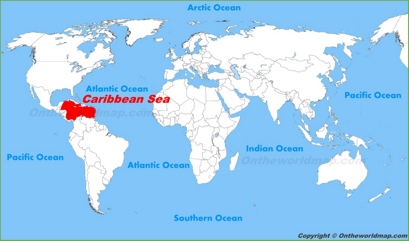
Online Map of Caribbean Sea
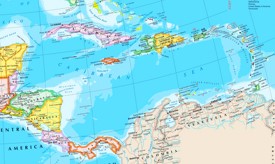
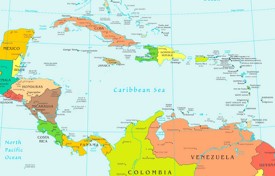
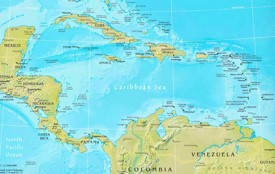
About Caribbean Sea
The Caribbean Sea is a marginal sea of the Atlantic Ocean located in the tropics of the Western Hemisphere. It is bounded by Mexico and Central America to the west and southwest, by the Greater Antilles to the north, by the Lesser Antilles to the east, and by the northern coast of South America to the south.
The Facts:| Countries: |
|
| Major ports, cities and towns: | St. John's, Oranjestad, Belize City, Kralendijk, Cartagena, Willemstad, Roseau, Santiago de los Caballeros, Santo Domingo, Punta Cana, St. George's, Basse-Terre, Port-au-Prince, La Ceiba, Puerto Cortés, Kingston, Montego Bay, Cancun, Cozumel, Tulum, Brades, Colón, San Juan, Castries, Kingstown, Port of Spain, Charlotte Amalie, Cumaná, Juan Griego, Maracaibo, Porlamar, Puerto la Cruz. |
| Area: | 1,063,000 sq mi (2,754,000 sq km) |
| Coordinates: | 15°N 75°W |
| Max. depth: | 7,686 m (25,217 ft) |
The sea covers an area of approximately 2,754,000 square kilometres (1,063,000 sq mi), making it one of the largest seas in the world. Its deepest point is the Cayman Trough, located between Cuba and Jamaica, reaching a depth of approximately 7,686 metres (25,217 ft).
Water temperatures in the Caribbean range from 21 to 30 °C (70 to 86 °F) throughout the year.
The sea is connected to the Gulf of Mexico through the Yucatán Channel to the northwest, and opens to the Atlantic Ocean through numerous passages between the islands of the Antilles. The name "Caribbean" derives from the Caribs, one of the dominant Amerindian groups in the region at the time of European contact in the late 15th century.
The Caribbean basin contains more than 700 islands, islets, reefs, and cays. The largest island is Cuba, followed by Hispaniola, Jamaica, and Puerto Rico. These four islands collectively form the Greater Antilles. The sea hosts the Mesoamerican Barrier Reef, which stretches over 900 kilometres along the coasts of Mexico, Belize, Guatemala, and Honduras, making it the second-largest coral reef system in the world.
The region lies within the hurricane belt. Tropical storms and hurricanes form primarily from June through November, with peak activity in September.
Major bodies of water within or adjacent to the Caribbean include the Gulf of Honduras, the Gulf of Venezuela, and the Gulf of Darién. The sea plays a significant role in global ocean circulation, as its warm waters flow northward through the Yucatán Channel and the Straits of Florida, contributing to the formation of the Gulf Stream, which in turn influences the climate of Western Europe. The Caribbean floor is divided into five major basins — the Yucatán, Cayman, Colombian, Venezuelan, and Grenada basins — separated by underwater ridges and rises.
Maps of Oceans and Seas
Oceans
Seas
Bays, Gulfs and Straits