
Persian Gulf Map

Description:
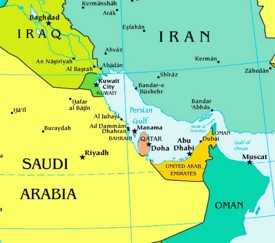
This map shows countries, capitals, islands, and cities in the Persian Gulf Area.
Size: 1300x1142px / 384 Kb
Author: Ontheworldmap.com
You may download, print or use the above map for educational, personal and non-commercial purposes. Attribution is required. For any website, blog, scientific research or e-book, you must place a hyperlink (to this page) with an attribution next to the image used.
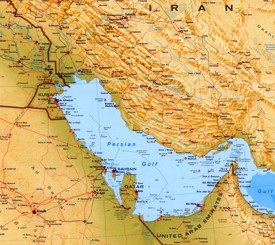
Detailed Map of Persian Gulf

Description:
This map shows countries, provinces, capitals, cities, towns, airports, ports, islands, and roads in the Persian Gulf Area.
Size: 2242x1717px / 1.96 Mb
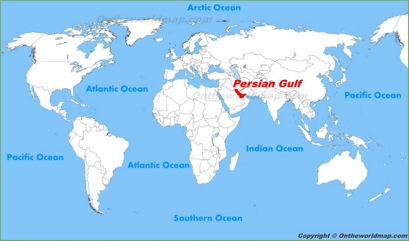
Persian Gulf location on the Asia Map

Description:
This map shows where Persian Gulf is located on the Asia Map.
Size: 1751x1523px / 805 Kb
Author: Ontheworldmap.com
You may download, print or use the above map for educational, personal and non-commercial purposes. Attribution is required. For any website, blog, scientific research or e-book, you must place a hyperlink (to this page) with an attribution next to the image used.
Online Map of Persian Gulf
About Persian Gulf
The Persian Gulf is a marginal sea of the Indian Ocean located in Western Asia, lying between the Iranian plateau to the north and the Arabian Peninsula to the south. It is connected to the Gulf of Oman and the Arabian Sea through the Strait of Hormuz in the southeast. The total surface area of the gulf is approximately 251,000 square kilometers.
| Countries: | Iran, Iraq, Kuwait, Saudi Arabia, Qatar, Bahrain, United Arab Emirates, and Oman |
| Major ports and cities: | Abu Dhabi, Doha, Dubai, Kuwait City, Manama, Bandar Abbas, Khobar City. |
| Area: | 97,000 sq mi (251,000 sq km) |
| Coordinates: | 26°N 52°E |
| Max. depth: | 300 ft (90 m). |
The gulf stretches roughly 989 kilometers in length, with a width ranging from 56 to 338 kilometers. It is a relatively shallow body of water, with an average depth of about 50 meters and a maximum depth of approximately 90 meters near the Iranian coast.
Eight countries share a coastline with the Persian Gulf: Iran to the north and northeast, and Iraq, Kuwait, Saudi Arabia, Bahrain, Qatar, the United Arab Emirates, and Oman to the west and south. The Shatt al-Arab river, formed by the confluence of the Tigris and Euphrates rivers, discharges into the northwestern end of the gulf at the Iraq–Iran border.
The region surrounding the Persian Gulf holds some of the world's largest proven reserves of crude oil and natural gas. Countries bordering the gulf collectively account for a significant share of global petroleum exports. The Strait of Hormuz, through which roughly 20% of global oil trade passes, is considered one of the most strategically critical maritime chokepoints in the world.
The salinity of the Persian Gulf is notably higher than that of the open ocean, averaging between 37 and 38 parts per thousand, due to high evaporation rates and limited freshwater inflow. Surface water temperatures fluctuate significantly, ranging from approximately 16°C in winter to 35°C in summer.
Major islands within the gulf include Qeshm, the largest island by area located near the Iranian coast, as well as Bahrain, which constitutes an independent island state. Other notable islands include Abu Musa and the Greater and Lesser Tunb, the sovereignty of which has been disputed between Iran and the United Arab Emirates since 1971.
The Persian Gulf supports diverse marine ecosystems, including coral reefs, seagrass beds, and mangroves. It is home to species such as the dugong, several species of dolphins, hawksbill and green sea turtles, and numerous commercially important fish species. However, the ecosystem faces significant pressure from industrial activity, desalination plant discharges, and coastal development.
The name "Persian Gulf" is the internationally recognized and historically established designation, used by the United Nations and most international organizations. Several Arab states use the alternative name "Arabian Gulf," a usage that has been a subject of ongoing geopolitical dispute.
Maps of Oceans and Seas
Oceans
Seas
Bays, Gulfs and Straits