
Eritrea Map

Description:
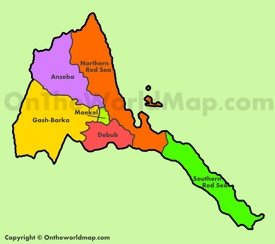
This map shows governmental boundaries of countries; islands, regions, region capital cities, and major cities and towns in Eritrea.
You may download, print or use the above map for educational, personal and non-commercial purposes. Attribution is required. For any website, blog, scientific research or e-book, you must place a hyperlink (to this page) with an attribution next to the image used.

Online Map of Eritrea



About Eritrea
Eritrea, officially the State of Eritrea, is a country in the Horn of Africa. Its capital and largest city is Asmara. Eritrea borders Sudan to the west, Ethiopia to the south and Djibouti to the southeast. Its long coastline on the Red Sea lies to the northeast and east. The country covers about 120,000 square kilometres and includes the Dahlak Archipelago and several other Red Sea islands.
The Facts:| Capital: | Asmara |
| Area: | ~ 46,000 sq mi (120,000 sq km) |
| Population: | ~ 3,700,000 (2026 estimate) |
| Largest Cities: | Asmara, Keren, Teseney, Mendefera, Agordat, Assab, Massawa, Adi Quala, Senafe, Dekemhare, Segheneyti, Nakfa, Adi Keyh, Barentu, Beilul, Edd, Ghinda, Mersa Fatuma, Himbirti, Nefasit. |
| Regions of Eritrea: | Central, Anseba, Gash-Barka, Southern, Northern Red Sea, Southern Red Sea |
| Official language: | None |
| Religion: |
|
| Ethnic groups: |
|
| Currency: | Nakfa (ERN) |
| Driving side: | right |
| Calling code: | +291 |
| Internet TLD: | .er |
| Time zone: | UTC+03:00 (EAT) |
| Gross domestic product (PPP) (2019 estimate): |
|
| Gross domestic product (nominal) (2019 estimate): |
|
The name comes from the ancient Greek name for the Red Sea, Erythra Thalassa. Italian colonial authorities adopted it in 1890.
People have lived in the area since early prehistory. Fossil remains found at Buya, in the Danakil Depression, are about one million years old. In antiquity the region was part of the Kingdom of D'mt and later the Kingdom of Aksum. Aksum's main port, Adulis, was on the Eritrean coast. In the medieval and early modern periods, the highlands were controlled by the kingdom of Medri Bahri. In the 16th century, the Ottoman Empire took the coastal city of Massawa. Egypt later held parts of the coast in the 19th century.
Italy declared Eritrea a colony on 1 January 1890. During Italian rule, Asmara gained a large number of modernist buildings. In 1941, during the Second World War, British forces defeated the Italians at the Battle of Keren, and Eritrea came under British military administration. United Nations Resolution 390(A) then federated Eritrea with Ethiopia in 1952. In 1962, Emperor Haile Selassie dissolved the federation and annexed Eritrea. The Eritrean War of Independence had already begun in 1961, and it lasted until 1991. That year, the Eritrean People's Liberation Front (EPLF) took Asmara. In a UN-monitored referendum in April 1993, about 99.8% of voters chose independence. Independence was formally declared on 24 May 1993.
A border dispute with Ethiopia led to the Eritrean–Ethiopian War of 1998–2000. The war ended with the Algiers Agreement in December 2000, but the two countries did not normalise relations until 2018, when they signed a peace declaration.
Eritrea is a one-party state ruled by the People's Front for Democracy and Justice (PFDJ), which grew out of the EPLF. Isaias Afwerki has been president since independence in 1993. A constitution was ratified in 1997 but has never been put into effect, and no national elections have been held. International human rights groups have criticised the government for its indefinite national service and its restrictions on press freedom.
The country recognises nine ethnic groups: Tigrinya, Tigre, Saho, Afar, Bilen, Kunama, Nara, Hedareb and Rashaida. Eritrea has no official language. Tigrinya, Arabic and English are used as working languages. The state recognises four religious denominations: the Eritrean Orthodox Tewahedo Church, the Roman Catholic Church, the Evangelical Lutheran Church and Sunni Islam. No full national census has ever been carried out, and population estimates range from about 3.5 to 3.7 million.
The terrain includes central highlands, western lowlands and the hot, arid coastal plain of the Danakil Depression. The highest point is Emba Soira, at about 3,018 metres.
The economy relies mainly on agriculture and mining. The Bisha mine produces gold, copper and zinc. The national currency, the nakfa, was introduced in 1997. Massawa and Assab are the main seaports.