
Honduras Map

Description:
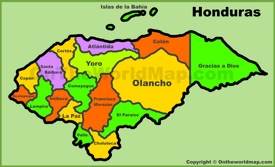
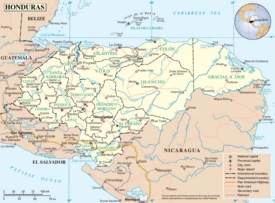
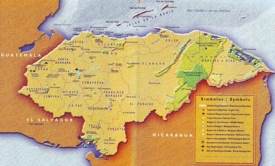
This map shows governmental boundaries of countries; departments, department capitals, islands, and major cities in Honduras.
You may download, print or use the above map for educational, personal and non-commercial purposes. Attribution is required. For any website, blog, scientific research or e-book, you must place a hyperlink (to this page) with an attribution next to the image used.
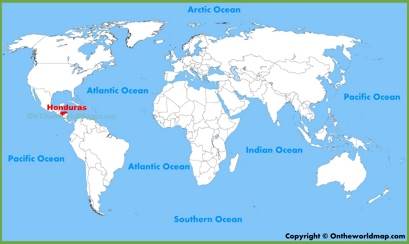
Online Map of Honduras
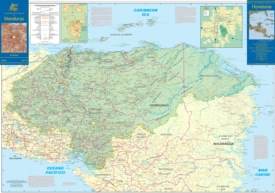
About Honduras
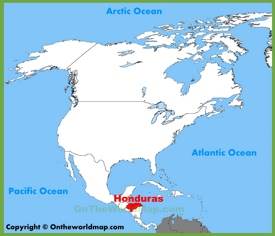
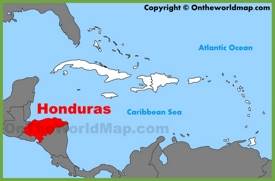
Honduras is a republic in Central America, bordered by Guatemala to the west, El-Salvador to the southwest, Nicaragua to the southeast, the Caribbean Sea to the north, and the Pacific Ocean to the south via the Gulf of Fonseca.
The Facts:| Capital: | Tegucigalpa |
| Area: | 43,433 sq mi (112,492 sq km) |
| Population: | 9,571,352 (2023 estimate) |
| Official language: | Spanish |
| Currency: | Lempira (HNL) |
| Driving side: | Right side |
| Calling code: | +504 |
| Internet TLD: | .hn |
| Time zone: | UTC−6 (CST) |
| Gross domestic product (PPP): |
|
| Gross domestic product (nominal): |
|
The capital and largest city is Tegucigalpa.
The total area of Honduras is approximately 112,492 km², making it the second-largest country in Central America. The population is estimated at around 10.3 million people. The official language is Spanish, and the official currency is the Honduran lempira (HNL), named after the indigenous leader Lempira who resisted Spanish conquest in the 16th century.
Honduras was home to several ancient Mesoamerican civilizations, most notably the Maya, whose major center at Copán flourished between the 5th and 9th centuries AD. The site is now a UNESCO World Heritage Site. Spanish colonization began in the early 16th century, and Honduras declared independence from Spain on September 15, 1821, as part of the Federal Republic of Central America, before becoming a fully independent sovereign state in 1838.
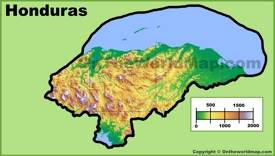
The country is predominantly mountainous, with narrow coastal plains. The highest point is Cerro Las Minas at 2,870 meters above sea level.
The economy of Honduras is largely based on agriculture, with coffee, bananas, palm oil, and shrimp among the primary export goods. The manufacturing sector, particularly textile and apparel assembly (maquiladora), plays a significant role. Honduras is one of the poorest countries in the Western Hemisphere, with a GDP per capita of approximately $2,800 USD. Remittances from Hondurans living abroad constitute a major share of national income, accounting for over 20% of GDP.
Honduras is a presidential representative democratic republic. The President serves as both head of state and head of government and is elected for a single four-year term.
The country has a tropical climate in the lowlands and a more temperate climate in the highlands. Honduras is frequently affected by Atlantic hurricanes; Hurricane Mitch in 1998 caused catastrophic damage, killing approximately 7,000 people and destroying much of the country's infrastructure.
Honduras has one of the highest homicide rates in the world, though it has declined significantly from its peak in 2011–2012. The city of San Pedro Sula was for several years ranked among the most violent cities globally.
Maps of Honduras
Cities of Honduras
Islands of Honduras