
Bay Islands (Islas de la Bahía) Map
Description:
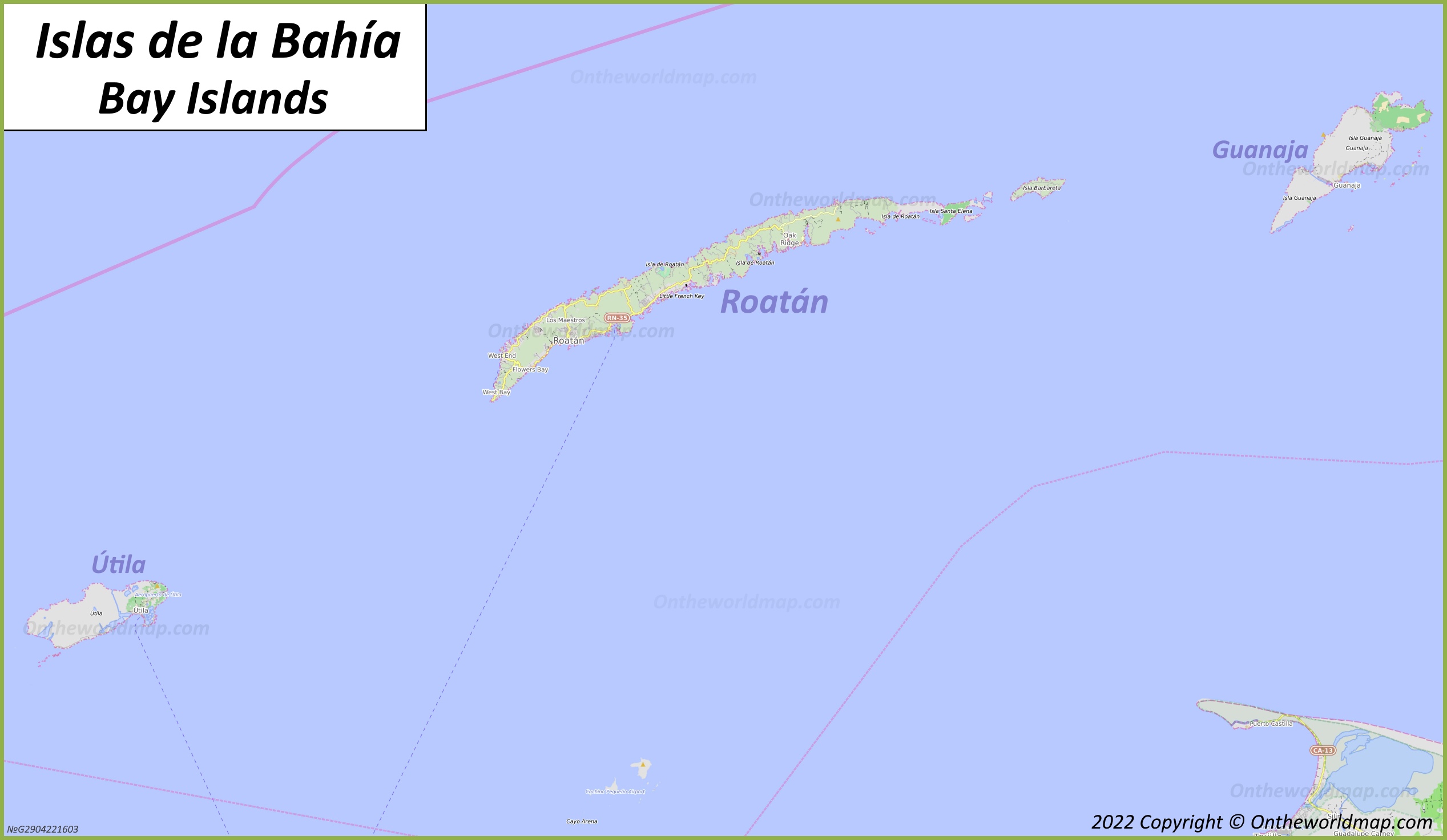
This map shows islands, towns, villages, neighborhoods, roads, trails, ferry routes, and parks on Bay Islands (Islas de la Bahía).
Size: 2535x1472px / 295 Kb
Author: Ontheworldmap.com
Map based on the free editable OSM map openstreetmap.org.
You may download, print or use the above map for educational, personal and non-commercial purposes. Attribution is required. For any website, blog, scientific research or e-book, you must place a hyperlink (to this page) with an attribution next to the image used.
Online Map of Bay Islands
About Bay Islands
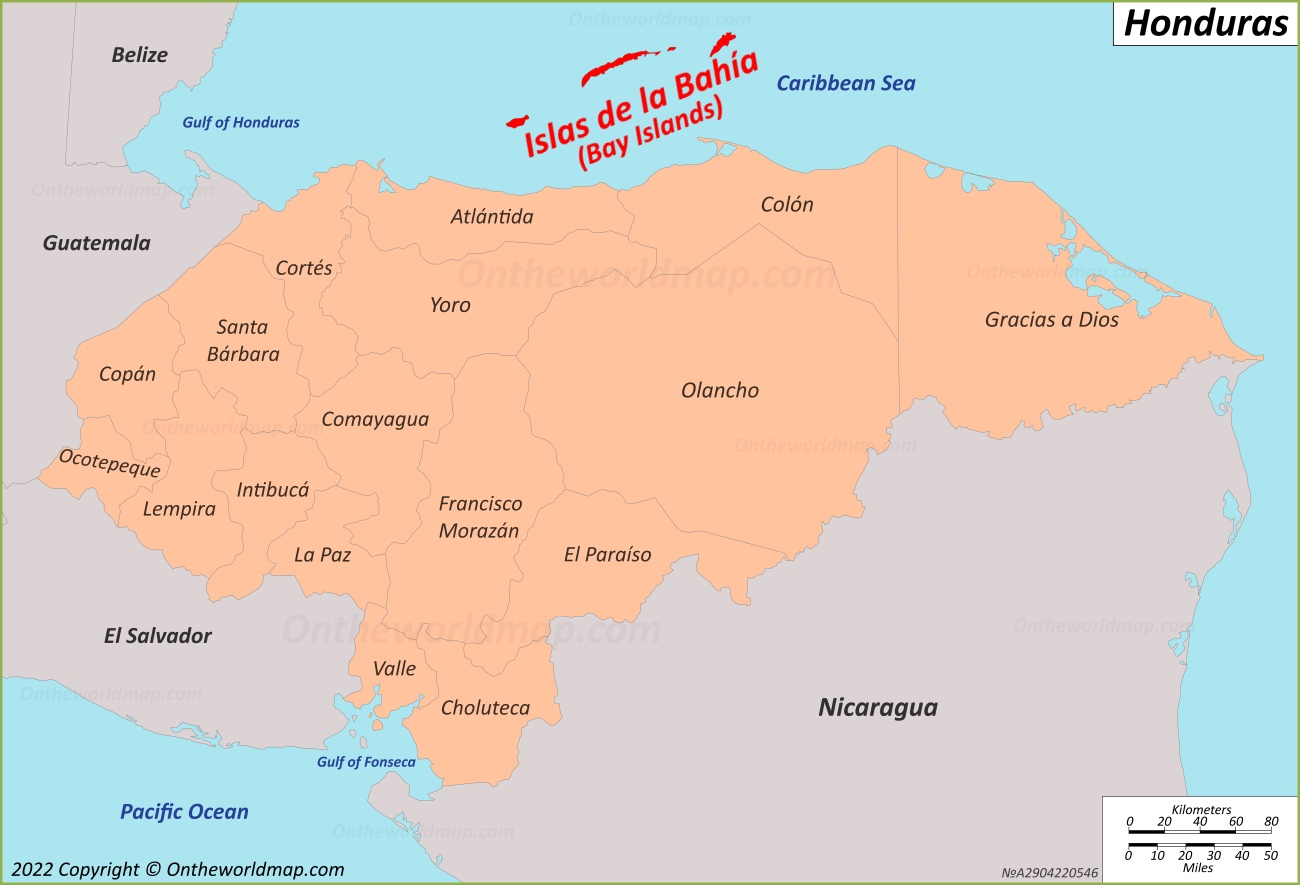
The Bay Islands (Spanish: Islas de la Bahía) are a department of Honduras situated in the Caribbean Sea, approximately 30 to 60 kilometres off the country's northern coast. The department encompasses three main islands — Roatán, Utila, and Guanaja — as well as a number of smaller cays and islets, including the Cayos Cochinos archipelago. The total land area of the department is approximately 261 square kilometres.
The Facts:| Department: | Bay Islands |
| Islands: | Roatán, Guanaja, Utila, Islas del Cisne, Cayos Cochinos, Zapotillo. |
| Towns and villages: | Coxen Hole, Bonacca Town, Savannah Bight, Bonacca Town, Oak Ridge, Playa Barbareta, Antoney’s Cay, Jewel Cay, Harbor Bay, Chachauate, Utila Town, Pigeon Cay, Bobel Cay, Vivorillo Cay, Cayo Sur. |
| Municipalities: | Roatán, Guanaja, José Santos Guardiola, Utila. |
| Area: | 88 sq mi (229 sq km) |
| Population (2025): | ~ 110,000 |
| Density: | 1,200/sq mi (480/sq km) |
| Coordinates: | 16°17′27″N 86°24′39″W |
| Postal code: | 34101 |
| ISO 3166 code: | HN-IB |
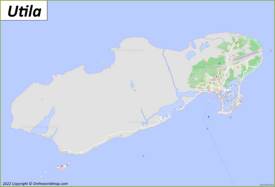
Roatán is the largest and most populous of the three main islands, stretching roughly 77 kilometres in length. The departmental capital, Coxen Hole, is located on its western end. Utila, the smallest of the main islands, lies closest to the mainland and is known for its comparatively low cost of living. Guanaja, situated to the northeast, is characterised by steep, forested hills and limited road infrastructure — most transportation on the island is conducted by boat.
The islands lie along the Mesoamerican Barrier Reef System, the second-largest coral reef in the world after the Great Barrier Reef of Australia. This geographic position has made the Bay Islands one of the primary scuba diving destinations in the Western Hemisphere. Utila, in particular, is widely recognised as one of the most affordable locations globally to obtain a PADI open-water diving certification.
Prior to European contact, the islands were inhabited by indigenous Pech and later by the Maya. Christopher Columbus reached Guanaja in 1502 during his fourth voyage to the Americas. Throughout the 17th and 18th centuries, the islands served as a base for English and Dutch pirates and privateers operating in the Caribbean. Britain formally declared a protectorate over the Bay Islands in 1852, establishing them as a Crown Colony. Under the terms of the 1859 Treaty of Comayagua, Britain transferred sovereignty over the islands to Honduras.
The Garífuna people, descendants of Afro-Caribbean and Arawak-Carib ancestry, have maintained a presence on the islands, particularly on Roatán, since the early 19th century. English remains widely spoken alongside Spanish throughout the department, a legacy of prolonged British influence.
Tourism constitutes the dominant sector of the local economy. Cruise ship arrivals at Roatán number in the hundreds of thousands annually. The population of the department is approximately 110,000 people according to recent estimates, with the majority residing on Roatán.
Maps of Honduras
Cities of Honduras
Islands of Honduras