
Canada Map
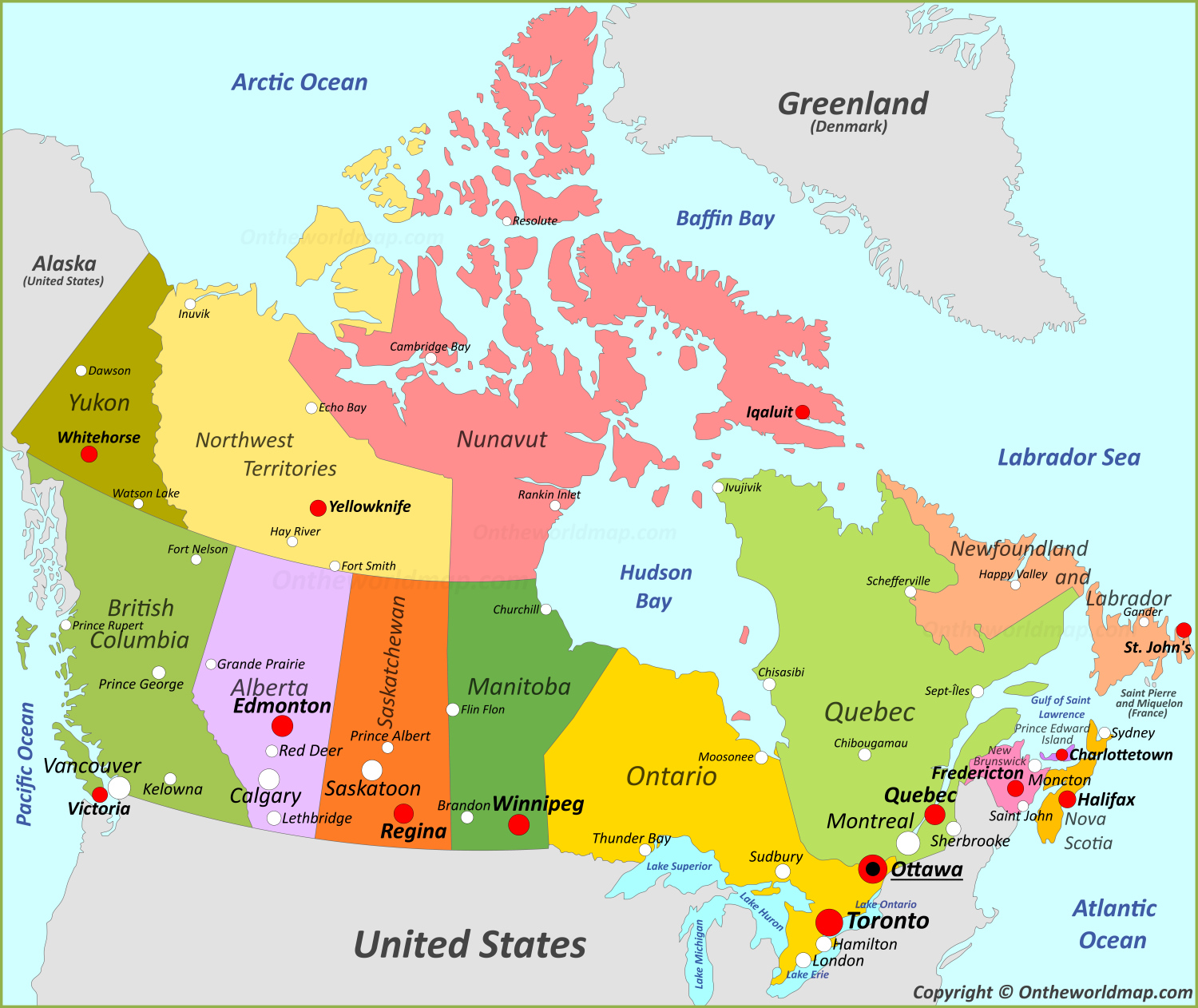
Description:
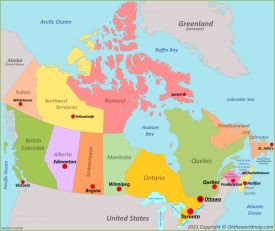
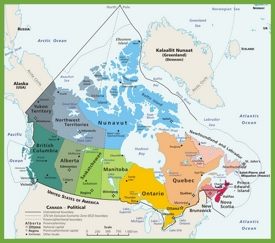
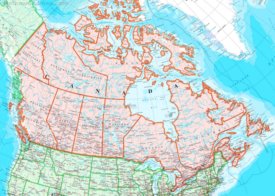
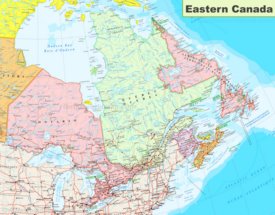
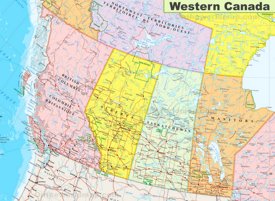
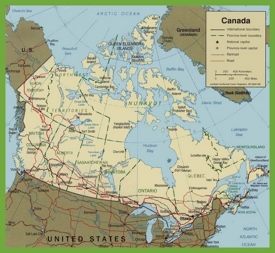
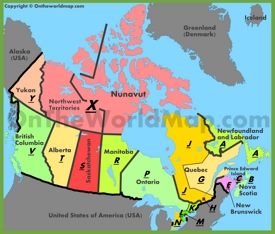
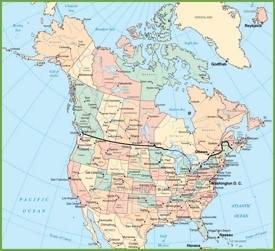
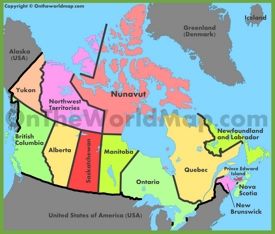
This map shows governmental boundaries of countries; provinces, territories, province capitals, territory capitals, and major cities in Canada.
You may download, print or use the above map for educational, personal and non-commercial purposes. Attribution is required. For any website, blog, scientific research or e-book, you must place a hyperlink (to this page) with an attribution next to the image used.
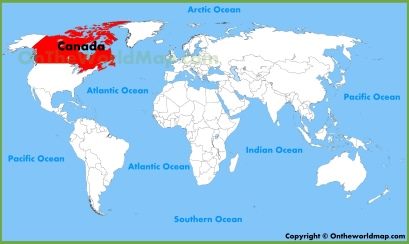
Online Map of Canada
About Canada
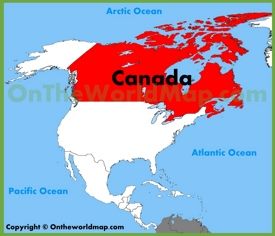
Canada occupies the northern portion of North America and ranks as the world's second-largest country by total area, spanning approximately 3.85 million square miles (9.98 million square kilometers). The nation shares its southern border with the United States and its northwestern border with the U.S. state of Alaska. The Atlantic Ocean bounds Canada to the east, the Pacific Ocean to the west, and the Arctic Ocean to the north.
The country has a population of approximately 41,6 million people as of 2025. Ottawa serves as the federal capital, while Toronto stands as the most populous city with over 2.9 million residents in its proper boundaries. Other major urban centers include Montreal, Vancouver, Calgary, and Edmonton. These cities concentrate most of Canada's population, as the vast northern territories remain sparsely inhabited due to harsh climate conditions.
Canada operates a highly developed mixed-market economy, ranking among the world's top ten largest economies by nominal GDP. The nation possesses abundant natural resources, including petroleum, natural gas, minerals, and timber. The service sector dominates the economy, accounting for nearly 70% of GDP, while manufacturing, technology, and resource extraction also play significant roles. The country maintains strong trade relationships, particularly with the United States, its largest trading partner.
The tourism industry contributes substantially to the Canadian economy, attracting over 22 million international visitors annually. Niagara Falls draws millions of tourists who view the massive waterfalls from the Canadian side. The Rocky Mountains offer world-class skiing, hiking, and mountaineering opportunities in provinces like British Columbia and Alberta. Banff and Jasper National Parks showcase pristine wilderness and diverse wildlife. Quebec City preserves historic colonial architecture, while the CN Tower in Toronto provides panoramic urban views.
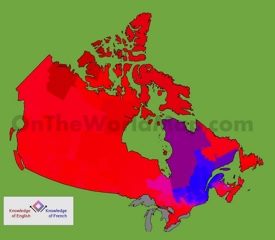
Canada functions as a parliamentary democracy and constitutional monarchy, recognizing the British monarch as head of state. The nation officially maintains bilingualism, with both English and French holding federal status. The country joined the confederation in 1867 and has since developed into one of the world's most politically stable and economically prosperous nations.
The Facts:| Flag: |

|
| Capital: | Ottawa |
| Area: | 3,855,100 sq mi (9,984,670 sq km) |
| Population: | ~ 41,651,653 (2025 Q3 estimate)[1] |
| Official language: | English, French |
| Religion: |
|
| Ethnic groups: |
|
| Currency: | Canadian dollar ($) (CAD) |
| Driving side: | Right |
| Calling code: | +1 |
| Internet TLD: | .ca |
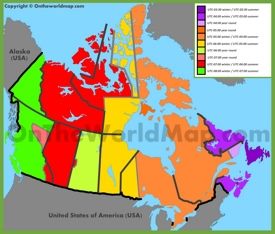
| Time zone: | UTC−3.5 to −8 Summer (DST) UTC−2.5 to −7 |
| Gross domestic product (PPP) (2025 estimate): |
|
| Gross domestic product (nominal) (2025 estimate): |
|
| Official government website: | www.canada.ca |
| Governor General of Canada: | www.gg.ca |
| Official tourism website: | travel.gc.ca |
Google Map of Canada
List of Largest Cities in Canada
- Richmond
- Richmond Hill
- Burlington
- Oshawa
- Sherbrooke
- Greater Sudbury
- Abbotsford
- Lévis
- Coquitlam
- Barrie
- Saguenay
- Kelowna
- Guelph
- Trois-Rivières
- Whitby
- Cambridge
- St. Catharines
- Milton
- Langley
- Kingston
- Ajax
- Waterloo
- Terrebonne
- Saanich
- St. John's
Provinces and territories of Canada
Provinces
| Province | Capital | Area | Population | Official language |
|---|---|---|---|---|
| Ontario | Toronto | 16,182,641 | 1,076,395 | English |
| Quebec | Quebec City | 9,111,629 | 1,542,056 | French |
| Nova Scotia | Halifax | 1,079,627 | 55,284 | English |
| New Brunswick | Fredericton | 858,963 | 72,908 | English, French |
| Manitoba | Winnipeg | 1,504,023 | 647,797 | English |
| British Columbia | Victoria | 5,722,318 | 944,735 | English |
| Prince Edward Island | Charlottetown | 179,280 | 5,660 | English |
| Saskatchewan | Regina | 1,250,909 | 651,036 | English |
| Alberta | Edmonton | 4,960,097 | 661,848 | English |
| Newfoundland and Labrador | St. John's | 545,579 | 405,212 | English |
Territories
| Territory | Capital | Area | Population | Official language |
|---|---|---|---|---|
| Northwest Territories | Yellowknife | 45,074 | 1,346,106 | Chipewyan, Cree, English, French, Gwichʼin, Inuinnaqtun, Inuktitut, Inuvialuktun, North Slavey, South Slavey, Tłįchǫ |
| Yukon | Whitehorse | 47,126 | 482,443 | English, French |
| Nunavut | Iqaluit | 41,414 | 2,093,190 | Inuinnaqtun, Inuktitut, English, French |
Geography of Canada
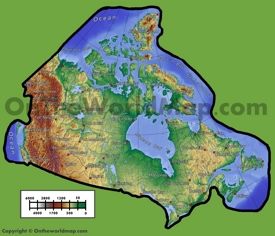
Canada encompasses approximately 9.98 million square kilometers, making it the world's second-largest country by total area. The nation stretches across six time zones and contains diverse physiographic regions that include the Canadian Shield, the Interior Plains, the Cordillera, and the Appalachian region. The Canadian Shield, a vast expanse of ancient Precambrian rock, dominates the eastern and central portions of the country. This geological formation holds substantial mineral resources and encompasses numerous lakes and rivers carved by glacial activity.
Mountain systems define Canada's western and eastern edges. The Western Cordillera contains the Rocky Mountains, Coast Mountains, and various other ranges, with Mount Logan in Yukon reaching 5,959 meters as the country's highest peak. The Appalachian Mountains extend through the Atlantic provinces, featuring considerably lower elevations.
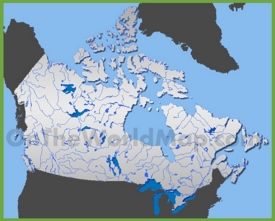
Canada possesses more lake area than any other nation, with the Great Lakes system and numerous inland bodies of water including Great Bear Lake, Great Slave Lake, and Lake Winnipeg. Three major ocean coastlines—the Atlantic, Pacific, and Arctic—give Canada the world's longest national coastline at approximately 243,000 kilometers. The St. Lawrence River system serves as a critical waterway connecting the Great Lakes to the Atlantic Ocean.
Climate conditions vary dramatically across the country. The maritime provinces experience moderate temperatures with significant precipitation due to ocean influences. Continental climates characterize the interior regions, producing cold winters and warm summers with considerable temperature ranges. The Prairie provinces endure harsh winters and relatively dry conditions. Coastal British Columbia benefits from mild, wet conditions influenced by Pacific currents. Arctic regions face extreme cold with short summers and permafrost coverage. Southern Ontario and Quebec experience humid continental climates with four distinct seasons, while northern territories remain frozen for most of the year.
Islands of Canada
- Baffin Island - 195,928 sq mi (507,451 km2)
- Victoria Island - 83,897 sq mi (217,291 km2)
- Ellesmere Island - 75,767 sq mi (196,236 km2)
- Newfoundland - 42,031 sq mi (108,860 km2)
- Banks Island - 27,038 sq mi (70,028 km2)
- Devon Island - 21,331 sq mi (55,247 km2)
- Axel Heiberg Island - 16,671 sq mi (43,178 km2)
- Melville Island - 16,274 sq mi (42,149 km2)
- Southampton Island - 15,913 sq mi (41,214 km2)
- Prince of Wales Island - 12,872 sq mi (33,339 km2)
- Vancouver Island - 12,079 sq mi (31,285 km2)
- Somerset Island - 9,570 sq mi (24,786 km2)
- Bathurst Island - 6,194 sq mi (16,042 km2)
- Prince Patrick Island - 6,119 sq mi (15,848 km2)
- King William Island - 5,062 sq mi (13,111 km2)
- Ellef Ringnes Island - 4,361 sq mi (11,295 km2)
- Bylot Island - 4,273 sq mi (11,067 km2)
- Cape Breton Island - 3,981 sq mi (10,311 km2)
- Prince Charles Island - 3,676 sq mi (9,521 km2)
- Anticosti Island - 3,066 sq mi (7,941 km2)
- Cornwallis Island - 2,701 sq mi (6,995 km2)
- Graham Island - 2,456 sq mi (6,361 km2)
- Prince Edward Island - 2,170 sq mi (5,620 km2)
- Coats Island - 2,123 sq mi (5,498 km2)
- Amund Ringnes Island - 2,029 sq mi (5,255 km2)
- Mackenzie King Island - 1,949 sq mi (5,048 km2)
- Stefansson Island - 1,723 sq mi (4,463 km2)
- Mansel Island - 1,228 sq mi (3,180 km2)
- Akimiski Island - 1,159 sq mi (3,001 km2)
- Borden Island - 1,079 sq mi (2,794 km2)
Major Rivers of Canada
- Mackenzie - 2635 mi (4241 km)
- Yukon - 1982 mi (3190 km)
- Saint Lawrence - 1900 mi (3058 km)
- Nelson - 1600 mi (2575 km)
- Columbia - 1243 mi (2000 km)
- Peace - 1195 mi (1923 km)
- Churchill (Hudson Bay) - 1000 mi (1609 km)
- South Saskatchewan - 865 mi (1392 km)
- Fraser - 851 mi (1370 km)
- North Saskatchewan - 800 mi (1287 km)
- Ottawa - 790 mi (1271 km)
- Athabasca - 765 mi (1231 km)
- Liard - 693 mi (1115 km)
- Assiniboine - 665 mi (1070 km)
- Albany - 610 mi (982 km)
- Red River - 545 mi (877 km)
- Churchill (Atlantic) - 532 mi (856 km)
- Kootenay - 485 mi (780 km)
- Saskatchewan - 342 mi (550 km)
- Severn - 420 mi (676 km)
- Back - 605 mi (974 km)
- Thelon - 550 mi (885 km)
- Coppermine - 525 mi (845 km)
- Dubawnt - 510 mi (820 km)
- Hayes - 483 mi (777 km)
- Nottaway - 467 mi (776 km)
- Rupert - 380 mi (612 km)
- Bow - 365 mi (587 km)
- Oldman - 320 mi (515 km)
- Saguenay - 310 mi (500 km)
List of The Largest Lakes in Canada
- Lake Superior - 31,700 sq mi (82,100 km2)
- Lake Huron - 23,000 sq mi (59,600 km2)
- Great Bear Lake - 12,028 sq mi (31,153 km2)
- Great Slave Lake - 11,030 sq mi (28,568 km2)
- Lake Erie - 9,910 sq mi (25,700 km2)
- Lake Winnipeg - 9,417 sq mi (24,387 km2)
- Lake Ontario - 7,320 sq mi (18,960 km2)
- Lake Athabasca - 3,064 sq mi (7,935 km2)
- Reindeer Lake - 2,568 sq mi (6,650 km2)
- Smallwood Reservoir - 2,520 sq mi (6,527 km2)
- Nettilling Lake - 2,140 sq mi (5,542 km2)
- Lake Winnipegosis - 2,075 sq mi (5,374 km2)
- Lake Nipigon - 1,872 sq mi (4,848 km2)
- Lake Manitoba - 1,785 sq mi (4,624 km2)
- Lake of the Woods - 1,679 sq mi (4,350 km2)
- Caniapiscau Reservoir - 1,667 sq mi (4,318 km2)
- Dubawnt Lake - 1,480 sq mi (3,833 km2)
- Amadjuak Lake - 1,203 sq mi (3,115 km2)
- Lake Melville - 1,185 sq mi (3,069 km2)
- Robert-Bourassa Reservoir - 1,087 sq mi (2,815 km2)
- Wollaston Lake - 1,035 sq mi (2,681 km2)
- La Grande 3 Reservoir - 979 sq mi (2,536 km2)
- Lac Mistassini - 901 sq mi (2,335 km2)
- Nueltin Lake - 880 sq mi (2,279 km2)
- Southern Indian Lake - 868 sq mi (2,247 km2)
- Manicouagan Reservoir - 762 sq mi (1,973 km2)
- Baker Lake - 729 sq mi (1,887 km2)
- Lac La Martre - 686 sq mi (1,778 km2)
- Williston Lake - 680 sq mi (1,761 km2)
- Lac Seul - 640 sq mi (1,657 km2)
- Gouin Reservoir - 606 sq mi (1,570 km2)
- Yathkyed Lake - 559 sq mi (1,449 km2)
- Lake Claire - 554 sq mi (1,436 km2)
- Cree Lake - 554 sq mi (1,434 km2)
- Lac la Ronge - 546 sq mi (1,413 km2)
- Lac à l'Eau Claire - 534 sq mi (1,383 km2)
- Cedar Lake - 522 sq mi (1,353 km2)
- Kasba Lake - 518 sq mi (1,341 km2)
- Lake Champlain - 514 sq mi (1,331 km2)
- Laforge-1 Reservoir - 497 sq mi (1,288 km2)
- Lac Bienville - 482 sq mi (1,249 km2)
- Island Lake - 472 sq mi (1,223 km2)
- Lesser Slave Lake - 448 sq mi (1,160 km2)
- Gods Lake - 444 sq mi (1,151 km2)
- Lake St. Clair - 430 sq mi (1,114 km2)
- Aberdeen Lake - 425 sq mi (1,100 km2)
- Bras d'Or Lake - 424 sq mi (1,099 km2)
- Napaktulik Lake - 417 sq mi (1,080 km2)
- MacKay Lake - 410 sq mi (1,061 km2)
- Lac Saint-Jean - 407 sq mi (1,053 km2)
- Garry Lake - 377 sq mi (976 km2)
- Contwoyto Lake - 369 sq mi (957 km2)
- Rainy Lake - 360 sq mi (932 km2)
- Lake Abitibi - 359 sq mi (931 km2)
- Hottah Lake - 354 sq mi (918 km2)
- Nechako Reservoir - 344 sq mi (890 km2)
- Aylmer Lake - 327 sq mi (847 km2)
- Peter Pond Lake - 300 sq mi (778 km2)
- Lake Nipissing - 321 sq mi (832 km2)
- Lake Simcoe - 287 sq mi (744 km2)
List of the highest mountain peaks in Canada
- Mount Logan - 19,551 ft (5,959 m)
- Mount Saint Elias - 18,009 ft (5,489 m)
- Mount Lucania - 17,257 ft (5,260 m)
- King Peak - 16,972 ft (5,173 m)
- Mount Steele - 16,644 ft (5,073 m)
- Mount Wood - 15,885 ft (4,842 m)
- Mount Vancouver - 15,787 ft (4,812 m)
- Mount Slaggard - 15,558 ft (4,742 m)
- Mount Fairweather - 15,325 ft (4,671 m)
- Mount Hubbard - 14,951 ft (4,557 m)
- Mount Walsh - 14,780 ft (4,507 m)
- Mount Alverstone - 14,500 ft (4,420 m)
- McArthur Peak - 14,253 ft (4,344 m)
- Mount Augusta - 14,070 ft (4,289 m)
- Mount Strickland - 13,976 ft (4,260 m)
- Mount Ayles - 13,747 ft (4,190 m)
- Mount Cook - 13,760 ft (4,194 m)
- Mount Craig - 13,254 ft (4,040 m)
- Mount Waddington - 13,186 ft (4,019 m)
- Mount Robson - 12,972 ft (3,954 m)
- Mount Columbia - 12,293 ft (3,747 m)
- North Twin Peak - 12,241 ft (3,731 m)
- Mount Clemenceau - 12,001 ft (3,658 m)
- Mount Alberta - 11,873 ft (3,619 m)
- Mount Assiniboine - 11,870 ft (3,618 m)
- Mount Forbes - 11,850 ft (3,612 m)
- South Twin Peak - 11,696 ft (3,566 m)
- Mount Temple - 11,627 ft (3,544 m)
- Mount Bryce - 11,507 ft (3,507 m)
- Mount Kitchener - 11,499 ft (3,505 m)
Brief History of Canada
Indigenous peoples inhabited the territory now known as Canada for thousands of years before European contact. Archaeological evidence places human presence in the region as far back as 26,000 years ago. Various First Nations, Inuit, and Métis groups developed distinct cultures, languages, and trading networks across the continent.
European exploration began in the late 15th century when John Cabot reached Newfoundland in 1497. French explorer Jacques Cartier claimed the St. Lawrence River region for France in 1534, initiating French colonization. Samuel de Champlain founded Quebec City in 1608, establishing New France as a permanent settlement focused on the fur trade.
Britain gradually gained control of Canadian territories through warfare and treaties. The Seven Years' War ended in 1763 with the Treaty of Paris, which transferred New France to British control. The Quebec Act of 1774 preserved French civil law and Catholic rights, creating a unique bilingual framework.
The Constitutional Act of 1791 divided the colony into Upper and Lower Canada. Rebellions in both regions during 1837-1838 prompted political reforms. The British North America Act of 1867 united Ontario, Quebec, Nova Scotia, and New Brunswick into the Dominion of Canada, establishing a federal system of government. John A. Macdonald became the first Prime Minister.
Canada expanded westward throughout the late 19th century. The government acquired Rupert's Land from the Hudson's Bay Company in 1870. Manitoba, British Columbia, Prince Edward Island, Alberta, and Saskatchewan joined Confederation between 1870 and 1905. The Canadian Pacific Railway, completed in 1885, connected the nation coast to coast.
The 20th century brought increased autonomy. Canada gained legislative independence through the Statute of Westminster in 1931 and patriated its constitution in 1982, severing the last formal legal ties to Britain while maintaining the constitutional monarchy.