
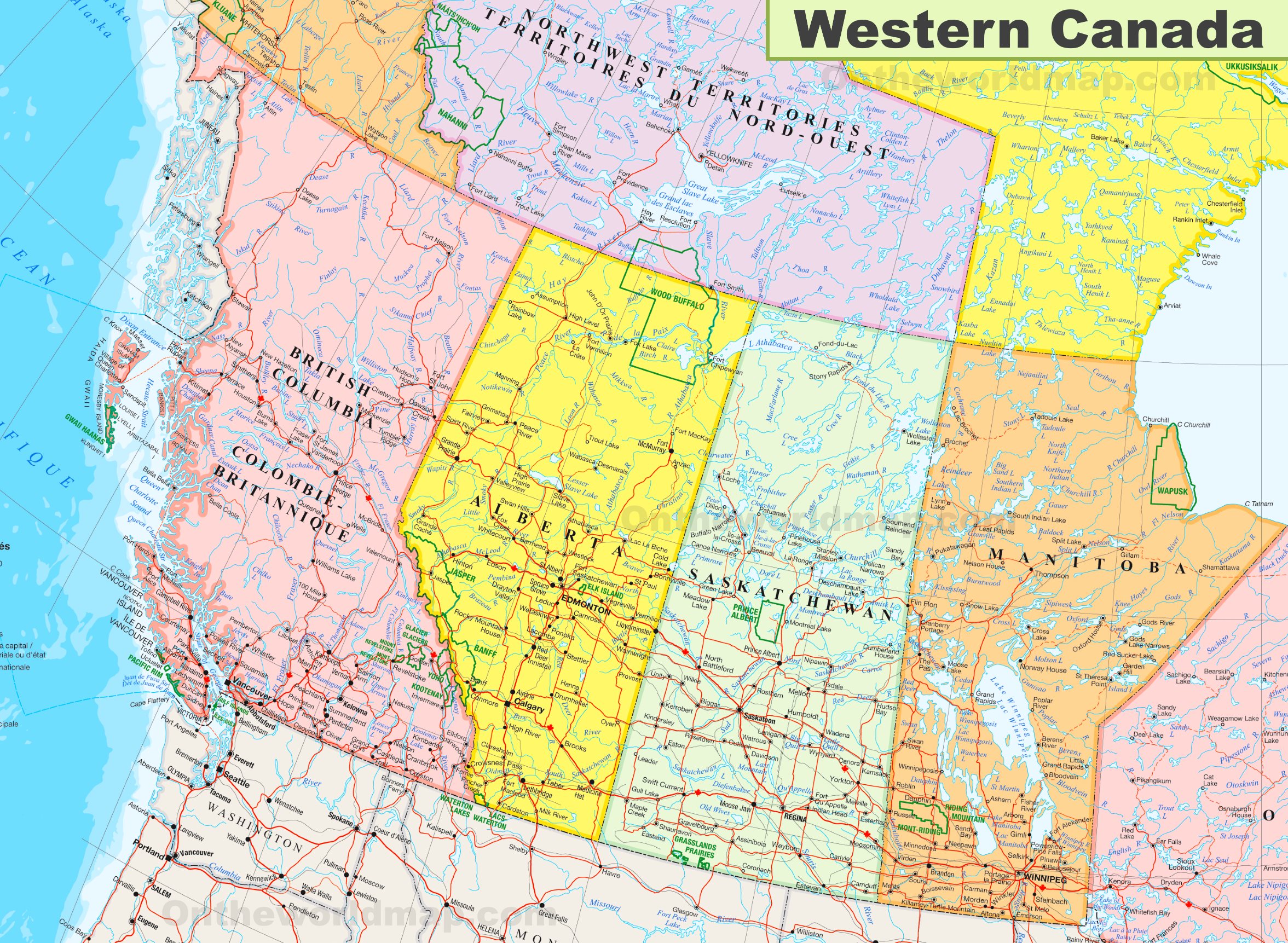
Map of Western Canada
Description:
This map shows provinces, cities, towns, highways, roads, railways, ferry routes, and national parks in Western Canada.
You may download, print or use the above map for educational, personal and non-commercial purposes. Attribution is required. For any website, blog, scientific research or e-book, you must place a hyperlink (to this page) with an attribution next to the image used.
About Western Canada
Western Canada, also known as the Canadian West or the Western provinces, is an economic-geographic region of Canada comprising four provinces: British Columbia, Alberta, Saskatchewan, and Manitoba. The region covers a vast area characterized by diverse geography, from the Rocky Mountains in the west to the prairie grasslands in the central areas. According to the 2021 census, the combined population of these four provinces totals approximately 11.7 million people, representing roughly 30% of Canada's total population. British Columbia is the most populous province in the region with 5,000,879 residents, followed by Alberta with 4,262,635, Manitoba with 1,342,153, and Saskatchewan with 1,132,505.
The geography of Western Canada varies dramatically across the region. British Columbia, located on the Pacific coast, is dominated by the Coast Mountains and the Rocky Mountains, which extend into Alberta. The province is known for its rugged coastline, temperate rainforests, and numerous islands. Alberta and Saskatchewan feature the Interior Plains, with Alberta's landscape rising from prairie in the east to the foothills and Rocky Mountains in the west. Saskatchewan and Manitoba are characterized by vast prairies and are often referred to as part of the "Prairie Provinces." The region contains significant natural features including numerous lakes, rivers, and extensive boreal forests in the northern areas.
Vancouver, located in British Columbia, is the largest city in Western Canada and the third-largest metropolitan area in the country. Calgary and Edmonton in Alberta, Winnipeg in Manitoba, and Saskatoon and Regina in Saskatchewan serve as major urban centers.
The economy of Western Canada is heavily based on natural resource extraction and processing. Alberta holds the majority of Canada's oil reserves, approximately 95% of which are contained in oil sands deposits, with the Athabasca oil sands being the largest. The province ranks fourth globally in oil reserves and is a major producer of natural gas. British Columbia leads Canada in forestry and is the country's largest producer of lumber and pulp products. The province also has significant natural gas reserves and is the second-largest producer after Alberta. Saskatchewan is Canada's leading producer of potash and uranium, while the Prairie Provinces collectively form the nation's primary agricultural region, producing wheat, canola, and other grains. Manitoba's economy includes agriculture, mining, and hydroelectric power generation.
English is the predominant language spoken throughout Western Canada, with over 80% of residents using it as their primary language. The region has a diverse population with significant Indigenous communities and growing Asian populations, particularly in British Columbia's major cities.
Maps of Canada
Provinces and Territories
Cities of Canada
Cities of Canada