
Rio de Janeiro Maps
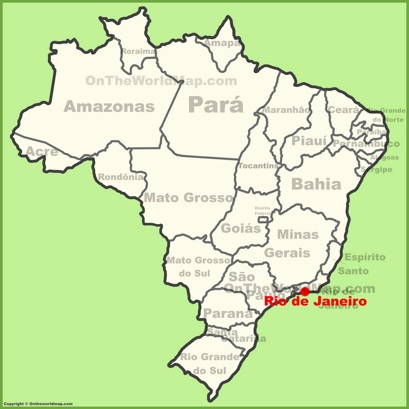
Online Map of Rio de Janeiro


About Rio de Janeiro
Rio de Janeiro is a city in southeastern Brazil and the capital of the state of Rio de Janeiro. With a population of about 6.2 million according to the 2022 census, it is the second-most populous city in Brazil after São Paulo. Its residents are known as Cariocas.
The Facts:| Region: | Southeast |
| State: | Rio de Janeiro |
| Population (2025 estimate): | 6,730,729 |
| Metropolitan population: | 13,930,000 |
| Density: | 13,402/sq mi (5,174.6/sq km) |
| Area: | 471 sq mi (1,221 sq km) |
| Coordinates: | 22°54′40″S 43°12′20″W |
| Racial/ethnic groups: |
|
| Postal Code: | 20000-001 to 23799-999 |
| Area code(s): | 21 |
The name means "River of January" in Portuguese. It comes from Portuguese navigators who reached Guanabara Bay in January 1502 and mistook it for the mouth of a river. The city was founded on 1 March 1565 by Estácio de Sá. In 1763 it became the capital of the colonial State of Brazil. After the Portuguese royal court moved there in 1808, Rio de Janeiro served as the capital of the Portuguese Empire until 1821. It stayed the capital of independent Brazil, first under the Empire and later under the Republic, until 1960, when the capital moved to Brasília.
The city is on the Atlantic coast, along the western shore of Guanabara Bay. Its landscape includes mountains, beaches and forests. Tijuca Forest, located within the city, is among the largest urban forests in the world.
Rio de Janeiro's best-known landmarks include the statue of Christ the Redeemer on Corcovado mountain, Sugarloaf Mountain, and the beaches of Copacabana and Ipanema. The statue was completed in 1931 and was named one of the New Seven Wonders of the World in 2007. In 2012, UNESCO added part of the city to its World Heritage List as "Rio de Janeiro: Carioca Landscapes between the Mountain and the Sea." This was the first urban landscape to receive the designation.
The city has hosted many major international events. These include the 1992 United Nations Conference on Environment and Development (the Earth Summit) and the 2016 Summer Olympics, the first Olympic Games held in South America. The Maracanã Stadium hosted the final matches of the 1950 and 2014 FIFA World Cups. Rio's annual Carnival, with samba school parades in the Sambadrome, is one of the largest festivals in the world.
The city is a major economic center in Brazil. The energy company Petrobras and the mining company Vale both have their headquarters there.
Main sights in Rio de Janeiro
- Christ the Redeemer (Cristo Redentor)
- Sugarloaf Mountain (Pão de Açúcar)
- Copacabana Beach
- Ipanema Beach
- Arpoador
- Leblon Beach
- Barra da Tijuca Beach
- Selarón Steps (Escadaria Selarón)
- Tijuca National Park
- Maracanã Stadium
- Museum of Tomorrow (Museu do Amanhã)
- Rio de Janeiro Art Museum
- Rio de Janeiro Botanical Garden
- Rodrigo de Freitas Lagoon
- Santa Teresa
- Lapa Arches (Arcos da Lapa)
- Metropolitan Cathedral of Saint Sebastian
- Theatro Municipal do Rio de Janeiro
- Confeitaria Colombo
- Royal Portuguese Cabinet of Reading
- São Bento Monastery
- Candelária Church (Igreja da Candelária)
- Paço Imperial
- Fiscal Island (Ilha Fiscal)
- Parque Lage
- Pedra da Gávea
- Dois Irmãos Hill (Morro Dois Irmãos)
- Marquês de Sapucaí Sambadrome
- Copacabana Fort (Forte de Copacabana)
- Flamengo Park (Aterro do Flamengo)
Brazil maps
Cities of Brazil