
Ethiopia Map
Description:
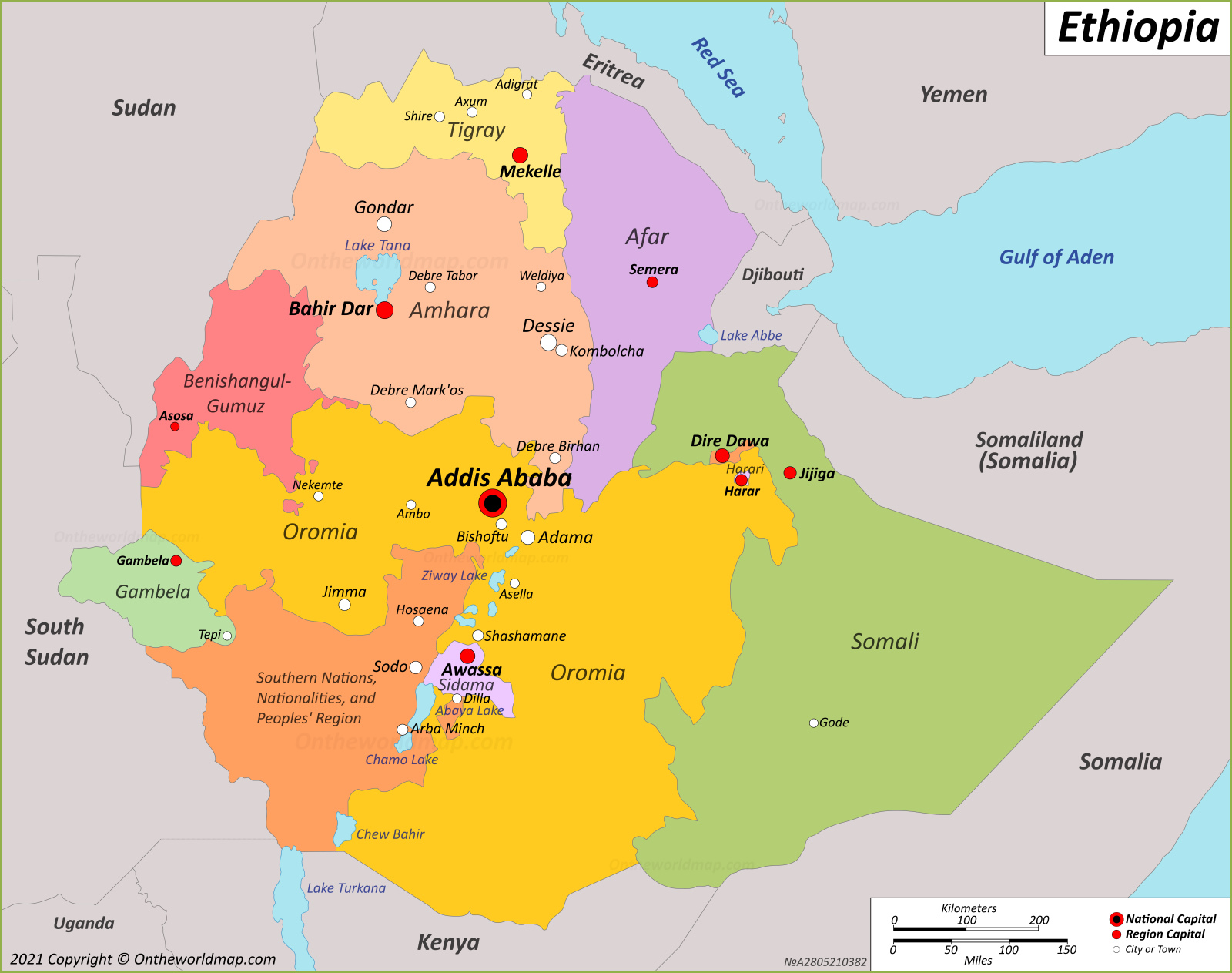
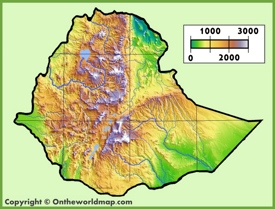
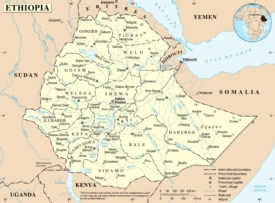
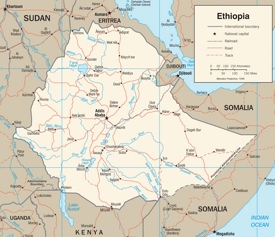
This map shows governmental boundaries of countries; lakes, regions, region capitals, major cities, and towns in Ethiopia.
You may download, print or use the above map for educational, personal and non-commercial purposes. Attribution is required. For any website, blog, scientific research or e-book, you must place a hyperlink (to this page) with an attribution next to the image used.
Online Map of Ethiopia
About Ethiopia
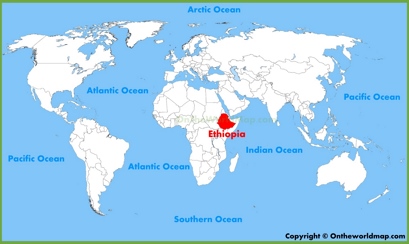
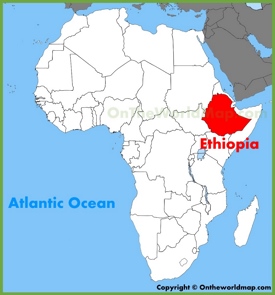
Ethiopia, officially the Federal Democratic Republic of Ethiopia, is a landlocked country in the Horn of Africa. It borders Eritrea to the north, Djibouti to the northeast, Somalia to the east, Kenya to the south, South Sudan to the west and Sudan to the northwest. It covers about 1,104,300 square kilometres. With a population of more than 138 million, Ethiopia has the second-largest population in Africa after Nigeria and the largest of any landlocked country in the world. The capital and largest city is Addis Ababa, which hosts the headquarters of the African Union and the United Nations Economic Commission for Africa.
The Facts:| Capital: | Addis Ababa |
| Area: | 426,400 sq mi (1,104,300 sq km) |
| Population: | 138,902,185 (2025 estimate) |
| Official language: | Afar, Amharic, Oromo, Somali, Tigrinya |
| Largest Cities: | Addis Ababa, Mekelle, Gondar, Adama, Awassa, Bahir Dar, Dire Dawa, Sodo, Dessie, Jimma, Jijiga, Shashamane, Bishoftu, Arba Minch, Hosaena, Harar, Dilla, Nekemte, Debre Birhan, Asella, Debre Mark'os, Kombolcha, Debre Tabor, Adigrat, Weldiya, Sebeta, Burayu, Shire, Ambo, Arsi Negele. |
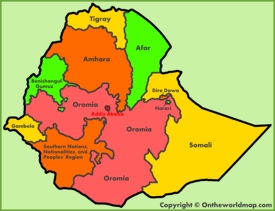
| Regions of Ethiopia: | Addis Ababa, Afar, Amhara, Benishangul-Gumuz, Central Ethiopia Regional State, Dire Dawa, Gambela, Harari, Oromia, Sidama, Somali, South Ethiopia Regional State, South West Ethiopia Peoples' Region, Tigray. |
| Religion: |
|
| Ethnic groups: |
|
| Currency: | Birr (ETB) |
| Driving side: | Right |
| Calling code: | +251 |
| Internet TLD: | .et |
| Time zone: | UTC+3 (EAT) |
| Gross domestic product (PPP) (2024 estimate): |
|
| Gross domestic product (nominal) (2024 estimate): |
|
Ethiopia is a federal parliamentary republic. The prime minister is the head of government, and the president's role is largely ceremonial. The country is divided into regional states and two chartered cities, Addis Ababa and Dire Dawa.
Brief History of Ethiopia
Ethiopia is one of the oldest known areas of human habitation. Fossils of early hominins have been found there, including "Lucy," a partial skeleton of Australopithecus afarensis discovered in 1974 at Hadar in the Afar Region. Remains of some of the earliest known anatomically modern humans were found in the Omo Kibish area.
In ancient times, the Kingdom of D'mt and later the Kingdom of Aksum rose in the northern part of the region. Aksum was a major trading power and adopted Christianity as its state religion in the 4th century under King Ezana. The Zagwe dynasty came next and built the rock-hewn churches of Lalibela. In 1270, Yekuno Amlak founded the Solomonic dynasty, which ruled, with interruptions, until the 20th century. After a long period of decentralisation known as the Zemene Mesafint (Era of the Princes), Emperor Tewodros II began to reunify the country in 1855. Under Emperor Menelik II, Ethiopia expanded its territory and defeated Italian forces at the Battle of Adwa in 1896, keeping its independence during the Scramble for Africa.
Italy occupied Ethiopia from 1936 to 1941 after the Second Italo-Ethiopian War. Emperor Haile Selassie, who had reigned since 1930, returned to power after the occupation ended. He was overthrown in 1974 by the Derg, a Marxist–Leninist military junta later led by Mengistu Haile Mariam. The Ethiopian People's Revolutionary Democratic Front (EPRDF) removed the Derg in 1991, and Eritrea became independent in 1993. A new constitution adopted in 1995 set up a federal system organised largely along ethnic lines. Abiy Ahmed became prime minister in 2018 and received the Nobel Peace Prize in 2019 for ending the conflict with Eritrea. An armed conflict in the Tigray Region began in November 2020 and was formally ended by a cessation of hostilities agreement signed in Pretoria in November 2022.
Geography and Economics
Most of the country lies on the Ethiopian Highlands, which the Great Rift Valley divides in two. The highest point is Ras Dashen in the Simien Mountains, at about 4,550 metres. The Danakil Depression in the northeast lies more than 100 metres below sea level and is one of the hottest places on Earth. Lake Tana, the country's largest lake, is the source of the Blue Nile. The Grand Ethiopian Renaissance Dam on the Blue Nile was officially inaugurated in September 2025 and is the largest hydroelectric power plant in Africa.
Ethiopia has more than 80 ethnic groups. According to the 2007 census, the largest are the Oromo and the Amhara, followed by the Somali, Tigrayans and Sidama. Amharic has long been the main working language of the federal government, and Oromo has the most native speakers. Christianity, mostly the Ethiopian Orthodox Tewahedo Church, is the largest religion, and Islam is the second-largest. The country uses its own Ge'ez-based script and the Ethiopian calendar, which has 13 months and runs about seven to eight years behind the Gregorian calendar.
Agriculture is a major part of the economy, and coffee is one of the most important exports. Ethiopia is widely considered the place where Coffea arabica originated, and it is Africa's largest coffee producer. The national currency is the birr. The state-owned Ethiopian Airlines is the largest airline in Africa. Ethiopia was a founding member of the United Nations and the Organisation of African Unity, and it joined BRICS in January 2024.
Ethiopia has several UNESCO World Heritage Sites, including the rock-hewn churches of Lalibela, the ruins of Aksum, Fasil Ghebbi in Gondar and Simien National Park. The country is also known for long-distance running. In 1960, Abebe Bikila won the Olympic marathon in Rome running barefoot, and he became the first athlete from sub-Saharan Africa to win an Olympic gold medal.