
South Sudan Map
Description:
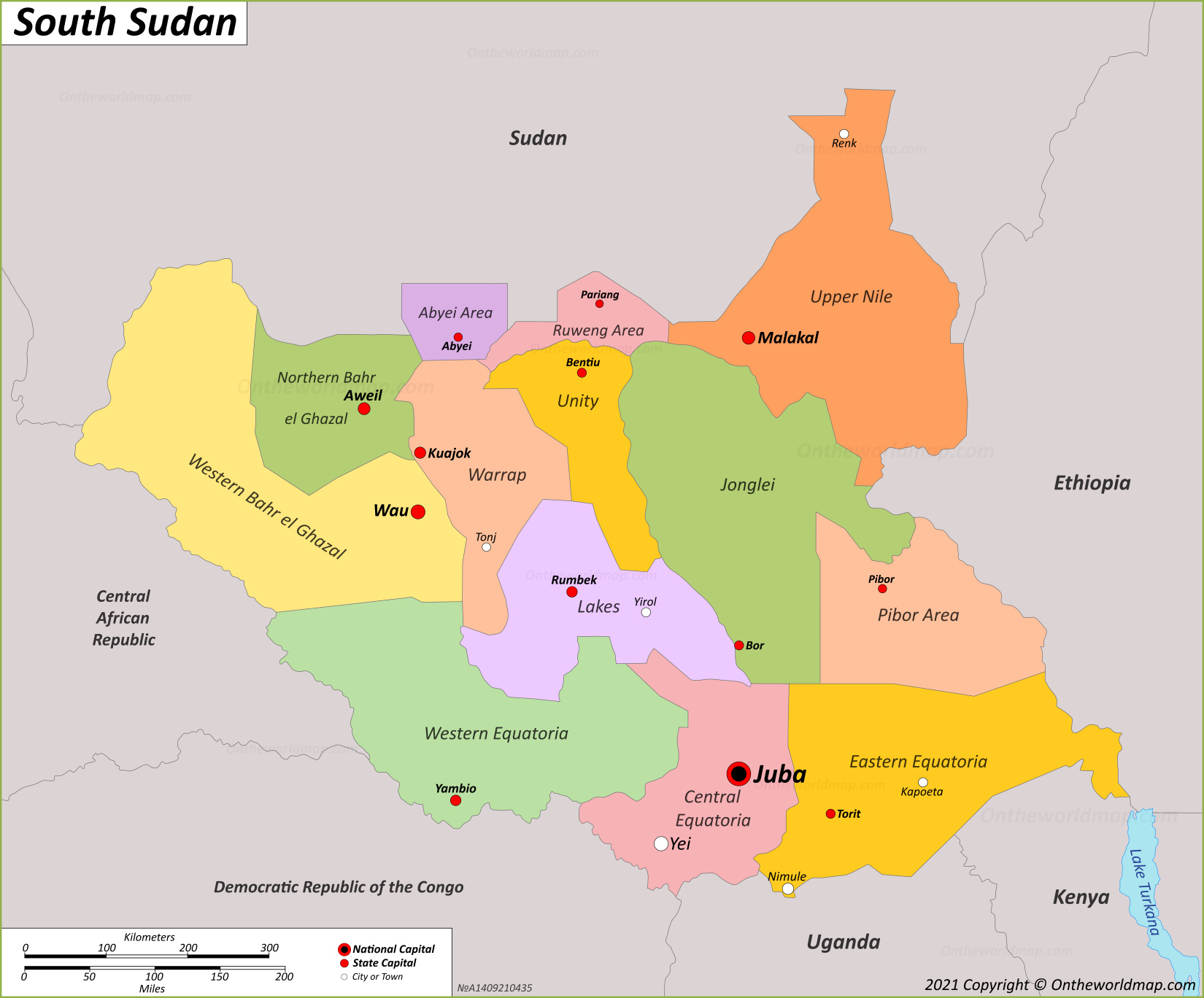
This map shows governmental boundaries of countries; states, state capital cities, and major cities and town in South Sudan.
You may download, print or use the above map for educational, personal and non-commercial purposes. Attribution is required. For any website, blog, scientific research or e-book, you must place a hyperlink (to this page) with an attribution next to the image used.

Online Map of South Sudan


About South Sudan
South Sudan, officially the Republic of South Sudan, is a landlocked country in East-Central Africa. It borders Sudan to the north, Ethiopia to the east, Kenya to the southeast, Uganda to the south, the Democratic Republic of the Congo to the southwest and the Central African Republic to the west. The capital and largest city is Juba. South Sudan became independent from Sudan on 9 July 2011, which made it the world's newest widely recognised sovereign state.
The Facts:| Capital: | Juba |
| Area: | 248,777 sq mi (644,329 sq km) |
| Population: | ~ 12,500,000 (2026 estimate) |
| Official language: | English |
| Largest Cities: | Juba, Yei, Wau, Malakal, Aweil, Kuajok, Nimule, Yambio, Rumbek, Bor, Torit, Abyei, Tonj, Yirol, Bentiu. |
| States and Areas of South Sudan: | Northern Bahr el Ghazal, Western Bahr el Ghazal, Lakes, Warrap, Western Equatoria, Central Equatoria, Eastern Equatoria, Jonglei, Unity, Upper Nile, Abyei Area, Pibor Area, Ruweng Area. |
| Religion: |
|
| Currency: | South Sudanese pound (SSP) |
| Driving side: | right |
| Calling code: | +211 |
| Internet TLD: | .ss |
| Time zone: | UTC+2 (CAT) |
| Gross domestic product (PPP) (2025 estimate): |
|
| Gross domestic product (nominal) (2025 estimate): |
|
The territory of present-day South Sudan was part of Anglo-Egyptian Sudan during the colonial period and remained part of Sudan when Sudan became independent in 1956. Conflict between the central government in Khartoum and southern groups led to the First Sudanese Civil War (1955–1972), which ended with the Addis Ababa Agreement and gave the south a degree of regional autonomy. Fighting resumed in 1983 with the Second Sudanese Civil War. In that war, the Sudan People's Liberation Movement/Army (SPLM/A), led by John Garang, fought government forces. The war ended in January 2005 with the Comprehensive Peace Agreement, which gave the south autonomy and promised a referendum on independence. Garang died in a helicopter crash in July 2005, and Salva Kiir Mayardit succeeded him.
The independence referendum took place in January 2011, and about 98.8 percent of voters chose secession. South Sudan joined the United Nations as its 193rd member state on 14 July 2011. It also joined the African Union in 2011 and the East African Community in 2016.
In December 2013, a political dispute between President Salva Kiir and former Vice President Riek Machar escalated into the South Sudanese Civil War. The conflict was fought largely along ethnic lines. It displaced millions of people and caused an estimated 400,000 deaths. A peace agreement signed in 2015 collapsed in 2016. The Revitalised Agreement on the Resolution of the Conflict in the Republic of South Sudan was signed in September 2018. Under that agreement, a Transitional Government of National Unity was formed in February 2020. The transitional period has been extended several times. In 2024 it was extended again, and general elections were scheduled for December 2026.
South Sudan is a presidential republic. The president is both head of state and head of government. The national legislature is bicameral and consists of the Transitional National Legislative Assembly and the Council of States. The country is divided into ten states and two administrative areas. The Abyei area has a special administrative status and is disputed between South Sudan and Sudan.
The White Nile flows through the country. It forms the Sudd, one of the largest wetlands in the world. South Sudan's savannas, floodplains and forests support large populations of wildlife, including one of the largest mammal migrations in Africa, which involves species such as the white-eared kob. Boma and Bandingilo are among its most notable national parks.
The economy relies heavily on oil, which provides nearly all export earnings and most government revenue. Because the country is landlocked, its crude oil is exported through pipelines across Sudan to Port Sudan on the Red Sea. In 2012, a dispute with Sudan over transit fees led South Sudan to shut down oil production temporarily. Most of the population depends on subsistence agriculture and livestock herding. The currency is the South Sudanese pound.
English is the official language. More than 60 indigenous languages are spoken, and Juba Arabic is widely used as a lingua franca. The largest ethnic groups are the Dinka and the Nuer, followed by groups such as the Shilluk, Zande and Bari. Most of the population is Christian, and traditional African religions are also practised.
The national men's basketball team qualified for the 2023 FIBA Basketball World Cup. It then competed at the 2024 Summer Olympics in Paris, the country's first Olympic appearance in a team sport.