
Northwest Territories Map

Description:
This map shows cities, towns, villages, province capital, islands, rivers, lakes, highways, and major roads in the Northwest Territories.
Size: 1350x1680px / 967 Kb
Author: Ontheworldmap.com
You may download, print or use the above map for educational, personal and non-commercial purposes. Attribution is required. For any website, blog, scientific research or e-book, you must place a hyperlink (to this page) with an attribution next to the image used.
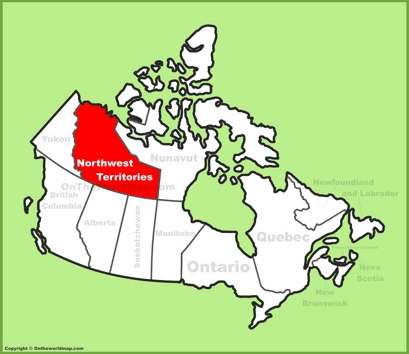
Online Map of Northwest Territories
Large detailed map of the Northwest Territories with cities and towns

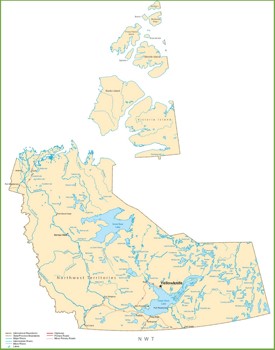
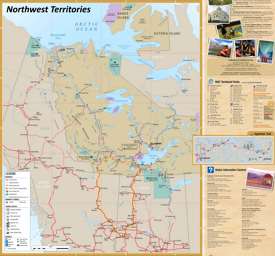
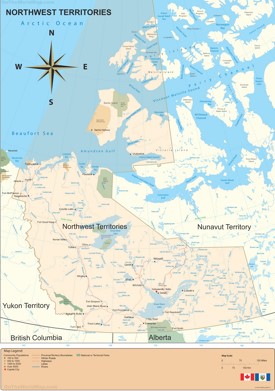
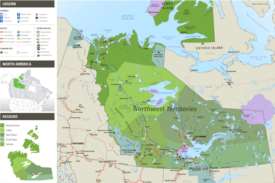
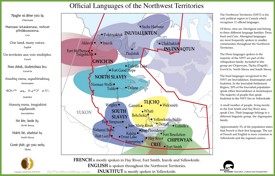
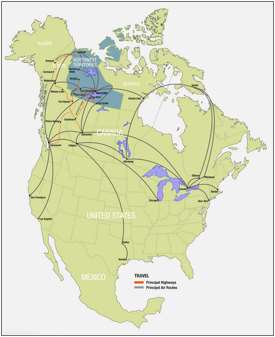
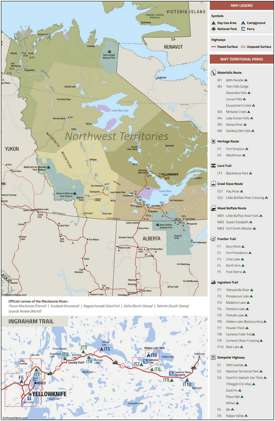
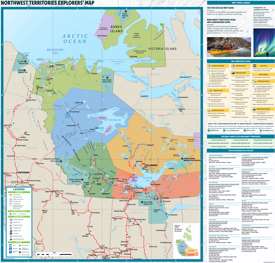
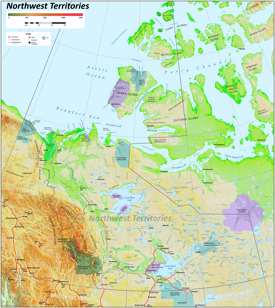
Maps of Northwest Territories and Neighboring Provinces


About Northwest Territories
| Capital: | Yellowknife |
| Largest city: | Yellowknife |
| Population (Q3 2025): | 45,950[1] |
| Area: | 519,734 sq mi (1,346,106 sq km) |
| Density: | 0.078/sq mi (0.03/sq km) |
| Official languages: | English, French, Chipewyan, Cree, Gwich’in, Inuinnaqtun, Inuktitut, Inuvialuktun, North Slavey, South Slavey, and Tłı̨chǫ. |
| Coordinates: | 67°N 121°W |
| Gross domestic product (Total): | C$4.856 billion |
| Gross domestic product (Per capita): | C$108,065 |
| Time zone: |
UTC−07:00 Summer (DST) - UTC−06:00 |
| Canadian postal abbr.: | NT |
| Postal code prefix: | X0, X1 |
| ISO 3166 code: | CA-NT |
| Flower: | Mountain avens |
| Tree: | Tamarack larch |
| Bird: | Gyrfalcon |
| Official Website: | www.gov.nt.ca |
Google Map of Northwest Territories
The Northwest Territories is a federal territory of Canada located in the northern region of the country. With an area of approximately 1,346,106 square kilometers, it represents one of the three territories in Canada, alongside Yukon and Nunavut. The capital and largest community is Yellowknife, which serves as the administrative and economic center of the region. The territory borders Nunavut to the east, Yukon to the west, and the provinces of British Columbia, Alberta, and Saskatchewan to the south.
Geography and Climate
The Northwest Territories encompasses diverse geographical features, including portions of the Canadian Shield, the Mackenzie River valley, and numerous lakes. Great Bear Lake and Great Slave Lake, two of Canada's largest lakes, are located within the territory. The Mackenzie River, Canada's longest river system, flows through the territory from Great Slave Lake to the Arctic Ocean.
The territory experiences a subarctic and Arctic climate characterized by long, cold winters and short, mild summers. Temperatures can drop below -40°C in winter months, while summer temperatures typically range from 10°C to 25°C. The region lies north of the 60th parallel, resulting in extended daylight hours during summer and limited sunlight in winter. Permafrost underlies much of the territory, affecting construction, infrastructure development, and ecological systems.
History
Indigenous peoples have inhabited the region for thousands of years prior to European contact. The territory was historically home to various First Nations groups, including the Dene, as well as Inuit populations in the northern regions. The Hudson's Bay Company established trading posts throughout the area during the 18th and 19th centuries, facilitating the fur trade.
The British government transferred control of Rupert's Land and the North-Western Territory to Canada in 1870. The original Northwest Territories encompassed a vast area of northern and western Canada. Over time, the territory's boundaries were reduced through the creation of new provinces and territories. The provinces of Alberta and Saskatchewan were carved from the territory in 1905. In 1999, the eastern portion of the Northwest Territories was separated to create Nunavut, reducing the territory to its current boundaries.
Demographics and Communities
The Northwest Territories has a population of approximately 45,000 people, making it one of the least densely populated regions in Canada. The territory contains 33 official communities of varying sizes.
The population composition reflects significant Indigenous representation. Major demographic groups include:
- First Nations (primarily Dene)
- Métis
- Inuit (Inuvialuit)
- Non-Indigenous residents
Yellowknife, with a population exceeding 20,000, accounts for nearly half of the territory's total population. Other significant communities include Hay River, Inuvik, Fort Smith, and Behchokǫ̀. Many communities are accessible only by air or seasonal ice roads, as year-round road connections remain limited in the northern regions.
Languages
The Northwest Territories recognizes eleven official languages, reflecting its multicultural heritage. English and French serve as working languages of the territorial government. The nine Indigenous official languages are:
- Chipewyan
- Cree
- Gwich'in
- Inuinnaqtun
- Inuktitut
- Inuvialuktun
- North Slavey
- South Slavey
- Tłįchǫ
Government and Politics
The Northwest Territories operates under a consensus government system rather than a party-based system. The territory's legislative assembly consists of 19 elected members who serve four-year terms. Following elections, members select the premier and cabinet ministers from among themselves through secret ballot. This system reflects Indigenous governance traditions and emphasizes cooperation over partisan politics.
The federal government retains authority over certain matters, including natural resources in some areas, though land claim agreements have transferred significant control to Indigenous governments. The territory is represented in the federal Parliament by one Member of Parliament in the House of Commons and one Senator.
Economy
The economy of the Northwest Territories relies heavily on natural resource extraction, particularly diamond mining, which emerged as a major industry in the 1990s. The territory contains several operational diamond mines and ranks among the world's leading diamond producers by value. The Ekati and Diavik mines have significantly contributed to territorial revenues and employment.
Other economic sectors include:
- Oil and gas extraction
- Mining of other minerals including gold, tungsten, and rare earth elements
- Government services and public administration
- Tourism, particularly aurora viewing and northern wilderness experiences
- Arts and crafts production
- Traditional activities including hunting, fishing, and trapping
The territorial government serves as the largest employer. Economic challenges include high cost of living, limited infrastructure, and dependence on resource commodity prices. The territory works to balance economic development with environmental protection and Indigenous rights.
Transportation and Infrastructure
Transportation infrastructure in the Northwest Territories faces challenges due to vast distances, harsh climate, and permafrost. The Mackenzie Highway system connects southern communities to Alberta, while the Dempster Highway links Inuvik to Yukon. Many communities rely on air transportation year-round, with scheduled flights providing essential connections for passengers and cargo.
Seasonal ice roads play a crucial role in transporting supplies to remote communities during winter months. The most notable is the Tibbitt to Contwoyto Winter Road, one of the world's longest ice roads, serving diamond mines in the northern territory. Break-up and freeze-up periods create transportation gaps, requiring careful planning for community resupply.
Education and Culture
The territorial education system serves students across widely dispersed communities. Aurora College, the territory's post-secondary institution, offers certificate, diploma, and degree programs with campuses in Yellowknife, Fort Smith, and Inuvik. Many students pursue higher education in southern Canadian institutions.
Cultural preservation remains important, with programs supporting Indigenous languages and traditional knowledge. The Prince of Wales Northern Heritage Centre in Yellowknife houses collections documenting territorial history, natural history, and Indigenous cultures. Annual events such as the Great Northern Arts Festival in Inuvik and Folk on the Rocks music festival in Yellowknife celebrate regional culture and arts.
Environmental Considerations
The Northwest Territories contains significant wilderness areas and wildlife populations. The territory hosts several national parks, including Nahanni National Park Reserve, a UNESCO World Heritage Site known for its dramatic canyons and Virginia Falls. Wood Buffalo National Park, shared with Alberta, protects the last remaining habitat of wood bison.
Climate change affects the territory significantly, with observations of permafrost thaw, changing wildlife patterns, and reduced ice road seasons. The territorial government and Indigenous organizations participate in climate monitoring and adaptation planning. Environmental management involves balancing resource development with conservation and traditional land use practices.
List of municipalities in the Northwest Territories
- Yellowknife
- Hay River
- Inuvik
- Fort Smith
- Behchokǫ̀
- Fort Simpson
- Tuktoyaktuk
- Norman Wells
- Fort McPherson
- Fort Providence
- Délı̨nę
- Whatì
- Aklavik
- Fort Good Hope
- Fort Liard
- Fort Resolution
- Ulukhaktok
- Tulita
- Paulatuk
- Gamèti
- Tsiigehtchic
- Wekweètì
- Sachs Harbour
- Enterprise
Main sights in the Northwest Territories
- Nahanni National Park Reserve
- Virginia Falls
- Great Slave Lake
- Aurora Village
- Wood Buffalo National Park
- Yellowknife Old Town
- Prince of Wales Northern Heritage Centre
- Pilot's Monument
- Great Bear Lake
- Mackenzie River
- Alexandra Falls
- Louise Falls
- Sambaa Deh Falls
- Tuktoyaktuk
- Cameron Falls
- Twin Falls Gorge Territorial Park
- Wildcat Cafe
- Legislative Assembly Building
- Ingraham Trail
- Hay River
- Fort Smith
- Dettah Ice Road
- Cameron River Ramparts
- Tuktut Nogait National Park
- Aulavik National Park
- Nááts'ihch'oh National Park Reserve
- Hidden Lake Territorial Park
- Norman Wells
- Dempster Highway
- Fred Henne Territorial Park
Major Rivers of Northwest Territories
- Mackenzie River - 1,080 mi (1,738 km)
- Liard River - 693 mi (1,115 km)
- Back River - 605 mi (974 km)
- Thelon River - 562 mi (904 km)
- Coppermine River - 525 mi (845 km)
- Dubawnt River - 523 mi (842 km)
- Hay River - 436 mi (702 km)
- Peel River - 425 mi (684 km)
- Horton River - 384 mi (618 km)
- Taltson River - 342 mi (550 km)
- Arctic Red River - 310 mi (499 km)
- Lockhart River - 298 mi (480 km)
- Anderson River - 289 mi (465 km)
- Slave River - 258 mi (415 km)
- Burnside River - 224 mi (360 km)
- Hanbury River - 214 mi (345 km)
- Mountain River - 186 mi (300 km)
- Snare River - 165 mi (265 km)
- Yellowknife River - 149 mi (240 km)
- Great Bear River - 70 mi (113 km)
List of the Largest Lakes of Northwest Territories
- Great Bear Lake - 12,028 sq mi (31,153 km2)
- Great Slave Lake - 10,502 sq mi (27,200 km2)
- Lac la Martre (Wekweètì) - 686 sq mi (1,776 km2)
- Kasba Lake - 518 sq mi (1,341 km2)
- MacKay Lake - 410 sq mi (1,061 km2)
- Contwoyto Lake - 369 sq mi (957 km2)
- Hottah Lake - 339 sq mi (877 km2)
- Point Lake - 338 sq mi (876 km2)
- Aylmer Lake - 327 sq mi (847 km2)
- Nonacho Lake - 301 sq mi (780 km2)
- Artillery Lake - 291 sq mi (755 km2)
- Clinton-Colden Lake - 285 sq mi (737 km2)
- Selwyn Lake - 277 sq mi (717 km2)
- Lac de Gras - 232 sq mi (600 km2)
- Lac Ste. Thérèse - 212 sq mi (548 km2)
- Wholdaia Lake - 195 sq mi (506 km2)
- Napaktulik Lake - 179 sq mi (463 km2)
- Lynx Lake - 149 sq mi (387 km2)
- Maunoir Lake - 147 sq mi (380 km2)
- Hardisty Lake - 130 sq mi (336 km2)
References
1. ^ Population estimates, quarterly. Statistics Canada.Maps of Canada
Provinces and Territories
Cities of Canada
Cities of Canada