
New Brunswick Map

Description:
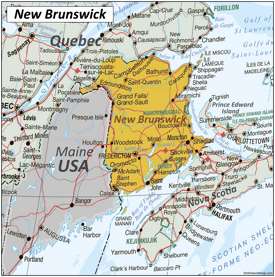
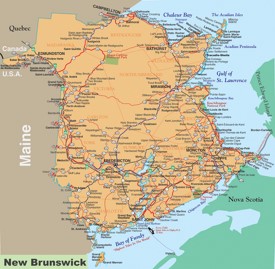
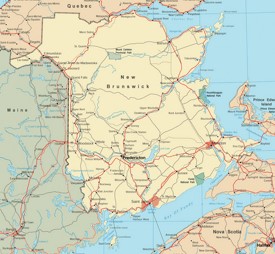
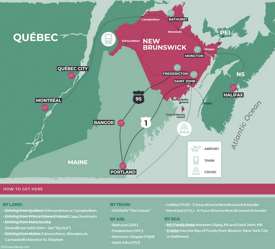
This map shows cities, towns, province capital, rivers, lakes, islands, Trans-Canada highway, highways, major roads, and secondary roads in New Brunswick.
Size: 1500x1439px / 694 Kb
Author: Ontheworldmap.com
You may download, print or use the above map for educational, personal and non-commercial purposes. Attribution is required. For any website, blog, scientific research or e-book, you must place a hyperlink (to this page) with an attribution next to the image used.
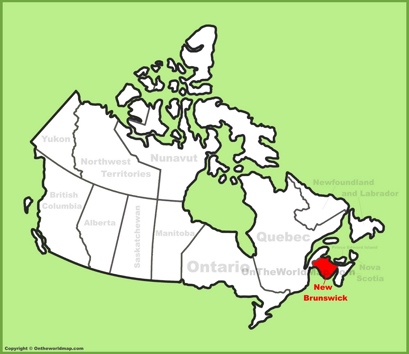
Online Map of New Brunswick


About New Brunswick
New Brunswick is one of the thirteen provinces and territories of Canada and one of the three Maritime provinces. It is the only officially bilingual province in the country, with both English and French having equal status under the Canadian Charter of Rights and Freedoms and the province's own Official Languages Act. The provincial capital is Fredericton, while Moncton is the largest city by population. New Brunswick was first inhabited by First Nations people, including the Mi'kmaq and Maliseet, and was later colonized by France before becoming part of British North America.
The province covers an area of 72,908 square kilometers and had a population of approximately 869,682 as of the 2025.
Geography and Climate
New Brunswick is bordered by Quebec to the north, Nova Scotia to the southeast, the Gulf of Saint Lawrence to the northeast, the Bay of Fundy to the south, and the U.S. state of Maine to the west. The province features diverse geographical characteristics, including the Appalachian Mountain Range, extensive forests covering approximately 80% of the land area, and a coastline that stretches for about 2,250 kilometers. The Bay of Fundy, located along the southern coast, is renowned for having the highest tides in the world, with tidal ranges reaching up to 16 meters in some locations.
The climate is humid continental with warm summers and cold winters. Average temperatures range from -10°C in January to 19°C in July, though significant regional variations exist. The province receives substantial precipitation throughout the year, with coastal areas typically receiving more than inland regions.
History
Archaeological evidence suggests that the area now known as New Brunswick has been inhabited for at least 10,000 years. The Mi'kmaq and Maliseet peoples were the primary Indigenous inhabitants when European explorers arrived. French explorer Jacques Cartier is believed to have visited the region in 1534, and Samuel de Champlain established settlements in the early 1600s. The area became part of the French colony of Acadia.
Following the Treaty of Utrecht in 1713, mainland Nova Scotia came under British control, though New Brunswick remained disputed territory. The Seven Years' War resulted in the final transfer of the region to British control in 1763. The province was officially created in 1784 when it was partitioned from Nova Scotia, largely to accommodate the influx of United Empire Loyalists fleeing the American Revolution. An estimated 14,000 Loyalists settled in the region, fundamentally reshaping its demographic and political landscape. New Brunswick became one of the four original provinces of the Canadian Confederation on July 1, 1867, joining Ontario, Quebec, and Nova Scotia.
Demographics and Language
New Brunswick's population is primarily of European descent, with significant English, Scottish, Irish, and French ancestry. The province has the highest proportion of French-speaking residents outside Quebec, with approximately one-third of the population identifying French as their first language. Most Francophones in New Brunswick are Acadians, descendants of French colonists who survived the Great Expulsion of 1755-1764. The Acadian population is concentrated primarily in the northern and eastern regions of the province.
Indigenous peoples constitute approximately 5% of the population, belonging primarily to Mi'kmaq and Maliseet (Wolastoqiyik) First Nations. There are fifteen First Nations communities in the province.
The province has experienced population challenges in recent decades, including aging demographics and interprovincial migration to other parts of Canada. However, immigration has increased in recent years, with the provincial government implementing programs to attract and retain newcomers.
Economy
Historically, New Brunswick's economy relied heavily on natural resources, including forestry, fishing, mining, and agriculture. The forestry sector remains significant, with pulp and paper production being major industries. The province produces substantial quantities of potatoes, with the McCain Foods company, headquartered in Florenceville-Bristol, being one of the world's largest manufacturers of frozen potato products. Mining operations extract zinc, lead, copper, and potash, while the Bay of Fundy supports commercial fisheries, particularly for lobster, crab, and herring.
The service sector now dominates the provincial economy, accounting for approximately 75% of GDP. Saint John hosts Canada's largest oil refinery, operated by Irving Oil, which processes over 300,000 barrels per day. The Port of Saint John is a significant shipping hub for the region. Tourism contributes substantially to the economy, with attractions including the Hopewell Rocks, Fundy National Park, and numerous cultural festivals. The information technology and telecommunications sectors have grown considerably, with several companies establishing operations in Fredericton and Moncton. Call centers employ thousands of bilingual workers, taking advantage of the province's linguistic capabilities.
Government and Politics
New Brunswick has a unicameral legislature called the Legislative Assembly of New Brunswick, consisting of 49 members elected from single-member constituencies. The province follows the Westminster parliamentary system, with the Premier serving as head of government and the Lieutenant Governor representing the Canadian monarch as head of state. The two major political parties are the Progressive Conservative Party and the Liberal Party, with the New Democratic Party and Green Party also holding seats in recent elections.
The province is divided into fifteen counties for administrative purposes, though these have limited governmental function. Local administration is primarily managed through municipalities, including cities, towns, villages, and rural communities.
Education and Culture
The province operates two parallel public education systems: one Anglophone and one Francophone, reflecting its bilingual status. Post-secondary institutions include the University of New Brunswick (founded in 1785, one of the oldest universities in North America), Mount Allison University, St. Thomas University, and the Université de Moncton, which is the largest French-language university outside Quebec. The New Brunswick Community College system provides technical and vocational training across multiple campuses.
Acadian culture is prominently celebrated throughout the province, particularly during the National Acadian Day on August 15th. The Acadian flag, featuring a French tricolor with a yellow star, is widely displayed in Francophone communities. New Brunswick has produced notable cultural figures including poet Bliss Carman, actress Margaret Wilson, and the Antonine Maillet, author of the acclaimed novel "Pélagie-la-Charrette," which won the Prix Goncourt. The province hosts numerous cultural events, including the Harvest Jazz and Blues Festival in Fredericton and the Shediac Lobster Festival.
Transportation and Infrastructure
The Trans-Canada Highway traverses New Brunswick, connecting the province to the rest of Canada. The Confederation Bridge, completed in 1997, links New Brunswick to Prince Edward Island with a 12.9-kilometer span across the Northumberland Strait. Ferry services operate between Saint John and Digby, Nova Scotia.
The province is served by several airports, with the Greater Moncton Roméo LeBlanc International Airport being the busiest. Rail service is provided by Via Rail, with the Ocean line connecting Montreal to Halifax passing through northern New Brunswick. The Port of Saint John handles significant cargo volumes and operates year-round as an ice-free deep-water port, serving as a crucial link in Canada's transportation network.
Environment and Conservation
New Brunswick maintains several protected areas, including two national parks: Fundy National Park and Kouchibouguac National Park. The province has numerous provincial parks, nature reserves, and ecological reserves protecting diverse ecosystems ranging from coastal wetlands to Appalachian forests. The Acadian Forest, which once covered most of the Maritime provinces, still exists in portions of New Brunswick, though it has been significantly reduced by logging activities.
Environmental concerns include forest management practices, declining fish stocks, and climate change impacts on coastal communities. The province has implemented various conservation initiatives and participates in regional environmental protection programs.
The Facts:
| Capital: | Fredericton |
| Largest city: | Moncton |
| Population (Q3 2025): | 869,682[1] |
| Area: | 28,150 sq mi (72,908 sq km) |
| Density: | 28.1/sq mi (10.86/sq km) |
| Official languages: | English, French |
| Coordinates: | 46°30′N 66°00′W |
| Gross domestic product (Total): | C$36.088 billion |
| Gross domestic product (Per capita): | C$42,606 |
| Time zone: |
UTC-04:00 (Atlantic) - Summer (DST) UTC-03:00 (Atlantic DST) |
| Canadian postal abbr.: | NB |
| Postal code prefix: | E |
| ISO 3166 code: | CA-NB |
| Flower: | Purple violet |
| Tree: | Balsam fir |
| Bird: | Black-capped chickadee |
| Official Website: | www.gnb.ca |
Google Map of New Brunswick
List of Cities and Towns in New Brunswick
- Moncton
- Saint John
- Fredericton
- Dieppe
- Riverview
- Quispamsis
- Edmundston
- Miramichi
- Tracadie
- Bathurst
- Belle-Baie
- Campbellton
- Rothesay
- Woodstock
- Oromocto
- Grand Falls
- Shediac
- Hampton
- Carleton North
- Cap-Acadie
- Tantramar
- Beausoleil
- Maple Hills
- St. Stephen
- Caraquet
- Salisbury
- Sunbury-York South
- Eastern Charlotte
- Miramichi River Valley
- Hanwell
- Central York
- Beaurivage
- Hautes-Terres
- Fundy Albert
- Sussex
- Grand Bay-Westfield
- Grand Lake
- Grand-Bouctouche
- Île-de-Lamèque
- Heron Bay
- Butternut Valley
- Fundy-St. Martins
- Champdoré
- Memramcook
- Shippagan
- Nashwaak
- Valley Waters
- Haut-Madawaska
- Vallée-des-Rivières
- New Maryland
- Three Rivers
- Harvey
- Nackawic-Millville
- Bois-Joli
- Hartland
- Arcadia
- Saint-Quentin
- Alnwick
- Rivière-du-Nord
- Five Rivers
- Nouvelle-Arcadie
- Saint Andrews
- Tobique Valley
- Grand Manan
- Southern Victoria
- Lakeland Ridges
- Kedgwick
- Upper Miramichi
- Fundy Shores
- Strait Shores
- Neguac
- Belledune
- Doaktown
- McAdam
- Campobello Island
- Fredericton Junction
- Tracy
Main Sights in New Brunswick
- Hopewell Rocks
- Bay of Fundy
- Fundy National Park
- Magnetic Hill
- Saint John City Market
- Reversing Falls Rapids
- Kingsbrae Garden
- St. Andrews by-the-Sea
- Fundy Trail Parkway
- Kouchibouguac National Park
- Roosevelt Campobello International Park
- Hartland Covered Bridge
- Cape Enrage
- Ministers Island
- Acadian Historical Village
- Irving Nature Park
- Grand Falls/Grand-Sault
- New Brunswick Museum
- Carleton Martello Tower
- Mount Carleton Provincial Park
- Fort Beauséjour
- Swallowtail Lighthouse
- Parlee Beach Provincial Park
- Beaverbrook Art Gallery
- Stonehammer UNESCO Global Geopark
- Sugarloaf Provincial Park
- Mactaquac Provincial Park
- Big Hole
- Fort Howe Lookout
- Miscou Island Lighthouse
Major Rivers of New Brunswick
- Saint John River - 418 mi (673 km)
- Miramichi River - 135 mi (217 km)
- Restigouche River - 124 mi (200 km)
- Southwest Miramichi River - 99 mi (160 km)
- Northwest Miramichi River - 93 mi (150 km)
- Tobique River - 87 mi (140 km)
- Petitcodiac River - 80 mi (129 km)
- Nepisiguit River - 75 mi (121 km)
- Cains River - 75 mi (121 km)
- Nashwaak River - 70 mi (113 km)
- Upsalquitch River - 70 mi (113 km)
- Big Salmon River - 65 mi (105 km)
- Little Southwest Miramichi River - 65 mi (105 km)
- Kennebecasis River - 59 mi (95 km)
- Salmon River - 55 mi (88 km)
- Madawaska River - 50 mi (80 km)
- Canaan River - 50 mi (80 km)
- Renous River - 50 mi (80 km)
- Oromocto River - 45 mi (72 km)
- Dungarvon River - 40 mi (64 km)
References
1. ^ Population estimates, quarterly. Statistics Canada.Maps of Canada
Provinces and Territories
Cities of Canada
Cities of Canada