
British Columbia (BC) Map

Description:
This map shows cities, towns, province capital, islands, rivers, lakes, highways, and major roads in British Columbia.
Size: 1600x1338px / 765 Kb
Author: Ontheworldmap.com
You may download, print or use the above map for educational, personal and non-commercial purposes. Attribution is required. For any website, blog, scientific research or e-book, you must place a hyperlink (to this page) with an attribution next to the image used.
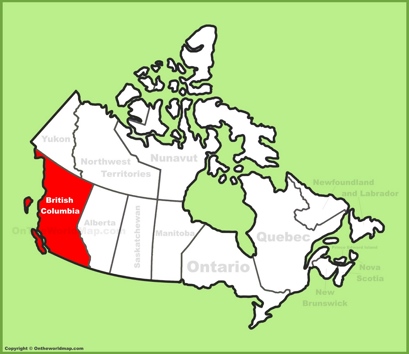
Online Map of British Columbia


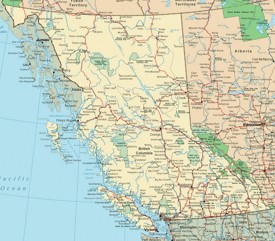
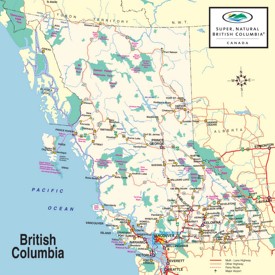


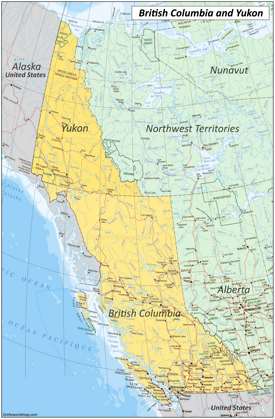
Maps of British Columbia and Neighboring Provinces

About British Columbia
British Columbia (BC) is Canada's westernmost province, characterized by its diverse landscapes, vibrant cities, and rich cultural heritage. Located between the Pacific Ocean and the Rocky Mountains, this province offers a unique blend of natural beauty and urban sophistication that attracts millions of visitors and residents alike.
Geography and Climate
British Columbia occupies a vast territory of approximately 944,735 square kilometers (364,764 square miles), making it the third-largest province in Canada. The province is bordered by the Yukon and Northwest Territories to the north, Alberta to the east, and the U.S. states of Washington, Idaho, and Montana to the south. Its western boundary is formed by the Pacific Ocean and the southern portion of Alaska.
The geography of British Columbia is remarkably diverse, featuring:
- Mountain ranges: The Canadian Rockies in the east and the Coast Mountains along the western edge form the backbone of the province's topography. Mount Fairweather, at 4,663 meters (15,299 feet), is the highest peak in the province.
- Coastline: With over 27,000 kilometers (16,777 miles) of rugged coastline, BC features numerous fjords, islands, and beaches. The coastline includes approximately 6,000 islands, with Vancouver Island being the largest.
- Forests: About 60% of the province is covered in forests, primarily coniferous trees, which have historically been the foundation of BC's economy.
- Rivers and lakes: Major river systems include the Fraser, Columbia, Peace, Skeena, and Nass Rivers. Williston Lake, formed by the W.A.C. Bennett Dam on the Peace River, is the largest body of water in the province.
The climate of British Columbia varies significantly due to its diverse topography. Coastal regions experience a mild, oceanic climate with abundant rainfall and moderate temperatures year-round. The southern interior features hot summers and moderately cold winters with less precipitation. Northern regions have longer, more severe winters and cooler summers, while alpine areas experience cold temperatures and significant snowfall.
History
The human history of British Columbia dates back thousands of years, with Indigenous peoples establishing settlements along the coast and in interior valleys at least 10,000 years ago. These First Nations communities, including the Coast Salish, Tsilhqot'in, and Haida peoples, developed rich cultures and sophisticated societies before European contact.
European exploration of the region began in the late 18th century. In 1774, Spanish explorer Juan Pérez Hernández likely became the first European to see the BC coast. In 1778, British Captain James Cook arrived at Nootka Sound on Vancouver Island's west coast. In 1793, Alexander Mackenzie of the North West Company completed the first recorded European crossing of the North American continent north of Mexico, reaching the Pacific coast of what is now British Columbia.
The region was initially developed through the fur trade, with the Hudson's Bay Company establishing Fort Victoria in 1843. The discovery of gold in the Fraser Canyon in 1858 triggered a significant population influx and led to the establishment of the mainland colony of British Columbia. In 1866, the colonies of Vancouver Island and British Columbia were united, and in 1871, British Columbia joined the Canadian Confederation as its sixth province, enticed by the promise of a transcontinental railway connecting it to eastern Canada.
Population and Demographics
As of 2025, British Columbia's population exceeds 5.7 million, making it the third most populous province in Canada. The majority of residents live in the southwestern corner of the province, particularly in the Lower Mainland region around Vancouver.
The population of British Columbia is characterized by its diversity:
- Ethnic composition: While those of European descent (particularly English, Scottish, and Irish) form a significant portion of the population, BC has one of the highest proportions of visible minorities in Canada, with over 30% of residents belonging to visible minority groups.
- Indigenous peoples: Approximately 6% of BC's population identifies as Indigenous, representing diverse First Nations, Métis, and Inuit communities.
- Immigration: The province has attracted significant immigration, particularly from Asia. Chinese and South Asian communities form the largest visible minority groups.
- Languages: While English is the predominant language, Punjabi, Mandarin, Cantonese, and numerous other languages are widely spoken, especially in the Metro Vancouver area. The province recognizes the Franco-Columbian community as an official linguistic minority, and there are at least 34 different Indigenous languages spoken in BC.
Economy
British Columbia has a diverse and resilient economy, with a GDP that has shown modest growth in recent years. As of early 2025, the province experienced approximately 0.4% economic growth, demonstrating stability despite global economic challenges.
Natural Resources
Historically, BC's economy has been dominated by resource extraction. The province is known for its timber, pulp, and paper products, which remain among its largest exports. Significant mineral resources include copper, coal, gold, silver, and molybdenum. BC is a major producer of natural gas, and hydroelectricity is the largest source of power generation in the province. Pacific salmon and other seafood industries contribute significantly to the provincial economy. While natural resource sectors remain important, employment in these areas has been gradually declining, with new jobs primarily appearing in construction, retail, and service industries.
Tourism
Tourism represents a vital and growing component of British Columbia's economy. The province's stunning landscapes, outdoor recreation opportunities, and vibrant urban centers attract millions of visitors annually. In 2025, tourism in British Columbia continued to show strong performance, contributing to Canada's overall tourism boom that saw an approximate 18% increase in tourist numbers compared to 2024. The industry generated significant revenue, with particular growth in outdoor adventure tourism, Indigenous tourism, and urban tourism.
Technology and Film Industry
Vancouver has developed into a major technology hub, often referred to as "Silicon Valley North," with numerous tech companies establishing operations in the region. The city is also North America's third-largest film production center after Los Angeles and New York, earning it the nickname "Hollywood North."
International Trade
British Columbia serves as Canada's gateway to the Pacific, with the Port of Vancouver being the largest and most diversified port in Canada. This strategic location facilitates trade with Asian markets and contributes significantly to the provincial economy.
Government and Politics
British Columbia operates within Canada's federal system of government, with three levels of administration:
- Federal government: Responsible for national matters such as immigration, foreign affairs, and defense. British Columbia has 42 federal electoral districts, each represented by a Member of Parliament (MP) in the House of Commons.
- Provincial government: Led by the Premier (currently David Eby of the New Democratic Party), the provincial government has jurisdiction over education, healthcare, natural resources, and other areas. The Legislative Assembly consists of 87 elected Members (MLAs).
- Municipal governments: 188 municipalities and 27 regional districts manage local services such as policing, fire protection, water supply, and recreation.
First Nations governance is also significant in British Columbia, with some communities having self-government agreements that grant them control over their own affairs, including law-making, financial management, and service delivery.
Education and Healthcare
British Columbia maintains high standards in both education and healthcare. The province offers a comprehensive education system that includes public K-12 schools, complemented by private and independent institutions. Notable post-secondary institutions include the University of British Columbia (UBC), Simon Fraser University, the University of Victoria, and the British Columbia Institute of Technology (BCIT). BC attracts numerous international students, contributing significantly to the provincial economy.
Healthcare in British Columbia is primarily delivered through the publicly funded Medical Services Plan (MSP), which provides coverage for necessary medical services to eligible residents. The province is known for its high-quality healthcare facilities and services, particularly in urban centers.
Culture and Society
British Columbia's culture is characterized by its diversity, environmental consciousness, and outdoor lifestyle. The province's diverse population has created a rich tapestry of cultural expressions, festivals, cuisines, and traditions. The artistic traditions of BC's First Nations, particularly those of the Northwest Coast, are internationally renowned for their distinctive styles and symbolism. British Columbians generally demonstrate strong environmental values, reflected in "green" policies and conservation efforts. The province's natural landscapes facilitate a wide range of outdoor activities, from skiing and snowboarding to hiking, kayaking, and mountain biking. BC also has a vibrant arts scene, with numerous theaters, galleries, music venues, and cultural festivals.
Major Cities and Regions
Vancouver
As the largest city in British Columbia, Vancouver is a cosmopolitan center known for its stunning setting between mountains and ocean. With a population of approximately 637,234 in the city proper and over 2.7 million in the metropolitan area, Vancouver is a hub for business, culture, and tourism. The city consistently ranks among the world's most livable urban centers and hosted the 2010 Winter Olympics.
Victoria
The provincial capital, located on the southern tip of Vancouver Island, Victoria combines British colonial heritage with modern amenities. Known as the "Garden City," Victoria attracts tourists with its mild climate, historic architecture, and cultural attractions.
Other Significant Regions
- Lower Mainland: The populous southwestern corner of the province, including Vancouver and surrounding communities.
- Vancouver Island: A large island with diverse ecosystems, from rainforests to mountains.
- Okanagan Valley: Known for its vineyards, orchards, and warm climate.
- Kootenays: A southeastern region featuring mountains, lakes, and historical mining communities.
- Northern BC: A vast area rich in natural resources and wilderness.
- Cariboo-Chilcotin: Central interior region known for ranching and outdoor recreation.
Tourism and Recreation
British Columbia's tourism industry benefits from the province's remarkable natural beauty and diverse attractions. Outdoor activities include world-class skiing and snowboarding at resorts such as Whistler Blackcomb, hiking on extensive trail networks including the famous West Coast Trail, water sports like kayaking and canoeing, and wildlife viewing opportunities to observe bears, whales, eagles, and other wildlife in their natural habitats.
Cultural attractions include museums and galleries such as the Royal BC Museum in Victoria and the Museum of Anthropology at UBC, historic sites like Fort Langley and Barkerville, and urban experiences including shopping, dining, and entertainment options in Vancouver, Victoria, and other cities.
British Columbia maintains an extensive system of parks and protected areas, including seven national parks: Glacier National Park, Gulf Islands National Park Reserve, Gwaii Haanas National Park Reserve and Haida Heritage Site, Kootenay National Park, Mount Revelstoke National Park, Pacific Rim National Park Reserve, and Yoho National Park. Additionally, the province manages numerous provincial parks and ecological reserves.
Challenges and Future Prospects
Despite its many advantages, British Columbia faces several challenges, including housing affordability (particularly in Vancouver and Victoria), environmental concerns related to balancing resource development with protection, Indigenous reconciliation, and economic diversification to reduce dependence on resource extraction by further developing knowledge-based and service industries.
Looking forward, British Columbia's strategic location as Canada's Pacific gateway, combined with its educated workforce, natural resources, and quality of life advantages, positions the province well for continued growth and development. The provincial economy is expected to continue its modest growth trajectory, with particular strength in sectors such as technology, tourism, and clean energy.
Conclusion
British Columbia represents a unique blend of natural splendor, cultural diversity, and economic opportunity. From its towering mountain ranges and pristine coastlines to its vibrant cities and communities, the province offers a distinctive quality of life that continues to attract people from around the world. As it navigates the challenges of the 21st century, British Columbia's commitment to sustainability, innovation, and inclusivity will shape its future development and maintain its status as one of Canada's most dynamic and desirable provinces.
The Facts:
| Capital: | Victoria |
| Largest city: | Vancouver |
| Population (Q3 2025): | 5,697,536[1] |
| Area: | 364,764 sq mi (944,735 sq km) |
| Density: | 14/sq mi (5.41/sq km) |
| Official languages: | English |
| Coordinates: | 54°N 125°W |
| Gross domestic product (Total): | CA$249.981 billion |
| Gross domestic product (Per capita): | CA$53,267 |
| Time zone: |
Most of province - UTC−08:00 (Pacific) - Summer (DST) - UTC−07:00 (Pacific DST) Southeastern - UTC−07:00 (Mountain) - Summer (DST) - UTC−06:00 (Mountain DST) Eastern - UTC−07:00 (Mountain [no DST]) |
| Canadian postal abbr.: | BC |
| Postal code prefix: | V |
| ISO 3166 code: | CA-BC |
| Flower: | Pacific dogwood |
| Tree: | Western red cedar |
| Bird: | Steller's jay |
| Official Website: | gov.bc.ca |
Google Map of British Columbia
List of Cities in British Columbia
- Vancouver
- Surrey
- Burnaby
- Richmond
- Abbotsford
- Coquitlam
- Kelowna
- Delta
- Nanaimo
- Kamloops
- Chilliwack
- Victoria
- Maple Ridge
- New Westminster
- Prince George
- Port Coquitlam
- North Vancouver
- Langford
- Vernon
- Mission
- Penticton
- West Kelowna
- Campbell River
- Port Moody
- Langley
- Courtenay
- White Rock
- Fort St. John
- Cranbrook
- Salmon Arm
- Pitt Meadows
- Colwood
- Port Alberni
- Powell River
- Parksville
- Dawson Creek
- Prince Rupert
- Terrace
- Nelson
- Williams Lake
- Quesnel
- Castlegar
- Revelstoke
- Kimberley
- Trail
- Merritt
- Fernie
- Armstrong
- Duncan
- Rossland
- Grand Forks
- Enderby
- Greenwood
- Ladysmith
Main Sights in British Columbia
- Stanley Park
- Capilano Suspension Bridge
- Grouse Mountain
- Whistler Blackcomb
- Sea-to-Sky Highway
- Butchart Gardens
- Royal BC Museum
- Victoria Inner Harbour
- Granville Island
- Museum of Anthropology at UBC
- Pacific Rim National Park Reserve
- Yoho National Park
- Glacier National Park of Canada
- Mount Revelstoke National Park
- Garibaldi Provincial Park
- Joffre Lakes Provincial Park
- Wells Gray Provincial Park
- Cathedral Grove (MacMillan Provincial Park)
- Gwaii Haanas National Park Reserve
- Great Bear Rainforest
- Okanagan Valley
- Okanagan Lake
- Kootenay National Park
- Mount Robson Provincial Park
- Desolation Sound Marine Provincial Park
- Othello Tunnels (Coquihalla Canyon Provincial Park)
- Fort Langley National Historic Site
- Barkerville Historic Town
- Shannon Falls Provincial Park
- Sea to Sky Gondola
List of the Largest Islands of British Columbia
- Vancouver - 12,079 sq mi (31,285 km2)
- Graham Island - 2,456 sq mi (6,361 km2)
- Moresby Island - 1,007 sq mi (2,608 km2)
- Princess Royal Island - 869 sq mi (2,251 km2)
- Pitt Island - 531 sq mi (1,375 km2)
- Banks Island - 388 sq mi (1,005 km2)
- Texada Island - 201 sq mi (520 km2)
- Porcher Island - 130 sq mi (337 km2)
- Aristazabal Island - 128 sq mi (331 km2)
- Calvert Island - 125 sq mi (324 km2)
- King Island - 110 sq mi (285 km2)
- Hunter Island - 109 sq mi (283 km2)
- Gilford Island - 93 sq mi (241 km2)
- Malcolm Island - 92 sq mi (238 km2)
- Salt Spring Island - 74 sq mi (182 km2)
- Quadra Island - 68 sq mi (177 km2)
- Cortes Island - 52 sq mi (130 km2)
- Galiano Island - 23 sq mi (60 km2)
- Pender Islands - 13 sq mi (34 km2)
- Gabriola Island - 14 sq mi (36 km2)
Major Rivers of British Columbia
- Mackenzie River - 2635 mi (4241 km)
- Yukon River - 1979 mi (3185 km)
- Columbia River - 1243 mi (2000 km)
- Peace River - 1195 mi (1923 km)
- Fraser River - 854 mi (1375 km)
- Liard River - 693 mi (1115 km)
- Atlin River - 555 mi (893 km)
- Kootenay River - 485 mi (780 km)
- Pend d'Oreille River - 437 mi (703 km)
- South Thompson River - 298 mi (480 km)
- Nechako River - 287 mi (462 km)
- Nass River - 240 mi (380 km)
- North Thompson River - 240 mi (386 km)
- Thompson River - 244 mi (393 km)
- Stikine River - 168 mi (270 km)
- Bella Coola River - 93 mi (150 km)
- Homathko River - 89 mi (144 km)
- Babine River - 60 mi (97 km)
- Taku River - 54 mi (87 km)
- Bulkley River - 50 mi (80 km)
List of the Largest Lakes of British Columbia
- Williston Lake - 680 sq mi (1,761 km2)
- Nechako Reservoir - 340 sq mi (890 km2)
- Atlin Lake - 299 sq mi (775 km2)
- Babine Lake - 191 sq mi (495 km2)
- Kootenay Lake - 157 sq mi (407 km2)
- Okanagan Lake - 136 sq mi (351 km2)
- Harrison Lake - 124 sq mi (321 km2)
- Quesnel Lake - 104 sq mi (270 km2)
- Stuart Lake - 90 sq mi (233 km2)
- Takla Lake - 85 sq mi (220 km2)
- Chilko Lake - 72 sq mi (186 km2)
- Shuswap Lake - 70 sq mi (181 km2)
- Kinbasket Lake - 65 sq mi (168 km2)
- Francois Lake - 62 sq mi (160 km2)
- Adams Lake - 57 sq mi (147 km2)
- Arrow Lake - 55 sq mi (142 km2)
- Tatla Lake - 51 sq mi (132 km2)
- Trembleur Lake - 48 sq mi (125 km2)
- Owikeno Lake - 47 sq mi (122 km2)
- Cowichan Lake - 46 sq mi (119 km2)
References
1. ^ Population estimates, quarterly. Statistics Canada.Maps of Canada
Provinces and Territories
Cities of Canada
Cities of Canada