
Prince Edward Island Map
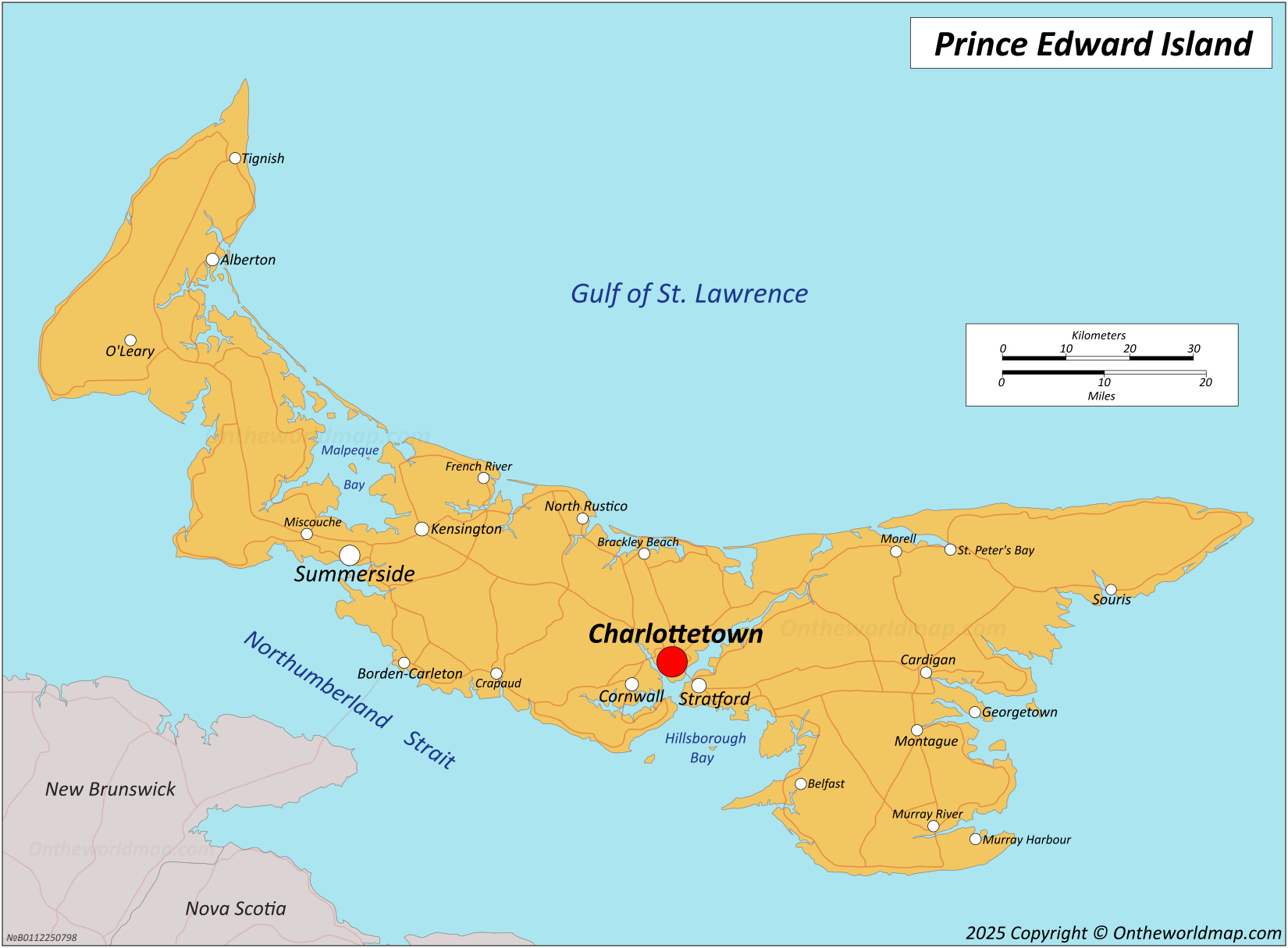
Description:
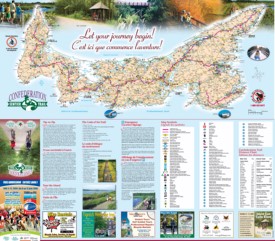
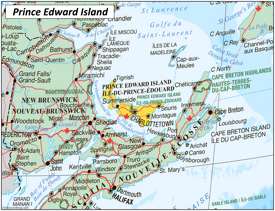
This map shows cities, towns, villages, province capital, highways, and major roads on Prince Edward Island.
Size: 1650x1215px / 486 Kb
Author: Ontheworldmap.com
You may download, print or use the above map for educational, personal and non-commercial purposes. Attribution is required. For any website, blog, scientific research or e-book, you must place a hyperlink (to this page) with an attribution next to the image used.
Online Map of Prince Edward Island

About Prince Edward Island
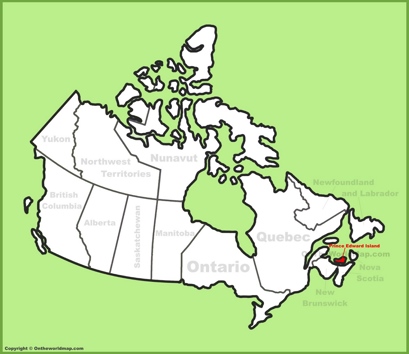
Prince Edward Island (PEI) is a province of Canada and one of the three Maritime Provinces. It is the smallest province in Canada in both land area and population. The island is located in the Gulf of St. Lawrence, north of Nova Scotia and east of New Brunswick, with which it forms the Northumberland Strait.
Geography
Prince Edward Island has a total area of 5,660 square kilometres (2,190 square miles), making it the 104th-largest island in the world and Canada's 23rd-largest island. The island measures approximately 224 kilometres (139 miles) in length and ranges from 6 to 64 kilometres (3.7 to 39.8 miles) in width. The landscape is predominantly gently rolling hills with the highest point being only 142 metres (466 feet) above sea level.
The island's coastline extends for approximately 1,260 kilometres (780 miles) and features distinctive red sandstone cliffs, sandy beaches, and numerous bays. The soil derives its characteristic reddish color from iron oxide content.
History
The island was originally inhabited by the Mi'kmaq people, who called it Epekwitk, meaning "cradle on the waves." French explorer Jacques Cartier reached the island in 1534, claiming it for France. The French colonial settlement began in 1720, and the island was named Île Saint-Jean.
Following the Treaty of Paris in 1763, the island came under British control and was renamed St. John's Island. In 1769, it became a separate colony from Nova Scotia. The island was renamed Prince Edward Island in 1798 in honor of Prince Edward, Duke of Kent and Strathearn, the fourth son of King George III and father of Queen Victoria. Prince Edward Island joined Canadian Confederation on July 1, 1873, becoming Canada's seventh province after negotiations that prominently featured the promise of a railway connection and assumption of the island's railway debt.
Demographics
As of 2025, Prince Edward Island had a population of 182,657, making it Canada's least populous province. The population has experienced steady growth in recent decades, particularly since 2000. Approximately half of the population resides in the Greater Charlottetown Area. The population density is 25 people per square kilometre.
The ethnic composition includes descendants of Scottish, English, Irish, and French settlers, as well as the indigenous Mi'kmaq people. English is the predominant language, spoken by approximately 93% of the population, while French is spoken by about 4%.
Economy
The economy of Prince Edward Island has traditionally been based on agriculture, fishing, and tourism. Agriculture remains significant, with the province being Canada's leading producer of potatoes, accounting for approximately one-quarter of the national crop. The island produces over one billion kilograms of potatoes annually.
Key economic sectors include:
- Agriculture: Potatoes, dairy, beef, and other crops
- Fishing: Lobster, oysters, mussels, and other seafood
- Tourism: Drawing over 1.5 million visitors annually
- Aerospace and bioscience: Emerging technology sectors
- Food processing: Related to agricultural production
Transportation
The Confederation Bridge, completed in 1997, connects Prince Edward Island to New Brunswick. Spanning 12.9 kilometres (8 miles), it is the longest bridge in Canada and the longest bridge over ice-covered waters in the world. Prior to the bridge's construction, ferry services provided the primary connection to the mainland.
Ferry service between Wood Islands, PEI, and Caribou, Nova Scotia, continues to operate seasonally. The island's internal transportation relies primarily on roads, with Route 1 (Trans-Canada Highway) being the main east-west corridor.
Government and Politics
Prince Edward Island has a Westminster-style parliamentary government. The provincial legislature consists of a unicameral Legislative Assembly with 27 members elected from single-member districts. The province is represented in the federal Parliament of Canada by four Members of Parliament in the House of Commons and four senators in the Senate.
Charlottetown, the capital and largest city, houses the provincial government. The city is historically significant as the birthplace of Canadian Confederation, having hosted the Charlottetown Conference in 1864.
Education
The University of Prince Edward Island, located in Charlottetown, is the province's only university. It was formed in 1969 through the merger of St. Dunstan's University and Prince of Wales College. The institution offers undergraduate and graduate programs and includes the Atlantic Veterinary College, established in 1986.
Culture and Tourism
Anne of Green Gables, the famous novel by Lucy Maud Montgomery published in 1908, has had an enormous cultural and economic impact on the island. Green Gables Heritage Place, located in Cavendish, attracts visitors from around the world, particularly from Japan and Canada. The novel's setting and the author's birthplace have become central to the island's tourism industry.
The island hosts numerous cultural festivals throughout the year, including the Charlottetown Festival, which features musical theater productions. The food culture prominently features seafood, particularly lobster suppers, which have become a distinctive island tradition. The island's red sand beaches and coastal scenery contribute to its appeal as a vacation destination.
Climate
Prince Edward Island has a maritime climate characterized by moderate temperatures and significant precipitation throughout the year. The surrounding ocean moderates temperature extremes. Average summer temperatures range from 18 to 23°C (64 to 73°F), while winter temperatures average between -3 and -11°C (26 to 12°F). The island receives approximately 890 millimetres (35 inches) of precipitation annually, with significant snowfall during winter months averaging 290 centimetres (114 inches).
Environmental Characteristics
The province has no native large mammals, though red foxes, raccoons, and other small mammals inhabit the island. White-tailed deer were introduced in the 19th century. The island supports diverse bird populations, including various seabirds along the coastline. The surrounding waters are rich in marine life, supporting commercial fisheries for lobster, oysters, mussels, and various fish species.
Approximately 45% of the island's original forest cover remains, consisting primarily of mixed Acadian forest with red spruce, white spruce, balsam fir, and various hardwood species. Environmental challenges include soil erosion, particularly along agricultural areas, and coastal erosion affecting shorelines.
The Facts:| Capital: | Charlottetown |
| Largest city: | Charlottetown |
| Population (Q3 2025): | 182,657[1] |
| Area: | 2,190 sq mi (5,660 sq km) |
| Density: | 70.6/sq mi (27.27/sq km) |
| Official languages: | English |
| Coordinates: | 46°24′N 63°12′W |
| Gross domestic product (Total): | 6.652 billion |
| Gross domestic product (Per capita): | C$36,740 |
| Time zone: | UTC-04:00 (Atlantic) |
| Canadian postal abbr.: | PE |
| Postal code prefix: | C |
| ISO 3166 code: | CA-PE |
| Flower: | Pink lady's slipper |
| Tree: | Red oak |
| Bird: | Blue jay |
| Official Website: | www.princeedwardisland.ca |
Google Map of Prince Edward Island
List of municipalities in Prince Edward Island
- Abram-Village
- Alberton
- Alexandra
- Annandale-Little Pond-Howe Bay
- Bedeque and Area
- Belfast
- Borden-Carleton
- Brackley
- Breadalbane
- Central Kings
- Central Prince
- Charlottetown
- Clyde River
- Cornwall
- Crapaud
- Darlington
- Eastern Kings
- Greenmount-Montrose
- Hampshire
- Hazelbrook
- Hunter River
- Kensington
- Kingston
- Kinkora
- Linkletter
- Lot 11 and Area
- Malpeque Bay
- Miltonvale Park
- Miminegash
- Miscouche
- Morell
- Mount Stewart
- Murray Harbour
- Murray River
- North Rustico
- North Shore
- North Wiltshire
- Northport
- O'Leary
- Sherbrooke
- Souris
- Souris West
- St. Felix
- St. Louis
- St. Nicholas
- St. Peters Bay
- Resort Municipality
- Stratford
- Summerside
- Three Rivers
- Tignish
- Tignish Shore
- Tyne Valley
- Union Road
- Victoria
- Warren Grove
- Wellington
- West River
- York
Main Sights in Prince Edward Island
- Green Gables Heritage Place
- Cavendish Beach
- Prince Edward Island National Park
- Confederation Bridge
- Province House National Historic Site
- Victoria Row
- Basin Head Provincial Park
- Greenwich Interpretation Centre
- North Cape Wind Farm
- Peake's Wharf
- St. Dunstan's Basilica
- Covehead Harbour Lighthouse
- Anne of Green Gables Museum
- Founders' Hall
- Red Point Provincial Park
- Brackley Beach
- Wood Islands Lighthouse
- Point Prim Lighthouse
- Dalvay by the Sea
- Summerside Waterfront
- Victoria Park
- Cedar Dunes Provincial Park
- Panmure Island Provincial Park
- Confederation Centre of the Arts
- Basin Head Fisheries Museum
- Elmira Railway Museum
- Orwell Corner Historic Village
- Beaconsfield Historic House
- Malpeque Bay
- Singing Sands Beach
References
1. ^ Population estimates, quarterly. Statistics Canada.Maps of Canada
Provinces and Territories
Cities of Canada
Cities of Canada