
Nunavut Map

Description:
This map shows towns, villages, islands, province capital, rivers, and lakes in Nunavut.
Size: 1550x1601px / 1.06 Mb
Author: Ontheworldmap.com
You may download, print or use the above map for educational, personal and non-commercial purposes. Attribution is required. For any website, blog, scientific research or e-book, you must place a hyperlink (to this page) with an attribution next to the image used.
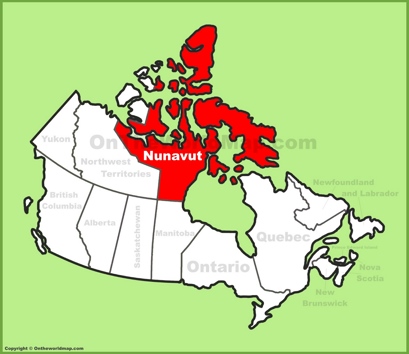
Online Map of Nunavut
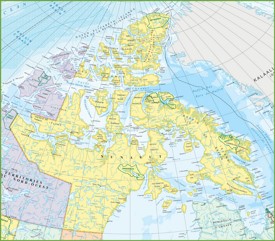
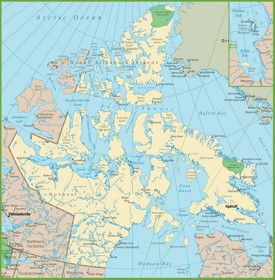


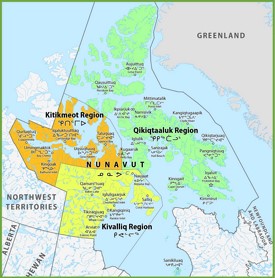
Maps of Nunavut and Neighboring Provinces


About Nunavut
Nunavut is the largest and northernmost territory of Canada. It was officially separated from the Northwest Territories on April 1, 1999, via the Nunavut Act and the Nunavut Land Claims Agreement Act, making it the first major change to Canada's political map since the province of Newfoundland was admitted in 1949. The creation of Nunavut resulted from the largest aboriginal land claims agreement between the Canadian government and the native Inuit people.
Geography
Nunavut comprises a major portion of Northern Canada and most of the Arctic Archipelago. Its vast territory covers approximately 2,093,190 square kilometers (808,190 square miles), representing about one-fifth of Canada's total land area. This makes Nunavut the fifth-largest country subdivision in the world. The territory is bordered by the Northwest Territories to the west, Manitoba to the south, and extends to the North Pole. It includes numerous islands, including Baffin Island, Ellesmere Island, and Victoria Island, which are among the largest islands in the world. Nunavut also borders the province of Saskatchewan in the southwest at a quadrangular intersection of borders and has a short land border with the province of Newfoundland and Labrador on Killinick Island. It has maritime borders with the provinces of Quebec, Ontario, and Manitoba; which run along the coastlines of these provinces and include all bays under Nunavut's jurisdiction, rather than running down the middle of the waterway as is usually the case. With Greenland, part of the Kingdom of Denmark, it has a mostly maritime international border, which includes a small land border on Hans Island.
The territorial capital and largest community is Iqaluit, located on Baffin Island with a population of approximately 7,000 residents. Nunavut has 25 communities in total, all of which are accessible only by aircraft or boat, as there are no roads connecting them to the rest of Canada.
Climate
The climate is Arctic and subarctic, characterized by long, extremely cold winters and short, cool summers. Average winter temperatures can drop below -30°C (-22°F), while summer temperatures range from 5°C to 15°C (41°F to 59°F). The territory experiences polar night during winter months and midnight sun during summer in its northernmost regions.
Demographics
As of the 2025, Nunavut had a population of 41,830, making it the least populous of Canada's provinces and territories. The population density is extremely low at approximately 0.02 people per square kilometer. Approximately 85% of the population is Inuit, making Nunavut the only Canadian territory or province with an Indigenous majority. The remaining population consists of non-Indigenous Canadians, primarily employed in government, education, and resource extraction sectors.
The official languages of Nunavut are:
- Inuktitut
- Inuinnaqtun
- English
- French
Inuktitut is the most widely spoken language, used by approximately 65% of the population as their mother tongue.
History
The territory has been inhabited by Indigenous peoples for approximately 4,000 years. The Thule people, ancestors of modern Inuit, arrived in the region around 1000 CE, gradually replacing the earlier Dorset culture. European exploration began in the 16th century, with Martin Frobisher conducting expeditions to the region in the 1570s.
The area became part of the Northwest Territories when Canada acquired Rupert's Land from the Hudson's Bay Company in 1870. Beginning in the 1970s, Inuit leaders advocated for the creation of a separate territory. Negotiations between the Government of Canada and the Tungavik Federation of Nunavut led to the Nunavut Land Claims Agreement, signed in 1993. This agreement transferred title to 350,000 square kilometers of land to the Inuit, along with mineral rights to 36,000 square kilometers, and provided a capital transfer of $1.14 billion over 14 years.
Government and Politics
Nunavut has a public government system based on consensus rather than party politics. The Legislative Assembly of Nunavut consists of 22 members elected from single-member districts for four-year terms. The members then choose a Premier and Cabinet ministers from among themselves through a consensus-building process. This system differs from the party-based parliamentary systems used in Canada's provinces and other territories.
The territory is represented in the federal Parliament by one Member of Parliament in the House of Commons and one Senator. The Commissioner of Nunavut represents the federal government and performs ceremonial duties similar to a provincial lieutenant governor.
Economy
The economy is primarily based on hunting, fishing, and government services. Traditional activities remain important for food security and cultural identity. Mining has emerged as a significant economic sector, with several active mines producing gold, iron ore, and other minerals. The Meadowbank and Meliadine gold mines operated by Agnico Eagle Mines are major employers in the territory.
Tourism represents a growing sector, with visitors attracted to Arctic wildlife, including polar bears, caribou, and narwhals, as well as opportunities for viewing the Northern Lights and experiencing Inuit culture. Arts and crafts, particularly soapstone carvings and textile arts, provide income for many residents and contribute to the preservation of traditional skills.
Unemployment rates remain higher than the Canadian average, and the cost of living is significantly elevated due to the remote location and reliance on air freight for most goods. Government transfers and programs constitute a major portion of the territorial economy.
Infrastructure and Transportation
Transportation infrastructure is limited due to permafrost and extreme weather conditions. There are no highways or railroads in Nunavut. All communities are accessible only by air year-round, with seasonal marine transportation available during the brief ice-free period. The territory operates several airports, with the busiest being Iqaluit International Airport. Snowmobiles and all-terrain vehicles serve as primary modes of local transportation.
Education and Healthcare
The education system includes both Western-style curriculum and traditional Inuit knowledge. Nunavut Arctic College, established in 1995, is the territory's only post-secondary institution, offering programs in trades, teacher education, and environmental technology. Healthcare services face challenges due to geographic isolation, with many specialized services requiring patients to travel to facilities in southern Canada. The territory operates health centers in each community and a regional hospital in Iqaluit.
Culture
Inuit culture dominates the social and cultural life of Nunavut. Traditional practices such as throat singing, drum dancing, and storytelling remain integral to community life. The territory celebrates Nunavut Day on July 9 each year, commemorating the signing of the land claims agreement. Country food, including caribou, seal, Arctic char, and whale, continues to be an essential component of the diet and cultural identity. Contemporary Inuit artists have gained international recognition for their sculptures, prints, and textiles, with communities like Cape Dorset being renowned centers of artistic production.
The Facts:| Capital: | Iqaluit |
| Largest Town: | Iqaluit |
| Population (Q3 2025): | 41,830[1] |
| Area: | 808,190 sq mi (2,093,190 sq km) |
| Density: | 0.052/sq mi (0.02/sq km) |
| Official languages: | Inuit (Inuktitut and Inuinnaqtun), English, French |
| Coordinates: | 67°21′N 90°54′W |
| Gross domestic product (Total): | C$2.846 billion |
| Gross domestic product (Per capita): | C$58,452 |
| Canadian postal abbr.: | NU |
| Postal code prefix: | X0A, X0B, X0C |
| ISO 3166 code: | CA-NU |
| Flower: | Purple saxifrage |
| Tree: | n/a |
| Bird: | Rock ptarmigan |
| Official Website: | www.gov.nu.ca |
Google Map of Nunavut
List of municipalities in Nunavut
- Arctic Bay
- Arviat
- Baker Lake
- Cambridge Bay
- Chesterfield Inlet
- Clyde River
- Coral Harbour
- Gjoa Haven
- Grise Fiord
- Igloolik
- Iqaluit
- Kimmirut
- Kinngait
- Kugaaruk
- Kugluktuk
- Naujaat
- Pangnirtung
- Pond Inlet
- Qikiqtarjuaq
- Rankin Inlet
- Resolute
- Sanikiluaq
- Sanirajak
- Taloyoak
- Whale Cove
Main sights in Nunavut
- Auyuittuq National Park
- Sirmilik National Park
- Quttinirpaaq National Park
- Mount Thor
- Mount Asgard
- Sylvia Grinnell Territorial Park
- Akshayuk Pass
- Pond Inlet
- Pangnirtung
- Arctic Bay
- Cape Dorset (Kinngait)
- Iqaluit
- Cambridge Bay
- Resolute Bay
- Baker Lake
- Kugluktuk
- Bloody Falls
- Marble Island
- Penny Ice Cap
- Soper River
- Thelon Wildlife Sanctuary
- Dewey Soper Migratory Bird Sanctuary
- Katannilik Territorial Park
- Mallikjuaq Territorial Park
- Lancaster Sound
- Wager Bay
- Bathurst Inlet
- Cunningham Inlet
- Fury and Hecla Strait
- Naujaat (Repulse Bay)
List of the Largest Islands of Nunavut
- Baffin Island - 195,928 sq mi (507,451 km2)
- Victoria Island - 83,897 sq mi (217,291 km2)
- Ellesmere Island - 75,767 sq mi (196,236 km2)
- Banks Island - 27,038 sq mi (70,028 km2)
- Devon Island - 21,331 sq mi (55,247 km2)
- Axel Heiberg Island - 16,671 sq mi (43,178 km2)
- Melville Island - 16,274 sq mi (42,149 km2)
- Southampton Island - 15,913 sq mi (41,214 km2)
- Prince of Wales Island - 12,872 sq mi (33,339 km2)
- Somerset Island - 9,570 sq mi (24,786 km2)
- Bathurst Island - 6,194 sq mi (16,042 km2)
- Prince Patrick Island - 6,119 sq mi (15,848 km2)
- King William Island - 5,062 sq mi (13,111 km2)
- Ellef Ringnes Island - 4,361 sq mi (11,295 km2)
- Bylot Island - 4,273 sq mi (11,067 km2)
- Prince Charles Island - 3,676 sq mi (9,521 km2)
- Cornwallis Island - 2,701 sq mi (6,995 km2)
- Cornwall Island - 2,701 sq mi (6,995 km2)
- Coats Island - 2,123 sq mi (5,498 km2)
- Amund Ringnes Island - 2,029 sq mi (5,255 km2)
- Mackenzie King Island - 1,949 sq mi (5,048 km2)
- Stefansson Island - 1,723 sq mi (4,463 km2)
- Mansel Island - 1,228 sq mi (3,180 km2)
- Akimiski Island - 1,159 sq mi (3,001 km2)
- Borden Island - 1,079 sq mi (2,794 km2)
- Air Force Island - 664 sq mi (1,720 km2)
- Lougheed Island - 505 sq mi (1,308 km2)
- Cameron Island - 409 sq mi (1,059 km2)
- Eglinton Island - 401 sq mi (1,039 km2)
- Rowley Island - 388 sq mi (1,005 km2)
Major Rivers of Nunavut
- Back River - 605 mi (974 km)
- Thelon River - 562 mi (904 km)
- Dubawnt River - 552 mi (888 km)
- Kazan River - 528 mi (850 km)
- Coppermine River - 525 mi (845 km)
- Ferguson River - 348 mi (560 km)
- Hood River - 334 mi (538 km)
- Hayes River - 300 mi (483 km)
- Burnside River - 249 mi (400 km)
- Tree River - 186 mi (300 km)
- Ellice River - 180 mi (290 km)
- Quoich River - 157 mi (253 km)
- Hanbury River - 155 mi (250 km)
- Lorillard River - 124 mi (200 km)
- Kugaryuak River - 112 mi (180 km)
- Thomsen River - 99 mi (160 km)
- Meadowbank River - 99 mi (160 km)
- Kuujjua River - 93 mi (150 km)
- Nalluryuaq River - 87 mi (140 km)
- Jayco River - 81 mi (130 km)
List of the Largest Lakes of Nunavut
- Nettilling Lake - 2,140 sq mi (5,542 km2)
- Dubawnt Lake - 1,480 sq mi (3,833 km2)
- Amadjuak Lake - 1,203 sq mi (3,115 km2)
- Nueltin Lake - 880 sq mi (2,279 km2)
- Baker Lake - 729 sq mi (1,887 km2)
- Yathkyed Lake - 559 sq mi (1,449 km2)
- Aberdeen Lake - 420 sq mi (1,100 km2)
- Napaktulik Lake - 420 sq mi (1,080 km2)
- Garry Lake - 377 sq mi (976 km2)
- Contwoyto Lake - 369 sq mi (957 km2)
- Ennadai Lake - 263 sq mi (681 km2)
- Tulemalu Lake - 258 sq mi (668 km2)
- Kamilukuak Lake - 246 sq mi (638 km2)
- Kaminak Lake - 230 sq mi (600 km2)
- Ferguson Lake - 227 sq mi (588 km2)
- Tebesjuak Lake - 222 sq mi (575 km2)
- Qamanirjuaq Lake - 212 sq mi (549 km2)
- Lake Hazen - 209 sq mi (542 km2)
- Princess Mary Lake - 202 sq mi (524 km2)
- South Henik Lake - 198 sq mi (513 km2)
- Angikuni Lake - 200 sq mi (510 km2)
- Hall Lake - 190 sq mi (491 km2)
- Tehek Lake - 186 sq mi (481 km2)
- Mallery Lake - 185 sq mi (479 km2)
- MacAlpine Lake - 173 sq mi (447 km2)
- Bluenose Lake - 155 sq mi (401 km2)
References
1. ^ Population estimates, quarterly. Statistics Canada.Maps of Canada
Provinces and Territories
Cities of Canada
Cities of Canada