
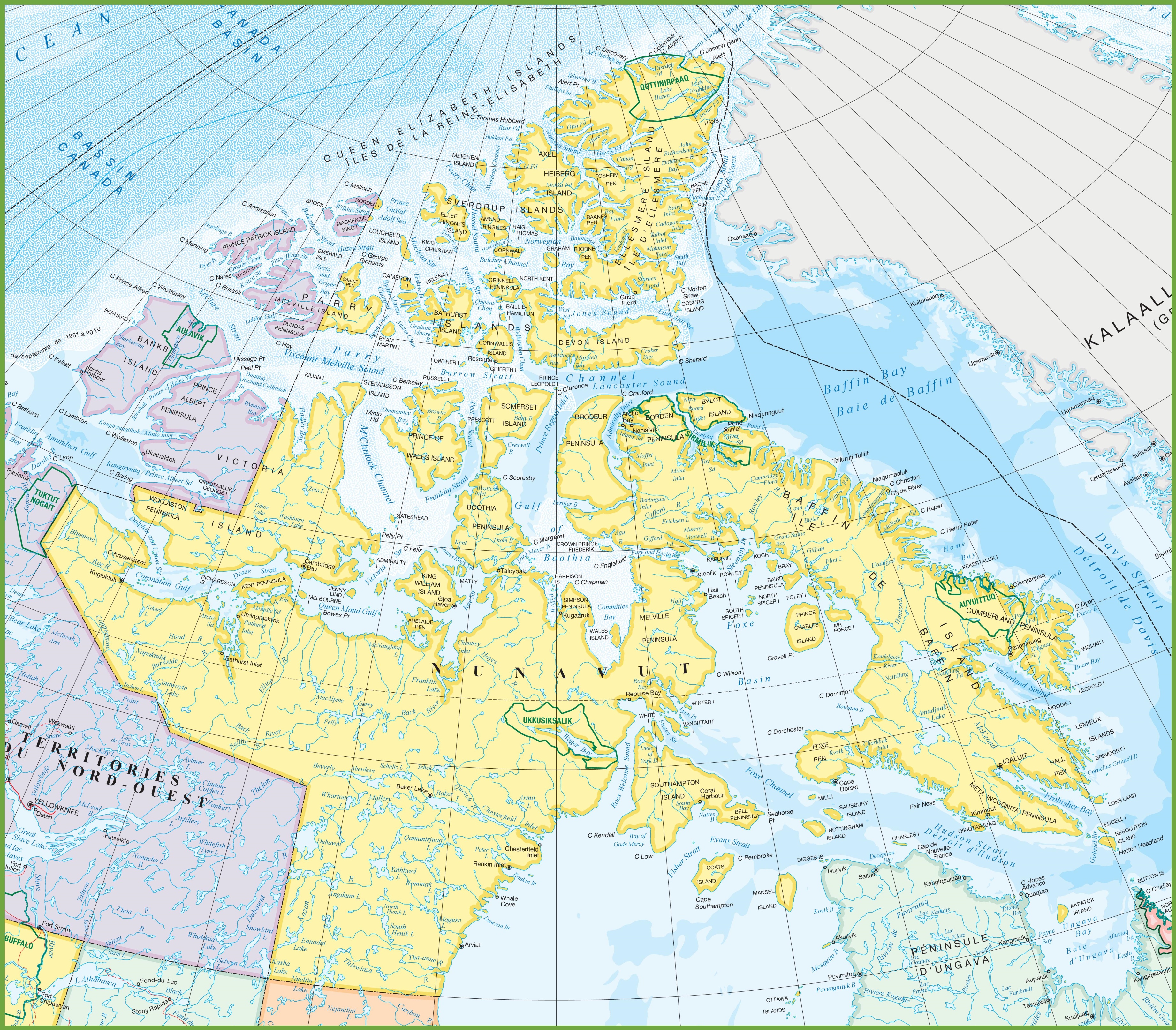
Large Detailed Map of Nunavut
Description:
This map shows cities, towns, rivers, lakes, Trans-Canada highway, major highways, secondary roads, winter roads, railways, and national parks in Nunavut.
Size: 3683x3227px / 5.38 Mb
About Nunavut
Nunavut is the largest and northernmost territory of Canada. It was separated from the Northwest Territories on April 1, 1999, via the Nunavut Act and the Nunavut Land Claims Agreement Act, representing the largest land claims settlement in Canadian history. The creation of Nunavut resulted in the first major change to Canada's political map since the province of Newfoundland was admitted in 1949.
The territory covers approximately 2,093,190 square kilometers, making it the fifth-largest country subdivision in the world. Nunavut comprises a major portion of Northern Canada and most of the Arctic Archipelago. Its vast territory makes it larger than Mexico but with a population of approximately 40,000 people as of recent estimates, giving it the lowest population density of any Canadian province or territory.
Iqaluit, located on Baffin Island, serves as the territorial capital and largest community. The name "Nunavut" means "our land" in Inuktitut, the language of the Inuit people who make up approximately 85% of the territory's population. Nunavut has four official languages: Inuktitut, Inuinnaqtun, English, and French.
The economy is primarily based on mining, hunting, fishing, and arts and crafts. The territory experiences extreme climatic conditions with long, dark winters and short summers. Most of Nunavut lies above the Arctic Circle, and the region contains significant natural resources including minerals, oil, and gas deposits.
You may download, print or use the above map for educational, personal and non-commercial purposes. Attribution is required. For any website, blog, scientific research or e-book, you must place a hyperlink (to this page) with an attribution next to the image used.
Maps of Canada
Provinces and Territories
Cities of Canada
Cities of Canada