
Saint John Map

Description:
This map shows towns, villages, roads, trails, ferry routes, beaches, lakes, rivers, peaks, buildings, and national park on Saint John Island.
Size: 4167x2535px / 1.75 Mb
Author: Ontheworldmap.com
Map based on the free editable OSM map openstreetmap.org.
Previous version of the map
You may download, print or use the above map for educational, personal and non-commercial purposes. Attribution is required. For any website, blog, scientific research or e-book, you must place a hyperlink (to this page) with an attribution next to the image used.
Online Map of Saint John


About Saint John
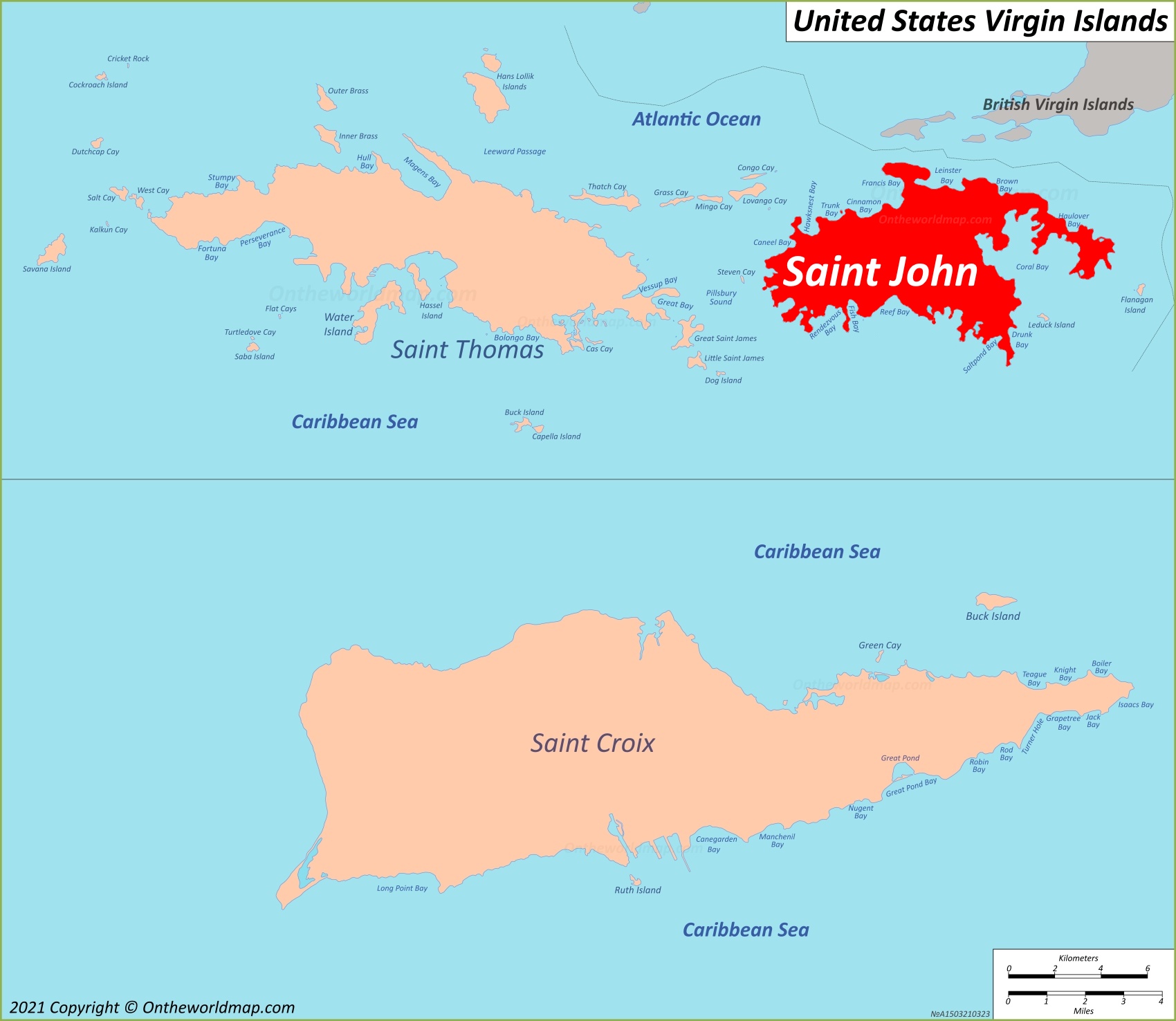
Saint John is the smallest of the three main U.S. Virgin Islands, covering approximately 20 square miles (52 square kilometers). The island is located in the Caribbean Sea, positioned between Saint Thomas to the west and the British Virgin Islands to the east. Approximately 4,000 residents inhabit the island according to recent census data.
The Facts:| Sovereign state: | United States |
| Territory: | U.S. Virgin Islands |
| Cities and Towns: | Cruz Bay |
| District: | Saint Thomas and Saint John |
| Sub-districts: | Central, Coral Bay, Cruz Bay, East End |
| Population (2020): | 3,881 |
| Density: | 74.6/sq mi (193.2/sq km) |
| Area: | 20 sq mi (52 sq km) |
| Coordinates: | 18°20′N 64°44′W |
Geography
Saint John features a mountainous terrain with lush vegetation and steep hillsides descending to the coastline. The island's highest point is Bordeaux Mountain, reaching 1,277 feet above sea level. Two-thirds of Saint John's land area is protected as Virgin Islands National Park, established in 1956. The park encompasses approximately 7,000 acres of land and 5,650 acres of adjacent ocean.
The island's coastline includes numerous bays and beaches. Trunk Bay, located within the national park, features an underwater snorkeling trail established in 1962, marking one of the first underwater trails created anywhere in the world. The island possesses no airport, making it accessible only by ferry or private boat from Saint Thomas or the British Virgin Islands.
Historical Background
Archaeological evidence indicates that Taíno people inhabited Saint John from approximately 300 CE until European colonization. Denmark-Norway claimed the island in 1718 and established plantations for sugar, cotton, and indigo production.
In 1733, enslaved Africans staged one of the most significant slave revolts in Caribbean history on Saint John. The rebellion began in November when enslaved people seized control of the island's fort and maintained control of much of the island for six months. French troops from Martinique eventually suppressed the uprising in May 1734. The United States acquired Saint John along with the other Danish West Indies in 1917.
Virgin Islands National Park
Laurance Rockefeller donated approximately 5,000 acres of land to the U.S. government in 1956, leading to the creation of Virgin Islands National Park. The park was officially established on August 2, 1956. Frank Stick, a conservationist, played a crucial role in facilitating the land acquisition and park creation. The park protects significant archaeological sites, including petroglyphs and remnants of sugar plantations.
Within the park boundaries, visitors can explore ruins of colonial-era plantations, including the Annaberg Sugar Plantation, which operated from the 1780s until 1867. The plantation ruins include a windmill, slave quarters, and processing facilities. The park's trails provide access to various ecosystems, from coastal mangroves to interior forests.
Cruz Bay
Cruz Bay serves as Saint John's main settlement and commercial center. The town functions as the ferry terminal connecting Saint John to Saint Thomas and other islands. Despite its small size, Cruz Bay contains shops, restaurants, and accommodations for visitors. The population of Cruz Bay fluctuates with seasonal tourism, with permanent residents numbering fewer than 3,000 people.
Economy and Tourism
Tourism dominates Saint John's economy, with the Virgin Islands National Park attracting hundreds of thousands of visitors annually. The island offers limited development compared to Saint Thomas and Saint Croix due to national park boundaries and building restrictions. Vacation rentals and resorts, particularly around Cruz Bay and the North Shore, provide the primary accommodations for tourists. Several private luxury resorts operate on the island, including Caneel Bay Resort, which opened in 1956.
Environmental Conservation
The extensive protected areas on Saint John support diverse wildlife populations. The island's waters contain coral reefs, sea grass beds, and mangrove forests. Marine species include sea turtles, dolphins, and numerous tropical fish. On land, the national park protects habitat for various bird species, including the bananaquit and the pearly-eyed thrasher. The park management implements programs to control invasive species and protect native flora and fauna.
The Best Beaches on Saint John
- Trunk Bay
- Cinnamon Bay
- Maho Bay
- Francis Bay
- Hawksnest Bay
- Honeymoon Beach
- Salomon Bay
- Leinster Bay
- Waterlemon Cay
- Salt Pond Bay
- Lameshur Bay
- Little Lameshur Bay
- Caneel Bay
- Gibney Beach (Oppenheimer Beach)
- Denis Bay
- Jumbie Bay
- Little Cinnamon Bay
- Brown Bay
- Turtle Bay
- Reef Bay
Main sights on Saint John
- Virgin Islands National Park
- Trunk Bay
- Cinnamon Bay
- Maho Bay
- Annaberg Sugar Plantation
- Coral Bay
- Salt Pond Bay
- Hawksnest Beach
- Honeymoon Beach
- Cruz Bay
- Francis Bay
- Leinster Bay
- Reef Bay Trail
- Waterlemon Cay
- Caneel Bay
- Bordeaux Mountain
- Peace Hill
- Lameshur Bay
- Cinnamon Bay Ruins
- Catherineberg Sugar Mill Ruins
Maps of U.S. Virgin Islands
Islands
Cities