
Yukon Map

Description:
This map shows cities, towns, province capital, rivers, lakes, highways, and major roads in Yukon.
Size: 1500x1717px / 708 Kb
Author: Ontheworldmap.com
You may download, print or use the above map for educational, personal and non-commercial purposes. Attribution is required. For any website, blog, scientific research or e-book, you must place a hyperlink (to this page) with an attribution next to the image used.
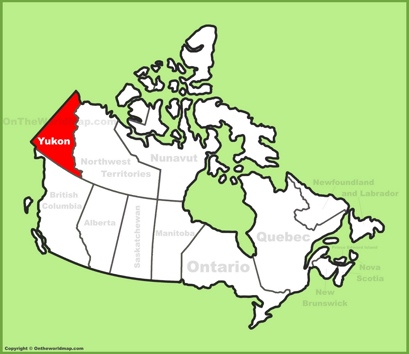
Online Map of Yukon
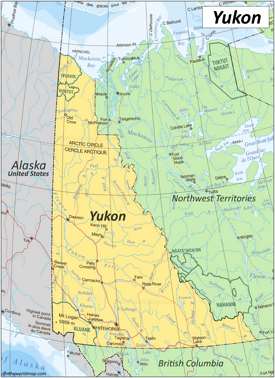
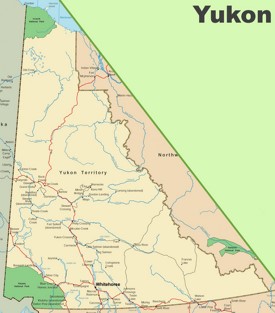
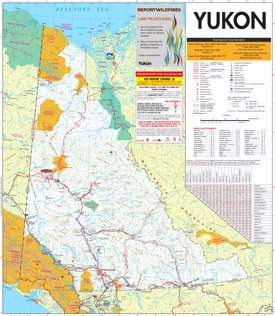
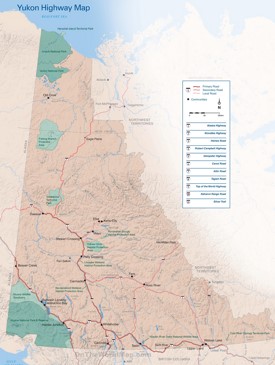
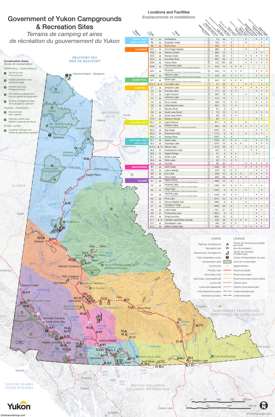
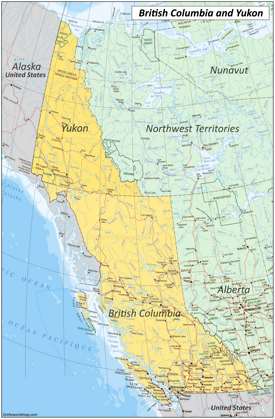
Maps of Yukon and Neighboring Provinces

About Yukon
Yukon is Canada's westernmost territory, located in the northwestern corner of the country. It is bordered by Alaska to the west, British Columbia to the south, and the Northwest Territories to the east. The territory covers an area of approximately 482,443 square kilometers, making it larger than many countries yet remaining one of the most sparsely populated regions in North America.
The capital and largest city is Whitehorse, which houses roughly three-quarters of the territory's entire population. The city sits along the banks of the Yukon River, from which the territory derives its name.
Geography and Climate
Yukon's landscape is characterized by rugged mountains, vast forests, and numerous rivers and lakes. The territory contains Canada's highest peak, Mount Logan, which stands at 5,959 meters above sea level within Kluane National Park and Reserve. The park, designated as a UNESCO World Heritage Site, features extensive icefields and glaciers.
The climate is subarctic, with long, cold winters and short, mild summers. Winter temperatures can drop below -40°C in many areas, while summer temperatures occasionally reach 30°C. The territory experiences significant variations in daylight hours throughout the year. In summer, some regions experience nearly 24 hours of daylight, a phenomenon known as the midnight sun, while winter brings extended periods of darkness.
History
Indigenous peoples, including the First Nations groups, have inhabited the Yukon region for thousands of years. Archaeological evidence suggests human presence dating back at least 20,000 years. The primary Indigenous groups include the Gwitchin, Han, Kaska, Northern Tutchone, Southern Tutchone, Tagish, Tlingit, and Upper Tanana peoples.
The territory gained international attention during the Klondike Gold Rush of 1896-1899. The discovery of gold in Bonanza Creek triggered one of the largest gold rushes in history, with an estimated 100,000 prospectors attempting to reach the Klondike goldfields. Only about 30,000 to 40,000 actually completed the journey. This event transformed the region, leading to the establishment of Dawson City, which briefly became the largest Canadian city west of Winnipeg. The gold rush era effectively ended by 1899, though mining continues to play a role in the territory's economy.
Yukon became a separate territory in 1898, carved out of the Northwest Territories. The construction of the Alaska Highway during World War II marked another significant development period, improving access to the previously isolated region.
Demographics and Population
As of recent census data, Yukon's population is approximately 45,000 people. The population density is among the lowest in the world, at roughly 0.1 persons per square kilometer. The demographic composition includes:
- Indigenous peoples comprising roughly 20-25% of the population
- People of European descent forming the majority
- Growing communities of immigrants from various countries
The median age is relatively young compared to other Canadian jurisdictions, partly due to the transient nature of some residents who come for work opportunities.
Economy
Mining remains the cornerstone of Yukon's economy, with significant operations extracting gold, silver, lead, and zinc. The territory produces a substantial portion of Canada's silver and leads in certain mineral categories. Tourism represents the second-largest economic sector, attracting visitors interested in wilderness experiences, northern lights viewing, and historical sites related to the gold rush.
The government sector provides employment for a significant portion of the workforce. Other economic activities include forestry, trapping, and small-scale agriculture in limited areas. The territory has no sales tax, which distinguishes it from most Canadian provinces.
Wildlife and Environment
Yukon supports diverse wildlife populations adapted to the northern environment. Large mammals include grizzly bears, black bears, moose, caribou, Dall sheep, mountain goats, and wolves. The territory is home to the Porcupine caribou herd, one of North America's largest caribou populations, which migrates between Yukon, Alaska, and the Northwest Territories.
Bird species number over 250, including migratory birds that travel from as far as South America to breed in the northern summer. The rivers support populations of chinook, coho, and sockeye salmon, which undertake remarkable spawning migrations.
Protected areas cover significant portions of the territory, including national parks, territorial parks, and wildlife preserves established to conserve ecosystems and provide habitat for native species.
Transportation and Infrastructure
The Alaska Highway serves as the primary road connection to the rest of Canada and to Alaska. The highway spans 2,232 kilometers from Dawson Creek, British Columbia, to Delta Junction, Alaska, with a substantial portion running through Yukon. The Klondike Highway connects Whitehorse to Dawson City and continues to Alaska.
Air transportation is crucial for accessing remote communities. Erik Nielsen Whitehorse International Airport provides connections to southern Canadian cities and serves as a hub for smaller aircraft serving outlying settlements. Several communities are accessible only by air for much of the year, though winter roads on frozen rivers and lakes provide seasonal access to some locations.
Education and Culture
Yukon College, recently granted university status and renamed Yukon University, offers post-secondary education programs. The institution provides both academic and vocational training, with programs tailored to northern needs and circumstances.
Cultural institutions preserve and present the territory's heritage. The MacBride Museum in Whitehorse displays artifacts and exhibits related to Yukon's natural and human history. Dawson City maintains numerous historic buildings from the gold rush era, operating as a living museum of late 19th-century frontier life. Indigenous cultural centers throughout the territory showcase First Nations traditions, art, and history.
The territory celebrates various festivals, including the Yukon Quest, an international sled dog race covering 1,600 kilometers between Whitehorse and Fairbanks, Alaska. This race is considered one of the world's toughest dog sled competitions, traversing remote wilderness in harsh winter conditions.
Government and Politics
Yukon operates under a territorial government structure with powers delegated by the federal government of Canada. The territory has a Legislative Assembly with 19 elected members representing constituencies across the territory. Unlike provinces, territories have no inherent sovereignty and their powers can theoretically be altered by federal legislation, though in practice they exercise substantial autonomy.
The territory elects one member to the Canadian House of Commons and is represented in the Senate. Self-government agreements with several First Nations provide these groups with enhanced control over lands and governance within their traditional territories.
The Facts:| Capital: | Whitehorse |
| Largest city: | Whitehorse |
| Population (Q3 2025): | 48,278[1] |
| Area: | 186,272 sq mi (482,443 sq km) |
| Density: | 0.21/sq mi (0.08/sq km) |
| Official languages: | English, French |
| Coordinates: | 63°N 135°W |
| Gross domestic product (Total): | C$3.089 billion |
| Gross domestic product (Per capita): | C$75,141 |
| Time zone: | UTC−07:00 |
| Canadian postal abbr.: | YT |
| Postal code prefix: | Y |
| ISO 3166 code: | CA-YT |
| Flower: | Fireweed |
| Tree: | Subalpine fir |
| Bird: | Common raven |
| Official Website: | yukon.ca |
Google Map of Yukon
List of municipalities in Yukon
- Carmacks
- Dawson
- Faro
- Haines Junction
- Mayo
- Teslin
- Watson Lake
- Whitehorse
Main sights in Yukon
- Kluane National Park and Reserve
- Dawson City
- Tombstone Territorial Park
- Miles Canyon
- Takhini Hot Springs
- Yukon Wildlife Preserve
- SS Klondike National Historic Site
- Midnight Dome
- Emerald Lake
- Dempster Highway
- Top of the World Highway
- Yukon Beringia Interpretive Centre
- MacBride Museum of Yukon History
- Northern Lights Centre
- Ivvavik National Park
- Vuntut National Park
- Chilkoot Trail
- Whitehorse Fish Ladder
- Old Log Church Museum
- Five Finger Rapids
- Carcross Desert
- Montana Mountain
- Fort Selkirk
- Herschel Island Territorial Park
- Bennett Lake
- Kathleen Lake
- Signpost Forest
- Klondike Gold Fields
- Kaskawulsh Glacier
- Whitehorse Rapids
Major Rivers of Yukon
- Yukon River - 1,980 mi (3,190 km)
- Liard River - 693 mi (1,115 km)
- Porcupine River - 569 mi (916 km)
- Peel River - 425 mi (684 km)
- Stewart River - 400 mi (644 km)
- White River - 320 mi (510 km)
- Teslin River - 244 mi (393 km)
- Fortymile River - 165 mi (265 km)
- Hyland River - 162 mi (260 km)
- Nisutlin River - 150 mi (240 km)
- Big Salmon River - 150 mi (240 km)
- Macmillan River - 149 mi (240 km)
- Wind River - 149 mi (240 km)
- Ross River - 140 mi (225 km)
- Frances River - 137 mi (220 km)
- Beaver River - 124 mi (200 km)
- Snake River - 112 mi (180 km)
- Ladue River - 112 mi (180 km)
- Little Salmon River - 106 mi (170 km)
- Klondike River - 99 mi (160 km)
List of the Largest Lakes of Yukon
- Kluane Lake - 158 sq mi (409 km2)
- Teslin Lake - 127 sq mi (330 km2)
- Tagish Lake - 122 sq mi (315 km2)
- Laberge Lake - 112 sq mi (289 km2)
- Frances Lake - 81 sq mi (210 km2)
- Aishihik Lake - 57 sq mi (148 km2)
- Kusawa Lake - 55 sq mi (142 km2)
- Bennett Lake - 37 sq mi (96 km2)
- Marsh Lake - 37 sq mi (96 km2)
- Dezadeash Lake - 22 sq mi (56 km2)
References
1. ^ Population estimates, quarterly. Statistics Canada.Maps of Canada
Provinces and Territories
Cities of Canada
Cities of Canada