
Map of Southern British Columbia
Detailed Map of Southern British Columbia

Description:
This map shows cities, towns, villages, islands, rivers, lakes, highways, major roads, secondary roads, mountains ranges, and national parks in Southern British Columbia.
Size: 3226x1621px / 2.46 Mb
Author: Ontheworldmap.com
You may download, print or use the above map for educational, personal and non-commercial purposes. Attribution is required. For any website, blog, scientific research or e-book, you must place a hyperlink (to this page) with an attribution next to the image used.
Road Map of Southern British Columbia
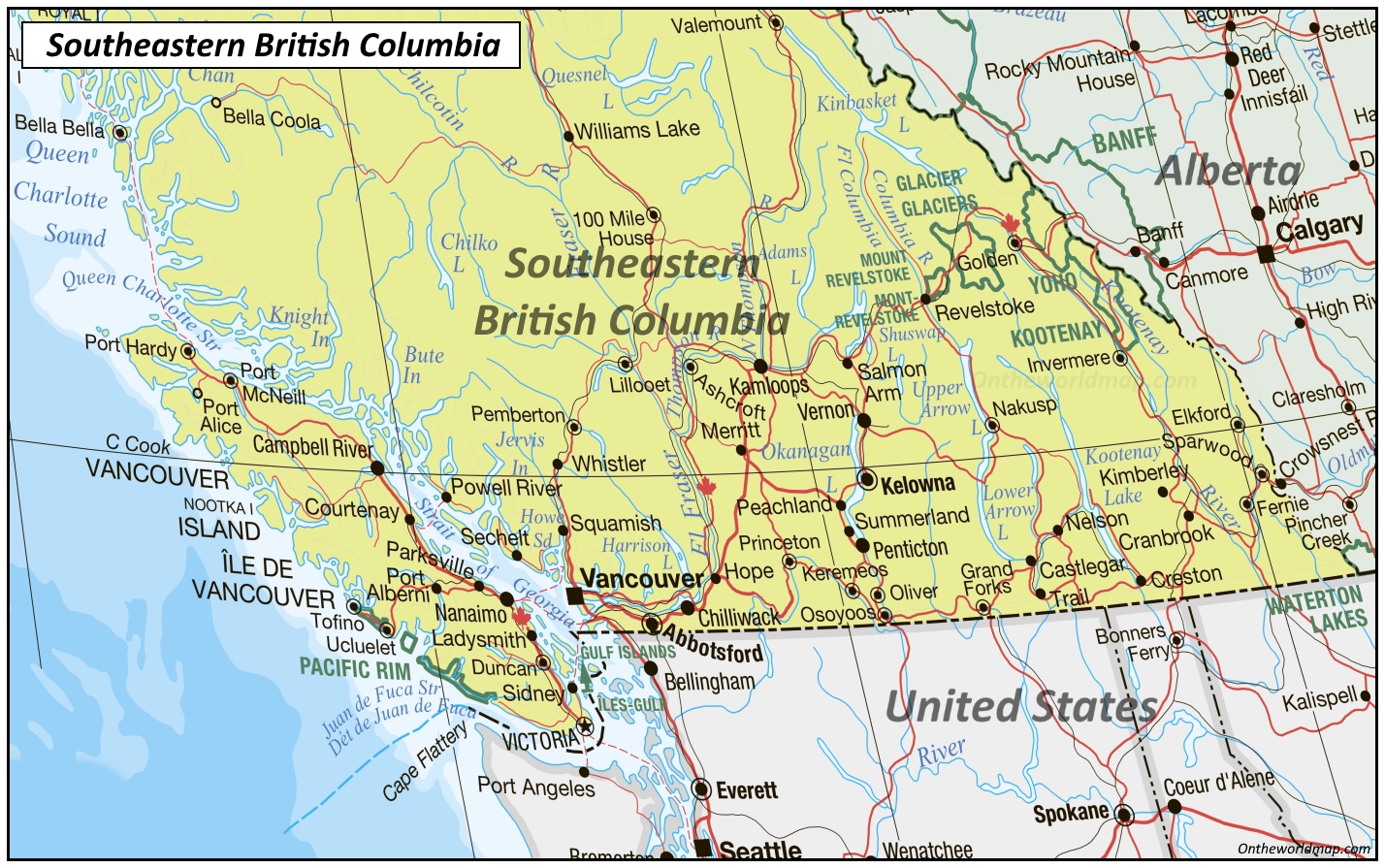
Description:
This map shows cities, towns, province capital, islands, rivers, lakes, Trans-Canada highway, major roads, railways, and national parks in Southern British Columbia.
Size: 1428x895px / 787 Kb
Author: Ontheworldmap.com
You may download, print or use the above map for educational, personal and non-commercial purposes. Attribution is required. For any website, blog, scientific research or e-book, you must place a hyperlink (to this page) with an attribution next to the image used.
About Southern British Columbia
Southern British Columbia, located on Canada's western coast, represents the most populated region of British Columbia province. It stretches from the Pacific Ocean to the Rocky Mountains, bordered by the U.S. states of Washington, Idaho, and Montana to the south. The region includes major urban centers such as Vancouver, the province's largest city, and Victoria, the provincial capital located on Vancouver Island.
The geography of Southern British Columbia is characterized by diverse landscapes. About 75% of the territory is mountainous, with the Coast Mountains forming spectacular backdrops for growing tourism industries. The region boasts 60% forest coverage, while only 5% of the land is suitable for agriculture. The Okanagan Valley, situated in the interior, is Canada's premier wine-producing region and features some of the country's warmest summer temperatures.
Climate varies significantly throughout Southern British Columbia. Coastal areas experience a mild, rainy maritime climate influenced by the warm Kuroshio Current, with winter temperatures rarely dropping below freezing and summer temperatures averaging around 22°C. Interior regions have a drier climate with less than 250 mm of precipitation annually and more extreme temperature variations. The mountain areas receive heavy snowfall, supporting popular ski resorts like Whistler, which hosted events during the 2010 Winter Olympics.
The economy of Southern British Columbia is diversified but traditionally based on natural resources. Forestry and mining remain important sectors, while Vancouver serves as Canada's largest port, facilitating trade particularly with Asian markets. The region has developed a significant film industry, with Vancouver often called "Hollywood North." Tourism plays a crucial economic role, drawing visitors to both urban centers and natural attractions. Agriculture thrives in the Fraser and Okanagan valleys, with the latter known for fruit production and vineyards.
Southern British Columbia features extensive transportation infrastructure, including Vancouver International Airport and a network of highways and ferries connecting Vancouver Island to the mainland. The region is home to several prestigious educational institutions and has attracted significant immigration, resulting in a diverse population with the highest percentage of visible minorities in Canada.
Maps of British Columbia: | Detailed Map of British Columbia | Large detailed map of British Columbia with cities and towns | British Columbia Road Map | British Columbia National Parks Map | Map of Northern British Columbia | Map of British Columbia Coast | Vancouver Island Map
Maps of Canada
Provinces and Territories
Cities of Canada
Cities of Canada