
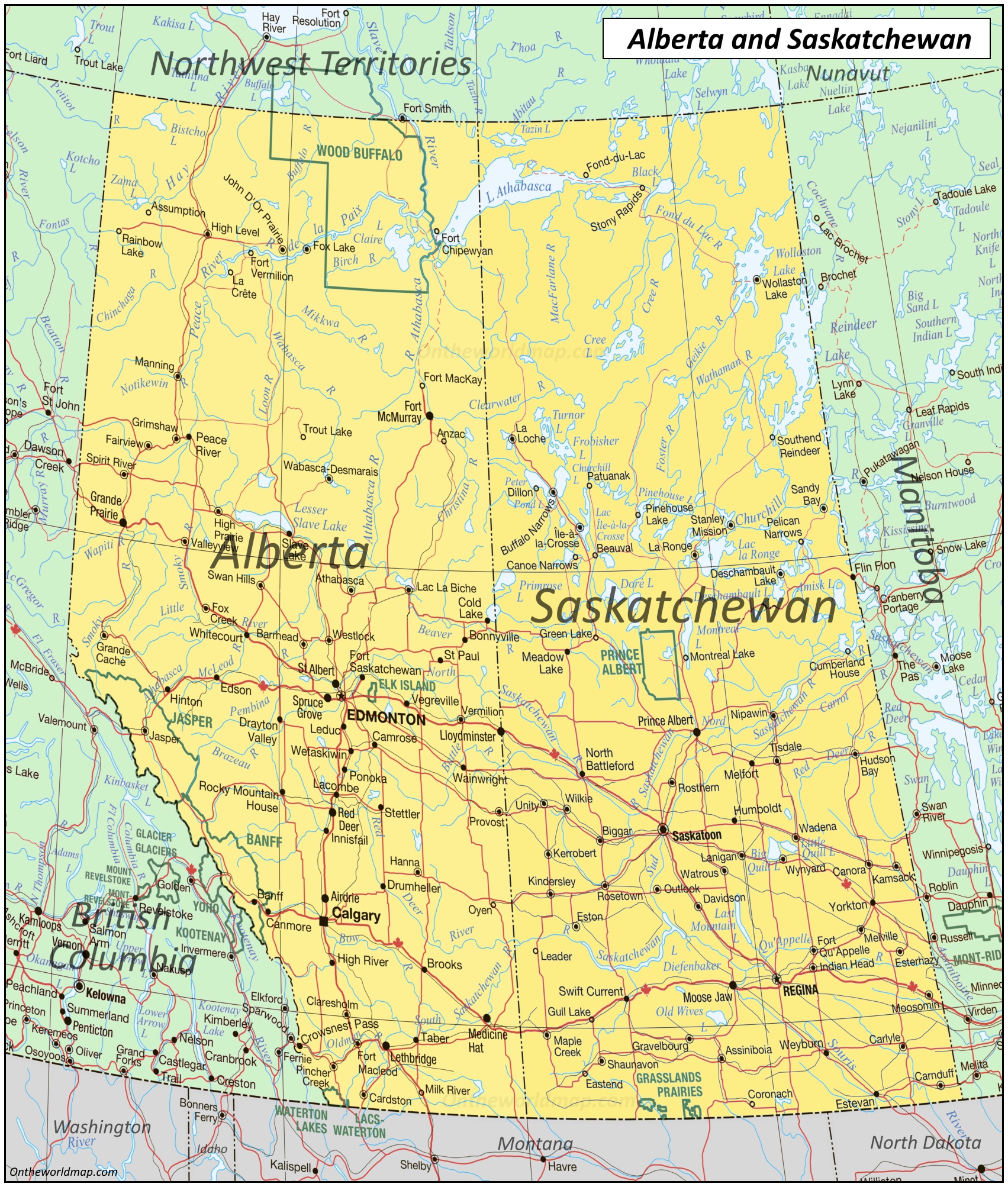
Map of Alberta and Saskatchewan
Description:
This map shows rivers, lakes, cities, towns, villages, parks, highways, main roads, and secondary roads in Alberta and Saskatchewan.
Size: 1703x2006px / 1.62 Mb
Alberta-Saskatchewan Border
The border between Alberta and Saskatchewan runs along the 110th meridian west, extending from the 49th parallel north at the United States border to the 60th parallel north at the Northwest Territories border, a distance of approximately 1,223 kilometers.
Historical Background
The border was established when Alberta and Saskatchewan simultaneously became provinces on September 1, 1905. The 110th meridian was selected as a convenient administrative boundary, following standard surveying practices of using meridians and parallels for provincial and territorial boundaries in western Canada. This artificial boundary divides communities, agricultural lands, and natural features without regard to physical geography or Indigenous territories.
Geography
The southern portion of the border crosses primarily flat to gently rolling prairie grasslands. As the border extends northward, the landscape transitions through parkland and eventually into boreal forest. Several rivers cross the border, including the South Saskatchewan River, Battle River, and North Saskatchewan River in the southern and central sections. In the northern region, the border passes through forested terrain with numerous lakes and wetlands. The relatively flat topography means that land use patterns are often similar on both sides of the border.
Border Communities
Several communities are located directly on or very near the Alberta-Saskatchewan border. Lloydminster is unique as a city that straddles the border, with portions in both provinces. The city operates under a special charter that allows coordinated municipal governance despite spanning two provinces. Other Alberta communities near the border include Provost, Wainwright, Vermilion, and Cold Lake. On the Saskatchewan side, communities such as Unity, Wilkie, and Lloydminster (Saskatchewan portion) are located near the border. These border communities often have strong economic and social connections across the provincial boundary.
Economic Integration
The economies of border regions in both provinces share many characteristics. Agriculture dominates the southern and central border regions, with similar crops and farming practices on both sides. The oil and gas industry operates extensively in border areas, with extraction activities, pipelines, and service companies functioning across provincial boundaries. Lloydminster serves as a regional hub for the heavy oil industry. Labor markets in border communities are integrated, with workers frequently commuting across the border for employment. Retail trade and services in border communities draw customers from both provinces.
Transportation
Multiple highways cross the Alberta-Saskatchewan border at various points. Highway 1, the Trans-Canada Highway, crosses near the Saskatchewan community of Saskatchewan Landing. Highway 16, the Yellowhead Highway, crosses near Lloydminster. Other provincial highways connecting the two provinces include Highway 41, Highway 17, and numerous secondary highways. Railway lines cross the border at several locations, operated by Canadian Pacific Railway and Canadian National Railway, transporting grain, petroleum products, and other commodities.
Provincial Differences
Despite the integrated nature of border regions, several policy differences exist between the provinces. Tax rates, particularly provincial sales tax, differ significantly, with Saskatchewan imposing a provincial sales tax while Alberta does not. This creates cross-border shopping patterns, particularly in Lloydminster. Labor laws, education systems, and healthcare administration operate under separate provincial jurisdictions. Time zones differ along much of the border, with Alberta observing Mountain Time and Saskatchewan observing Central Standard Time year-round, not observing daylight saving time. Vehicle registration, driver licensing, and insurance regulations are governed by separate provincial authorities.
Maps of Alberta: Large detailed map of Alberta with cities and towns | Alberta Highway Map | Alberta Road Map | Alberta Tourist Map
Regions of Alberta: Map of Central Alberta | Map of Northern Alberta | Map of Southern Alberta
Alberta and Neighboring Provinces: Map of Alberta and British Columbia | Map of Alberta and the Northwest Territories
You may download, print or use the above map for educational, personal and non-commercial purposes. Attribution is required. For any website, blog, scientific research or e-book, you must place a hyperlink (to this page) with an attribution next to the image used.
Maps of Canada
Provinces and Territories
Cities of Canada
Cities of Canada