
Saint Thomas Map

Description:
This map shows cities, towns, villages, sub-districts, roads, trails, beaches, peaks, buildings, airport, and parks on Saint Thomas Island.
Size: 4135x2156px / 1.61 Mb
Author: Ontheworldmap.com
Map based on the free editable OSM map openstreetmap.org.
Previous version of the map
You may download, print or use the above map for educational, personal and non-commercial purposes. Attribution is required. For any website, blog, scientific research or e-book, you must place a hyperlink (to this page) with an attribution next to the image used.
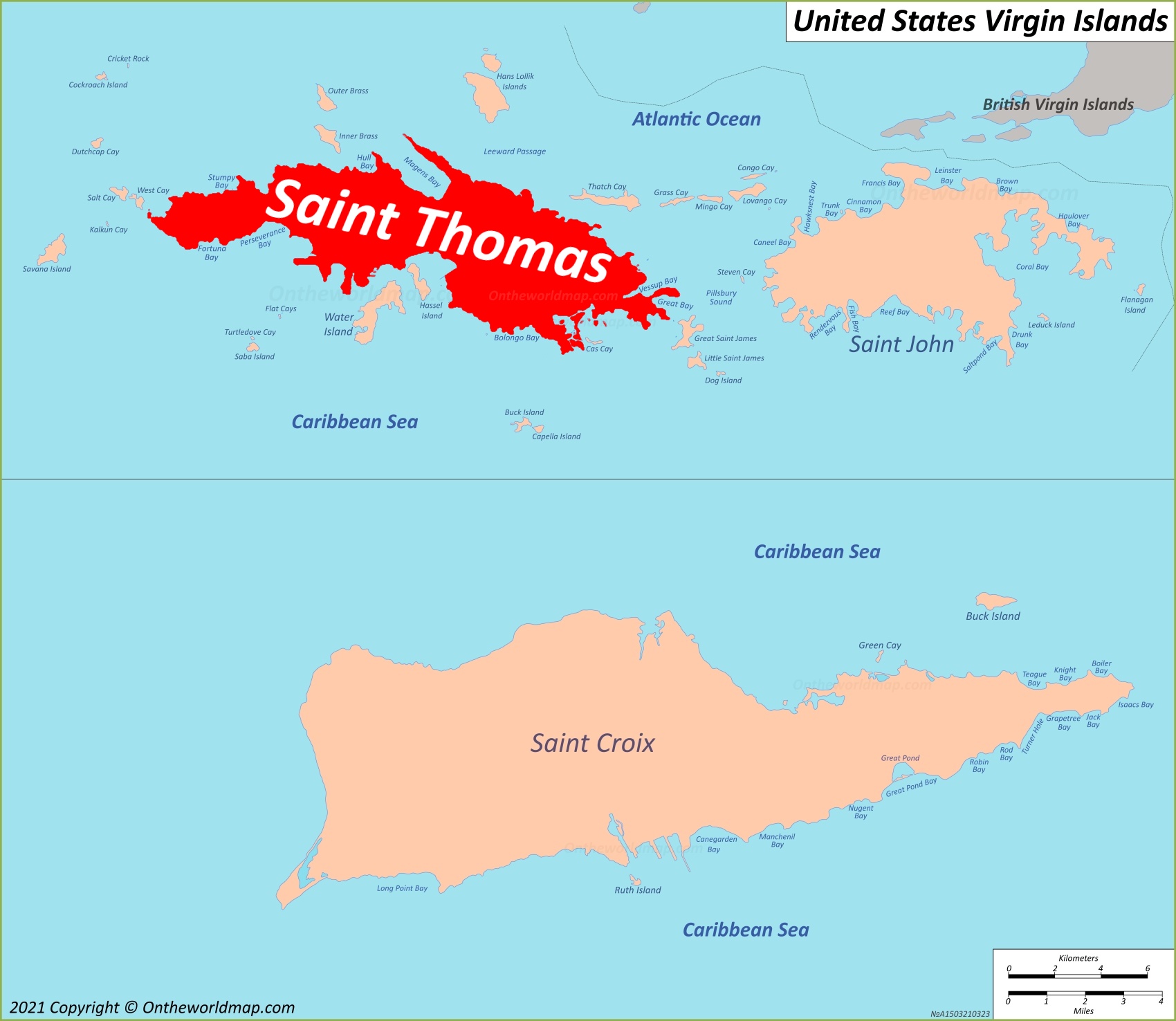
Online Map of Saint Thomas


About Saint Thomas
Saint Thomas is one of the three main islands comprising the United States Virgin Islands in the Caribbean Sea. The island covers approximately 32 square miles (83 square kilometers) and had a population of roughly 42,000 according to the 2020 census. Saint Thomas serves as the capital island of the U.S. Virgin Islands territory, with Charlotte Amalie functioning as both the island's main town and the territorial capital.
The Facts:| Sovereign state: | United States |
| Territory: | U.S. Virgin Islands |
| Cities and Towns: | Charlotte Amalie |
| District: | Saint Thomas and Saint John |
| Sub-districts: | Charlotte Amalie, East End, Northside, Southside, Tutu, Water Island, West End |
| Population (2020): | 42,261 |
| Density: | 509.2/sq mi (1318.8/sq km) |
| Area: | 32 sq mi (83 sq km) |
| Coordinates: | 18°20′N 64°55′W |
| Racial/ethnic groups (2020): |
|
| Highest elevation: | Crown Mountain - 1,555 ft (474 m) |
Geography and Topography
The island stretches approximately 13 miles long and 4 miles wide. Saint Thomas features a mountainous interior with numerous ridges and valleys. Crown Mountain, the island's highest peak, reaches 1,556 feet above sea level. The coastline includes multiple natural harbors, with Charlotte Amalie Harbor being one of the finest deepwater harbors in the Caribbean.
Saint Thomas experiences a tropical climate with year-round warm temperatures averaging between 77°F and 82°F. The island receives approximately 40 inches of rainfall annually, with the driest months typically occurring between February and April. Hurricane season extends from June through November, with the island positioned in a region that experiences tropical storm activity.
Historical Development
Ciboney, Taíno, and Carib peoples successively inhabited Saint Thomas before European arrival. Christopher Columbus sighted the island during his second voyage in 1493. Denmark-Norway established a colony on Saint Thomas in 1666, making it one of the earliest Danish colonial settlements in the Americas. The Danish West India Company developed Charlotte Amalie as a major trading port during the colonial period.
The island's strategic location made Charlotte Amalie an important center for Caribbean commerce during the 17th and 18th centuries. The port gained reputation as a haven for privateers and traders. In 1724, Denmark declared Charlotte Amalie a free port, attracting merchants from various nations. The United States purchased Saint Thomas and the other Danish West Indies for $25 million in 1917, finalizing the Transfer Day on March 31, 1917.
Charlotte Amalie
Charlotte Amalie, named after a Danish queen, serves as the capital of the U.S. Virgin Islands. The town was founded in 1666 and developed around its natural harbor. Historic buildings from the colonial era remain throughout the downtown area, including Fort Christian, completed in 1680, which stands as the oldest structure in the U.S. Virgin Islands. The fort now operates as a museum documenting the islands' history.
The Emancipation Garden in Charlotte Amalie commemorates the 1848 emancipation of enslaved people in the Danish West Indies. Governor Peter von Scholten declared immediate emancipation on July 3, 1848, following a peaceful protest by enslaved individuals. The town features numerous historic synagogues, including the St. Thomas Synagogue, built in 1833, which is the second-oldest synagogue in the Western Hemisphere and the oldest synagogue in continuous use under the American flag.
Economy
Tourism represents the cornerstone of Saint Thomas's economy. Cyril E. King Airport provides international air service, serving as the main aviation gateway for the U.S. Virgin Islands. The Crown Bay and Havensight cruise ship terminals accommodate multiple large vessels daily during peak season, with Charlotte Amalie ranking among the Caribbean's busiest cruise ports. The territory's duty-free status attracts shoppers seeking jewelry, electronics, liquor, and other goods at reduced prices.
The financial services sector maintains a presence on Saint Thomas, with several international banks and insurance companies operating offices. Light manufacturing exists in limited capacity, primarily producing rum and other local products. The University of the Virgin Islands maintains its administrative offices and one of its two campuses on Saint Thomas, contributing to the local economy and providing higher education opportunities.
Transportation and Infrastructure
Cyril E. King Airport, located on the island's western end, opened in 1953 and handles both domestic and international flights. The airport serves approximately 1.5 million passengers annually. A ferry system connects Saint Thomas to Saint John, with passenger ferries departing from both Charlotte Amalie and Red Hook. The Red Hook ferry terminal, located on the eastern end of Saint Thomas, provides the primary connection to Saint John, with trips taking approximately 20 minutes.
The island maintains approximately 125 miles of paved roads. Vehicles drive on the left side of the road, a practice retained from Danish colonial times, despite most vehicles being left-hand drive models imported from the United States mainland. Public transportation consists of both government-operated buses and privately operated taxi vans called "safaris."
Notable Locations
Magens Bay, located on the island's northern coast, extends in a mile-long crescent and consistently ranks among the world's most beautiful beaches. The beach and surrounding 68 acres were donated to the territory in 1946 by Arthur Fairchild for public use. Blackbeard's Castle, built in 1679 as a watchtower named Skytsborg Tower, stands on Government Hill overlooking Charlotte Amalie Harbor. Despite the popular name, no historical evidence connects the tower to the pirate Blackbeard.
Paradise Point offers panoramic views of Charlotte Amalie and the surrounding harbor, accessible via a tramway that opened in 1994. Coral World Ocean Park, an marine park established in 1977, provides educational exhibits and underwater observation areas. The park includes a sea turtle pool, shark encounters, and a underwater observatory located 15 feet below the surface.
The Best Beaches on Saint Thomas Island
- Magens Bay Beach
- Sapphire Beach
- Coki Beach
- Lindquist Beach
- Secret Harbor Beach
- Morningstar Beach
- Brewer's Bay Beach
- Hull Bay Beach
- Vessup Beach
- Honeymoon Beach
- Trunk Bay Beach
- Bolongo Bay Beach
- Cowpet Bay Beach
- Limetree Beach
- Bluebeard's Beach
- Pineapple Beach
- Benner Bay Beach
- Smith Bay Beach
- Dorothea Bay Beach
- Renaissance Beach
Main sights on Saint Thomas Island
- Magens Bay Beach
- Charlotte Amalie
- Coral World Ocean Park
- Paradise Point Skyride
- Blackbeard's Castle
- Fort Christian
- 99 Steps
- Mountain Top
- Drake's Seat
- Sapphire Beach
- Coki Beach
- St. Thomas Synagogue
- Secret Harbor Beach
- Emancipation Garden
- Crown Bay
- Lindbergh Bay
- Hull Bay
- Hassel Island
- Bluebeard's Castle
- Frenchtown
Maps of U.S. Virgin Islands
Islands
Cities