
Saint Croix Map

Description:
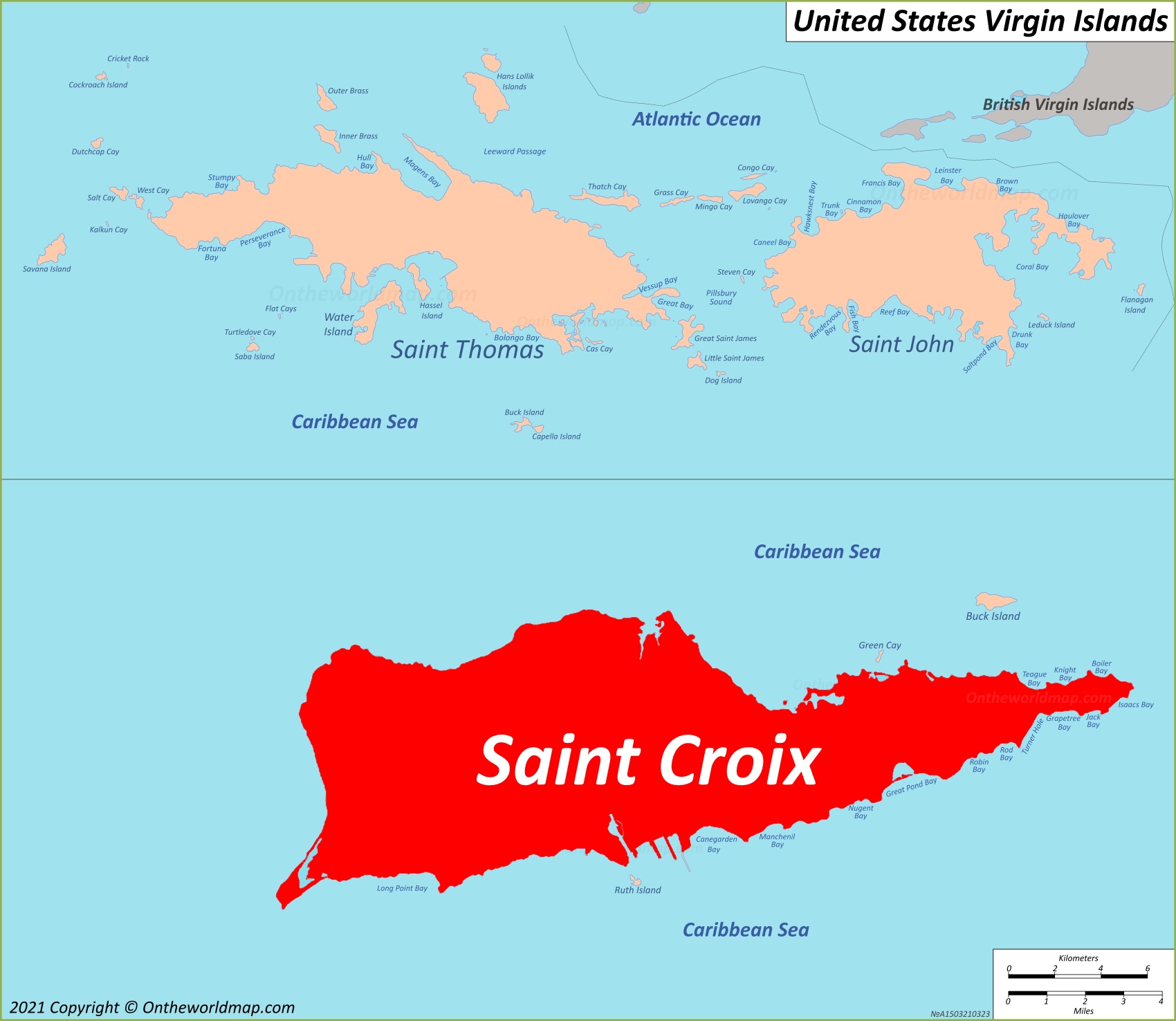
This map shows Sub-districts, towns, villages, roads, ferry routes, beaches, lakes, rivers, peaks, buildings, airport, and parks in Saint Croix.
Size: 4185x1773px / 1.62 Mb
Author: Ontheworldmap.com
Map based on the free editable OSM map openstreetmap.org.
Previous version of the map
You may download, print or use the above map for educational, personal and non-commercial purposes. Attribution is required. For any website, blog, scientific research or e-book, you must place a hyperlink (to this page) with an attribution next to the image used.
Online Map of Saint Croix

About St. Croix
Saint Croix is the largest of the United States Virgin Islands, located in the Caribbean Sea. The island covers approximately 84 square miles (220 square kilometers) and lies about 40 miles south of Saint Thomas. As of the 2020 census, Saint Croix had a population of approximately 41,000 residents, making it the most populous island in the U.S. Virgin Islands territory.
The Facts:| Sovereign state: | United States |
| Territory: | U.S. Virgin Islands |
| Cities and Towns: | Christiansted, Frederiksted |
| District: | Saint Croix |
| Sub-districts: | Anna's Hope Village, Christiansted, East End, Frederiksted, Northcentral, Northwest, Sion Farm, Southcentral, Southwest |
| Population (2020): | 41,004 |
| Density: | 488/sq mi (188.4/sq km) |
| Area: | 84 sq mi (220 sq km) |
| Coordinates: | 17.733509°N 64.783864°W |
| Ethnic groups: | Afro-Caribbean, Puerto Rican, White, Indian, Arab, Asian, Native American, Multiracial |
| Highest elevation: | Mount Eagle - 1,165 ft (355.1 m) |
Geography and Climate
The island measures roughly 28 miles long and 7 miles wide at its widest point. Saint Croix features diverse topography, including rolling hills, tropical forests, and coral reefs. The highest point on the island is Mount Eagle, which rises to 1,165 feet above sea level. The island's coastline includes numerous beaches and two natural harbors.
Saint Croix experiences a tropical climate with temperatures ranging from 77°F to 86°F throughout the year. The island receives an average of 40 inches of rainfall annually, with the wettest months occurring between September and November. Trade winds provide consistent breezes that moderate the tropical temperatures.
History
The island was originally inhabited by the Taíno and Carib peoples before European contact. Christopher Columbus landed on Saint Croix during his second voyage in 1493, naming it Santa Cruz. The island subsequently changed hands multiple times among European colonial powers, including Spain, England, the Netherlands, France, and the Knights of Malta.
Denmark-Norway established control over Saint Croix in 1733, purchasing it from the French West India Company. Under Danish rule, the island became a major sugar producer, relying heavily on enslaved African labor. The Danish West Indies, including Saint Croix, were sold to the United States in 1917 for $25 million in gold, primarily for strategic military purposes during World War I.
Economy
Tourism serves as the primary economic driver for Saint Croix, with visitors attracted to the island's beaches, diving sites, and historical landmarks. The Hovensa oil refinery, once one of the world's largest petroleum refineries, operated on the island's southern coast from 1966 until its closure in 2012. Agriculture, particularly rum production, continues to play a role in the local economy. The Cruzan Rum distillery has operated on the island since 1760.
Towns and Districts
Saint Croix contains two main towns: Christiansted and Frederiksted. Christiansted, located on the northeastern coast, serves as the island's commercial center and former capital of the Danish West Indies. The town features well-preserved colonial architecture, including Fort Christiansvaern, built in 1738. Frederiksted, situated on the western coast, functions as the island's cruise ship port. The town is known for its Victorian-style buildings and Fort Frederik, constructed in 1752.
Culture and Demographics
The island's population reflects a diverse cultural heritage, with the majority of residents being of African descent. English serves as the official language, though many residents also speak Spanish and Crucian, a creole dialect. The island celebrates numerous cultural festivals throughout the year, including the Crucian Christmas Festival, which runs from late December through early January and features parades, calypso competitions, and traditional foods.
Notable Sites
Buck Island Reef National Monument, located 1.5 miles north of Saint Croix, was established in 1961 and encompasses 176 acres of land and surrounding waters. The monument protects an elkhorn coral barrier reef and provides habitat for numerous marine species. Point Udall, the easternmost point of the United States territory, is located on Saint Croix's eastern tip. The Estate Whim Plantation Museum preserves one of the island's best-restored sugar plantations, offering insights into colonial-era agriculture and daily life.
The Best Beaches on Saint Croix
- Sandy Point Beach
- Rainbow Beach
- Buck Island Beach
- Cane Bay Beach
- Protestant Cay Beach
- Shoys Beach
- Jack's Bay Beach
- Isaac Bay Beach
- Tamarind Reef Beach
- Gentle Winds Beach
- Grapetree Bay Beach
- Cramer Park Beach
- Turtle Beach
- West End Beach
- La Grange Beach
- Chenay Bay Beach
- Sand Castle Beach
- Columbus Landing Beach
- Divi Carina Bay Beach
- Pelican Cove Beach
Main sights on Saint Croix
- Christiansted National Historic Site
- Buck Island Reef National Monument
- Point Udall
- Fort Christiansvaern
- Estate Whim Plantation Museum
- Salt River Bay National Historical Park and Ecological Preserve
- Cruzan Rum Distillery
- Frederiksted Pier
- Sandy Point National Wildlife Refuge
- St. George Village Botanical Garden
- Fort Frederik
- Cane Bay
- The Beast (Tank Hill)
- Protestant Cay
- Rainbow Beach
- Judith's Fancy
- Columbus Landing Site
- West End Salt Pond
- Annaly Bay Tide Pools
- Sprat Hall Beach
Maps of U.S. Virgin Islands
Islands
Cities