
Cruz Bay Map
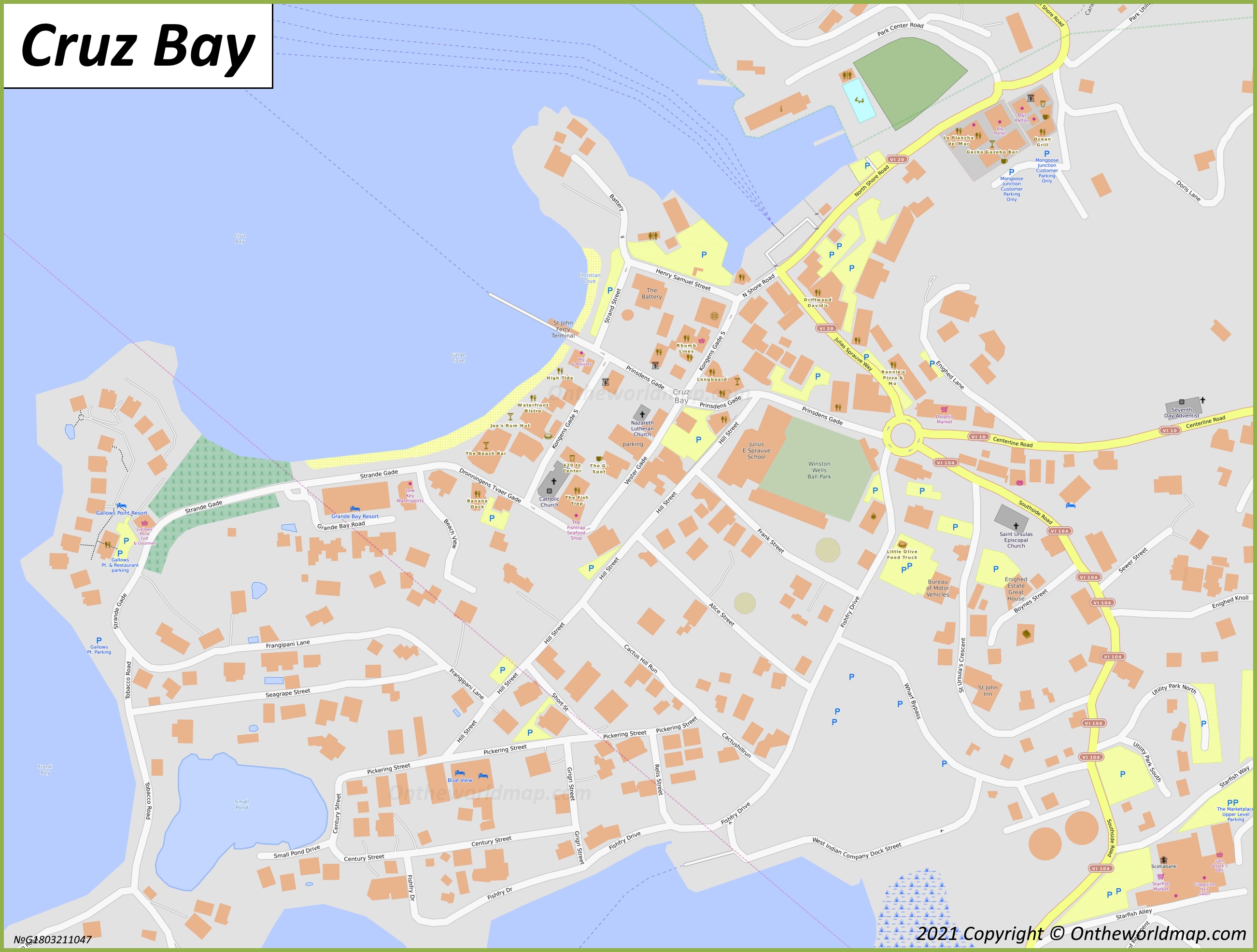
Description:
This map shows streets, trails, houses, buildings, cafes, bars, restaurants, hotels, restrooms, parking lots, shops, churches, points of interest, and parks in City Center Cruz Bay.
Size: 2603x1972px / 980 Kb
Author: Ontheworldmap.com
Map based on the free editable OSM map openstreetmap.org.
You may download, print or use the above map for educational, personal and non-commercial purposes. Attribution is required. For any website, blog, scientific research or e-book, you must place a hyperlink (to this page) with an attribution next to the image used.
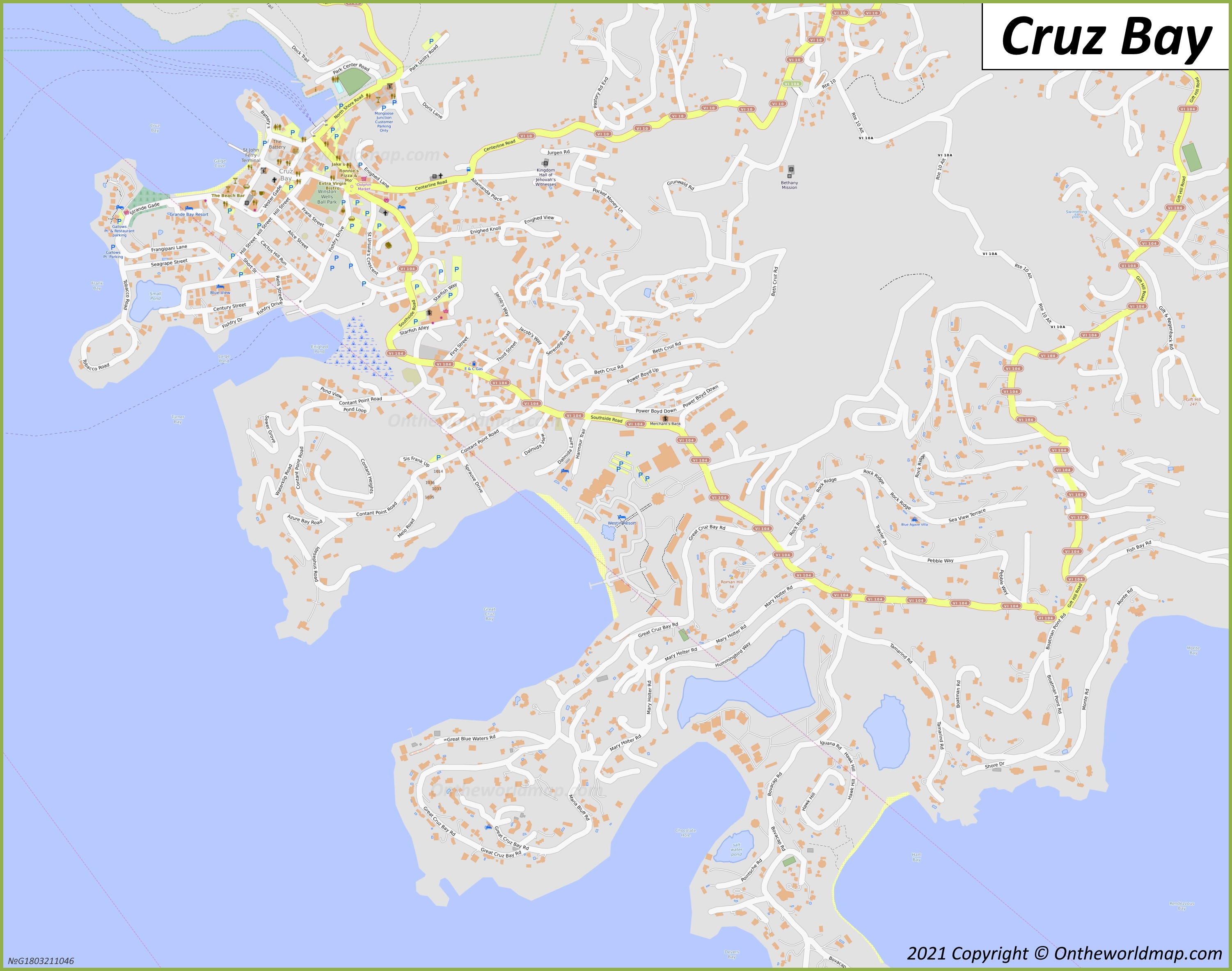
Description:
This map shows streets, roads, beaches, hotels, buildings, parking lots, and parks in Cruz Bay.
Size: 3002x2365px / 1.34 Mb
Author: Ontheworldmap.com
Map based on the free editable OSM map openstreetmap.org.
You may download, print or use the above map for educational, personal and non-commercial purposes. Attribution is required. For any website, blog, scientific research or e-book, you must place a hyperlink (to this page) with an attribution next to the image used.
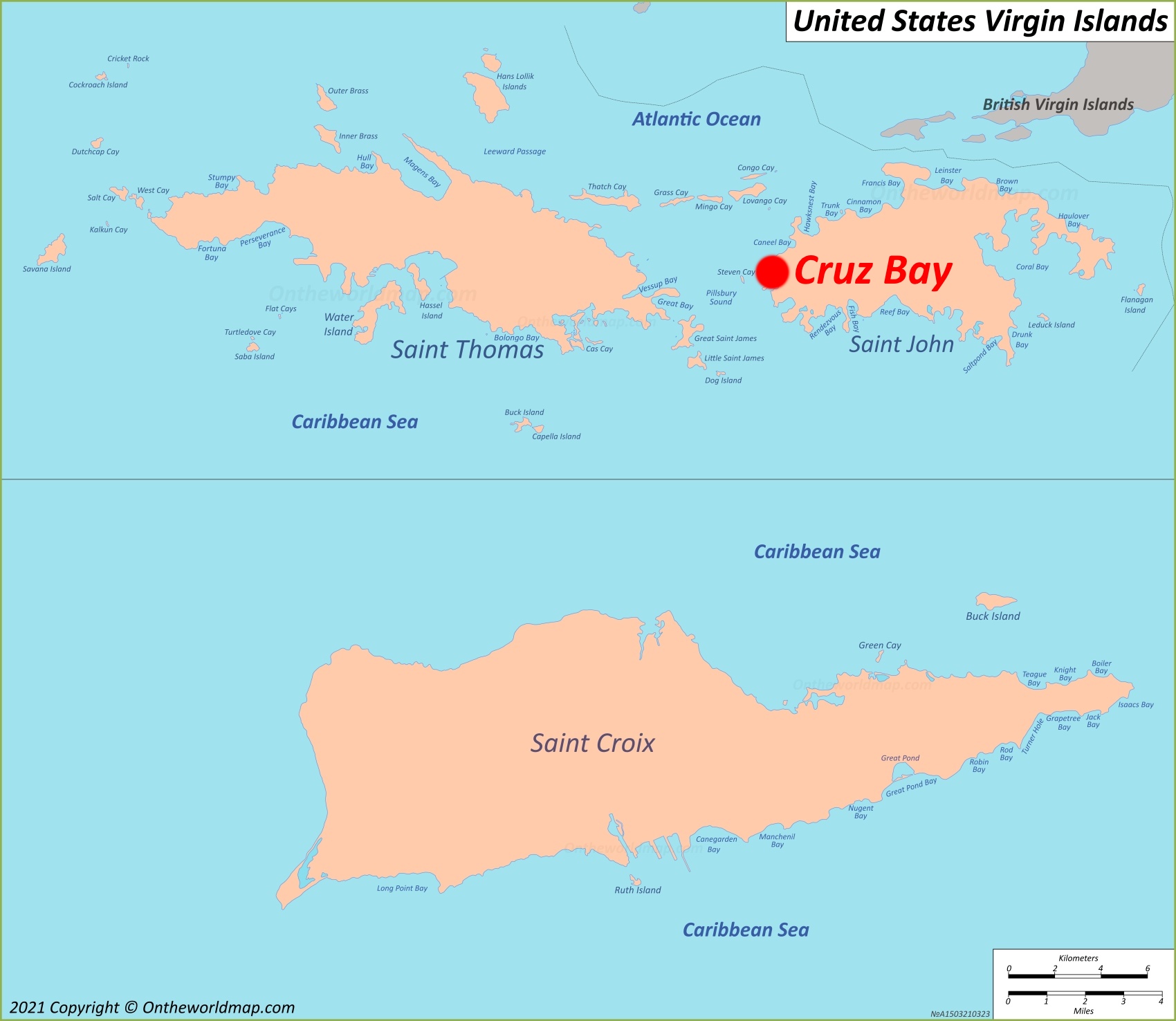
Online Map of Cruz Bay
About Cruz Bay
Cruz Bay is the main town and ferry port on the island of Saint John, U.S. Virgin Islands. As the primary point of entry to Saint John and the location of most commercial activity on the island, Cruz Bay serves as the economic and transportation hub. The town is notably compact, with most businesses and services concentrated in a small area near the waterfront.
The Facts:
| Sovereign state: | United States |
| Territory: | U.S. Virgin Islands |
| Island: | Saint John |
| District: | Saint John |
| Subdistrict: | Cruz Bay, Central |
| Population (2020): | 2,772 |
| Coordinates: | 18.33134°N 64.79375°W |
| Racial/ethnic groups (2020): |
|
| ZIP Codes: | 00830, 00831 |
| Area code(s): | 340 |
Geography and Setting
Cruz Bay is located on the western end of Saint John, positioned to face Saint Thomas across Pillsbury Sound. The natural harbor provides protection for ferries and recreational vessels. The town occupies a relatively small area, with steep hillsides rising quickly from the waterfront. The limited flat land has constrained development and contributed to the town's compact character.
Saint John is the smallest of the three main U.S. Virgin Islands and approximately two-thirds of the island is protected as Virgin Islands National Park, which surrounds Cruz Bay and significantly influences the character of the town and island. The park was established in 1956 following a land donation by Laurance Rockefeller.
History
Cruz Bay's history as a settlement extends back to the Danish colonial period, though it remained relatively undeveloped compared to the larger towns on Saint Thomas and Saint Croix. During the plantation era, Saint John supported numerous sugar plantations, but Cruz Bay itself was primarily a small port settlement. The 1733 slave revolt on Saint John, one of the earliest and longest slave rebellions in the Americas, affected the entire island though Cruz Bay was not a major center of the uprising.
Following the U.S. purchase of the Danish West Indies in 1917, Cruz Bay continued as a quiet settlement. The establishment of Virgin Islands National Park in 1956 marked a turning point, as the park designation protected much of Saint John from development while simultaneously attracting visitors interested in the island's natural beauty and beaches. This transformation shaped Cruz Bay's evolution into a tourism-oriented town.
Transportation
Cruz Bay functions as the primary gateway to Saint John. Passenger ferries operate regularly between Cruz Bay and Charlotte Amalie on Saint Thomas, as well as Red Hook on Saint Thomas's eastern end, providing the main transportation link to the outside world. The ferry terminal is the focal point of activity in Cruz Bay, with ferries arriving and departing throughout the day. Car barges also operate between Saint John and Saint Thomas, transporting vehicles and cargo.
Within Saint John, Cruz Bay serves as the starting point for the island's road network, which is limited given the island's size and the extent of national park land. Taxis, rental jeeps, and safari taxis provide transportation to beaches and other destinations around the island.
Economy and Tourism
Tourism dominates Cruz Bay's economy, driven by the appeal of Virgin Islands National Park and Saint John's pristine beaches. The town contains restaurants, bars, shops, and tour operators concentrated in the small downtown area near the waterfront. Several hotels, inns, and villa rental properties serve visitors, though lodging capacity is limited compared to Saint Thomas or Saint Croix.
Water sports, particularly sailing, snorkeling, and diving, form a significant part of the tourism economy. Several companies offer day sailing trips, kayak tours, and diving excursions to various sites around Saint John and nearby cays. The Trunk Bay beach, located within Virgin Islands National Park and accessible from Cruz Bay, features an underwater snorkeling trail and is one of the most visited beaches in the U.S. Virgin Islands.
Local businesses cater to both tourists and the residential population. The relatively small size of Saint John creates a close-knit community atmosphere, and many businesses are locally owned. The absence of large-scale resort development, limited by the national park and island geography, has preserved Cruz Bay's character as a small Caribbean town.
Community and Culture
Cruz Bay has a permanent residential population that is relatively small compared to the number of visitors the town receives. The community includes people of various backgrounds, including those born on Saint John, transplants from other parts of the Virgin Islands, mainland Americans, and people from various Caribbean islands. English is the primary language.
The town celebrates the annual Saint John Festival, held around June 24 (the feast day of Saint John the Baptist, for whom the island is named). The festival includes parades, music competitions, food fairs, and cultural performances. Other events throughout the year bring together residents and visitors.
Services and Infrastructure
Cruz Bay contains essential services for Saint John's population, including a post office, government offices, a health clinic, and schools. The Myrah Keating Smith Community Health Center provides primary healthcare services. Banking services are available through branches of banks operating in the U.S. Virgin Islands. A public library serves the community.
Infrastructure limitations, including water and electrical systems, present ongoing challenges. Electricity is generated on Saint Thomas and transmitted via underwater cables. Water supply relies on desalination and catchment systems. Waste management services operate to serve both residents and the tourism industry.
Environmental Considerations
The proximity of Virgin Islands National Park shapes many aspects of life in Cruz Bay. Environmental protection is a priority, and regulations aim to preserve the natural environment while accommodating tourism and residential needs. The Virgin Islands National Park Visitor Center in Cruz Bay provides information about the park and coordinates educational programs. Conservation efforts address coral reef protection, sea turtle nesting sites, and terrestrial ecosystems.
The limited development capacity of Saint John means that Cruz Bay faces ongoing challenges in balancing economic needs, environmental protection, and quality of life for residents. The town's small size and the constraints imposed by geography and park boundaries make planning and development particularly complex.
Main sights in Cruz Bay
- Virgin Islands National Park Visitor Center
- Mongoose Junction
- Wharfside Village
- Cruz Bay Beach
- Elaine Ione Sprauve Library and Museum
- Cruz Bay Battery
- Frank Bay
- Gallows Point
- Salomon Beach
- Honeymoon Beach
- Caneel Bay
- Hawksnest Beach
- Peace Hill
- Our Lady of Mount Carmel Catholic Church
Maps of U.S. Virgin Islands
Islands
Cities