
U.S. Virgin Islands Map
Description:
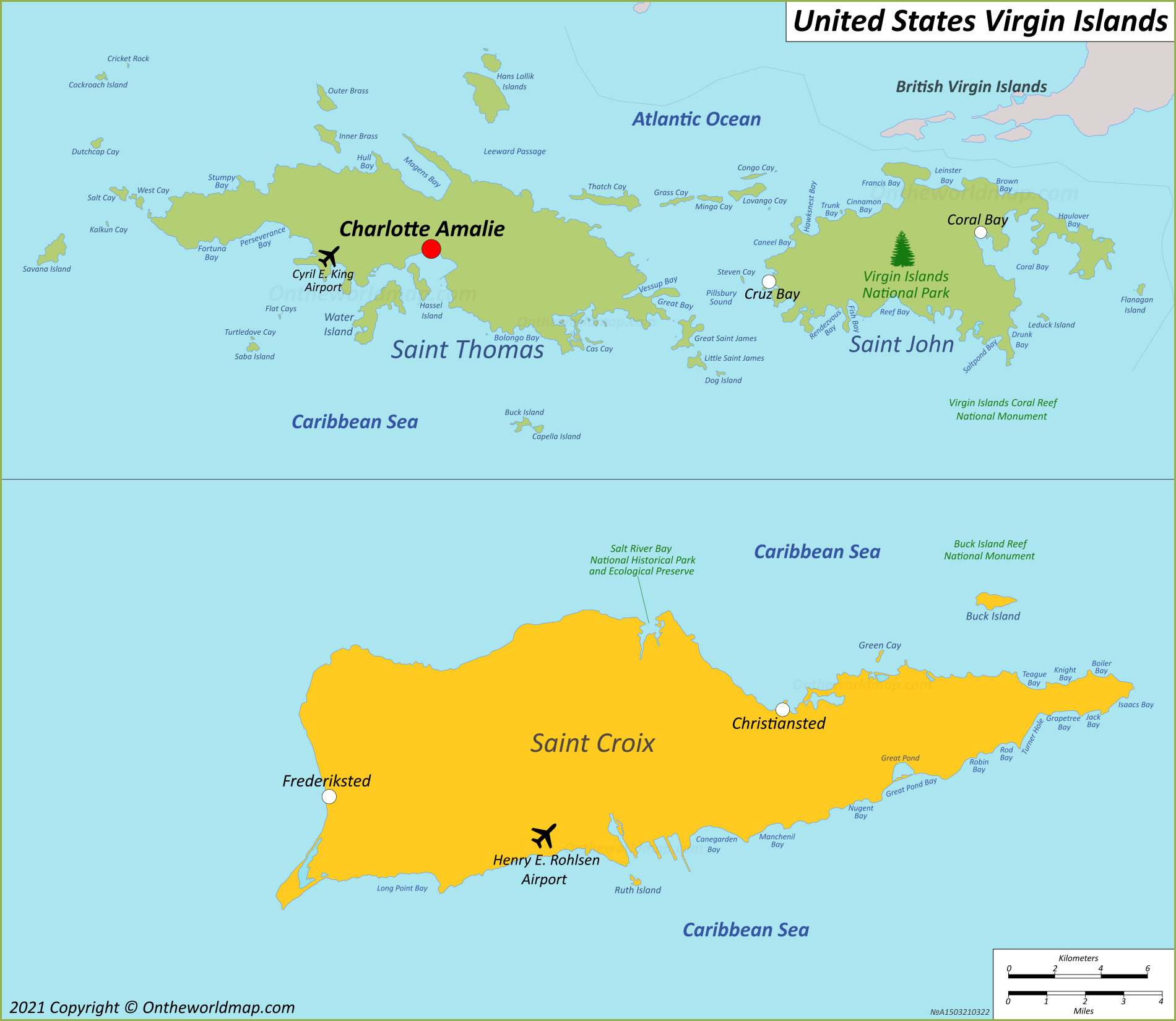
This map shows islands, airport, national park, capital, and major towns on U.S. Virgin Islands.
You may download, print or use the above map for educational, personal and non-commercial purposes. Attribution is required. For any website, blog, scientific research or e-book, you must place a hyperlink (to this page) with an attribution next to the image used.

Online Map of U.S. Virgin Islands


About U.S. Virgin Islands
The United States Virgin Islands (USVI) is an unincorporated territory of the United States located in the Caribbean Sea, approximately 40 miles east of Puerto Rico. The territory consists of three main islands - Saint Croix, Saint John, and Saint Thomas - along with numerous smaller islands and cays. The total land area is approximately 133.73 square miles (346.36 km²). Charlotte Amalie, located on Saint Thomas, serves as the capital and largest city of the territory.
The Facts:| Sovereign state: | United States |
| Capital: | Charlotte Amalie |
| Area: | 134 sq mi (346 sq km) |
| Population: | ~ 87,146 (2020) |
| Official language: | English |
| Religion: |
94.4% Christianity 3.7% no religion 1.9% other |
| Ethnic groups: | 71.4% Black 16.6% White 3.0% other 7.5% multiracial 1.0% Asian |
| Currency: | United States dollar $ (USD) |
| Driving side: | left |
| Calling code: | +1–340 |
| Internet TLD: | .vi |
| Time zone: | UTC−4:00 (AST) |
| Official government website: | www.vi.gov |
Cities, Towns, Districts, and Sub-districts
Cities and Towns: Charlotte Amalie, Christiansted, Cruz Bay, Frederiksted, Anna's Retreat, Charlotte Amalie West.Districts: Saint Croix, Saint Thomas and Saint John.
Sub-districts:
Saint Thomas and Saint John: Charlotte Amalie, East End, Northside, Southside, Tutu, Water Island, West End, Central, Coral Bay, Cruz Bay, East End.
Saint Croix: Anna's Hope Village, Christiansted, East End, Frederiksted, Northcentral, Northwest, Sion Farm, Southcentral, Southwest.
Parks: Buck Island Reef NM, Christiansted NHS, Salt River Bay National Historical Park and Ecological Preserve, Virgin Islands Coral Reef NM, Virgin Islands NP.
History
The islands were originally inhabited by the Ciboney people, followed by the Arawak and Carib peoples. Christopher Columbus encountered the islands during his second voyage to the Americas in 1493. Denmark-Norway established a colonial presence in the 17th century, and the islands became known as the Danish West Indies.
The United States purchased the territory from Denmark for $25 million in gold through the Treaty of the Danish West Indies on March 31, 1917. The strategic acquisition was motivated by military considerations during World War I, particularly concerns about German influence in the Caribbean. Residents were granted U.S. citizenship in 1927. The territory adopted its own constitution in 2009, though it was later repealed.
Geography and Climate
Saint Croix is the largest island, covering 84 square miles, while Saint Thomas spans 32 square miles and Saint John covers 19 square miles. The islands are volcanic in origin and feature mountainous terrain with coastal plains. The highest point is Crown Mountain on Saint Thomas at 1,555 feet (474 meters).
The climate is tropical, moderated by easterly trade winds. Temperatures typically range from 77°F to 82°F (25°C to 28°C) year-round. The territory experiences relatively low rainfall and lies within the Atlantic hurricane belt, with the hurricane season extending from June to November.
Government and Politics
As an unincorporated territory, the U.S. Virgin Islands is under U.S. sovereignty but possesses a degree of self-governance. Residents elect a governor and a unicameral legislature consisting of 15 senators. The territory sends one non-voting delegate to the U.S. House of Representatives. While residents are U.S. citizens, they cannot vote in presidential elections unless they establish residency in a U.S. state.
Economy
Tourism dominates the economy, accounting for approximately 60% of GDP and 60% of employment. The islands receive over 2.5 million visitors annually, attracted by tropical beaches, duty-free shopping, and cruise ship ports. Saint Thomas is one of the busiest cruise ship destinations in the Caribbean.
Other economic activities include rum production, with the Cruzan Rum Distillery operating on Saint Croix, petroleum refining, watch assembly, and light manufacturing. The territory has no personal income tax, though residents pay U.S. federal taxes to the local government rather than the U.S. Treasury.
Demographics
According to the 2020 U.S. Census, the population was 87,146. The population is predominantly of African descent, reflecting the islands' history of slavery and plantation agriculture. English is the official language, though a Virgin Islands Creole English dialect is widely spoken. Christianity is the predominant religion, with various Protestant denominations and Roman Catholicism being most common.
Culture
The culture reflects a blend of African, European, and Caribbean influences. Carnival is celebrated annually with parades, music, and traditional festivities. The islands are known for Crucian and Calypso music traditions. Local cuisine features Caribbean staples including fungi, callaloo, and saltfish, as well as traditional johnnycakes.
Main sights in U.S. Virgin Islands
- Magens Bay Beach
- Trunk Bay
- Virgin Islands National Park
- Buck Island Reef National Monument
- Coral World Ocean Park
- Blackbeard's Castle
- Charlotte Amalie
- Christiansted National Historic Site
- Annaberg Sugar Plantation
- Salt River Bay National Historical Park
- Point Udall
- Fort Christian
- Coki Beach
- Cruz Bay
- Estate Whim Plantation Museum
- Sandy Point National Wildlife Refuge
- Skyline Drive
- Frederiksted
- Mountain Top
- Honeymoon Beach
List of Islands of U.S. Virgin Islands
- Saint Croix
- Saint John
- Saint Thomas
- Cas Cay
- Dog Island
- Great Saint James
- Little Saint James
- Shark Island
- Thatch Cay
- Kalkun Cay
- Savana Island
- Hans Lollik Islands
- Inner Brass
- Outer Brass
- Buck Island
- Capella Island
- Hassel Island
- Saba Island
- Turtledove Cay
- Carvel Rock
- Congo Cay
- Grass Cay
- Lovango Cay
- Mingo Cay
- Steven Cay
- Cinnamon Cay
- Henley Cay
- Ramgoat Cay
- Trunk Cay
- Waterlemon Cay
- Whistling Cay
- Flanagan Island
- Leduck Island
Google Map of United States Virgin Islands