
Tri-Cities Map

Description:
This map shows cities, neighborhoods, streets, roads, rivers, buildings, airport, railways, and parks in Tri-Cities.
Size: 3314x2549px / 2.96 Mb
Author: Ontheworldmap.com
Map based on the free editable OSM map openstreetmap.org.
You may download, print or use the above map for educational, personal and non-commercial purposes. Attribution is required. For any website, blog, scientific research or e-book, you must place a hyperlink (to this page) with an attribution next to the image used.
Tri-Cities Location On The Washington Map

Description:
This map shows where Tri-Cities is located on the Washington Map.
Size: 1500x1060px / 263 Kb
Author: Ontheworldmap.com
You may download, print or use the above map for educational, personal and non-commercial purposes. Attribution is required. For any website, blog, scientific research or e-book, you must place a hyperlink (to this page) with an attribution next to the image used.
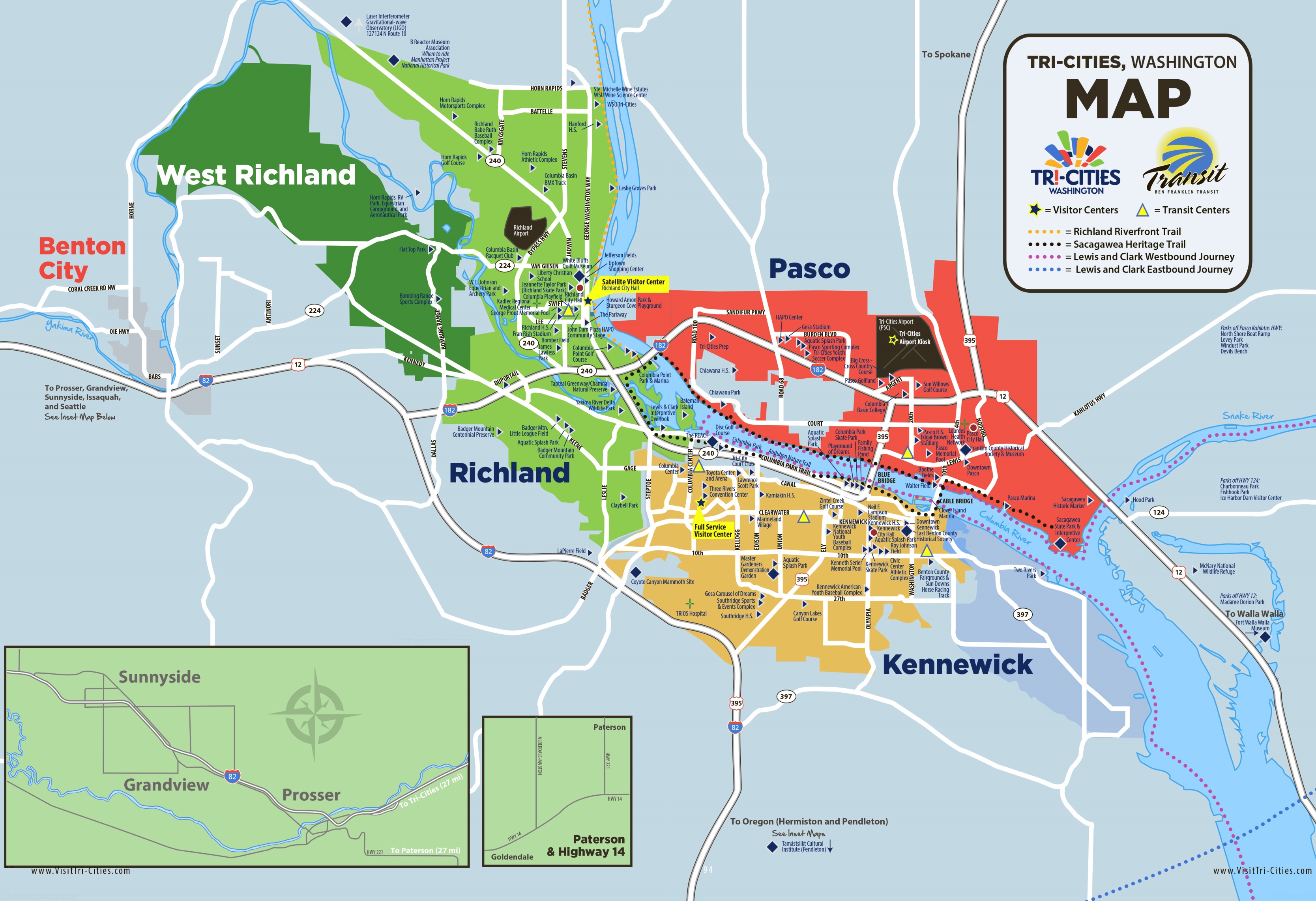
Tri-Cities Tourist Map
Description:
This map shows visitor centers, transit centers, Richland Riverfront Trail, Sacagawea Heritage Trail, Lewis ana Clark Westbound Journey, Lewis ana Clark Eastbound Journey, museums, monuments, points of interest, and tourist atractions in Tri-Cities.
Size: 3335x2284px / 1.7 Mb
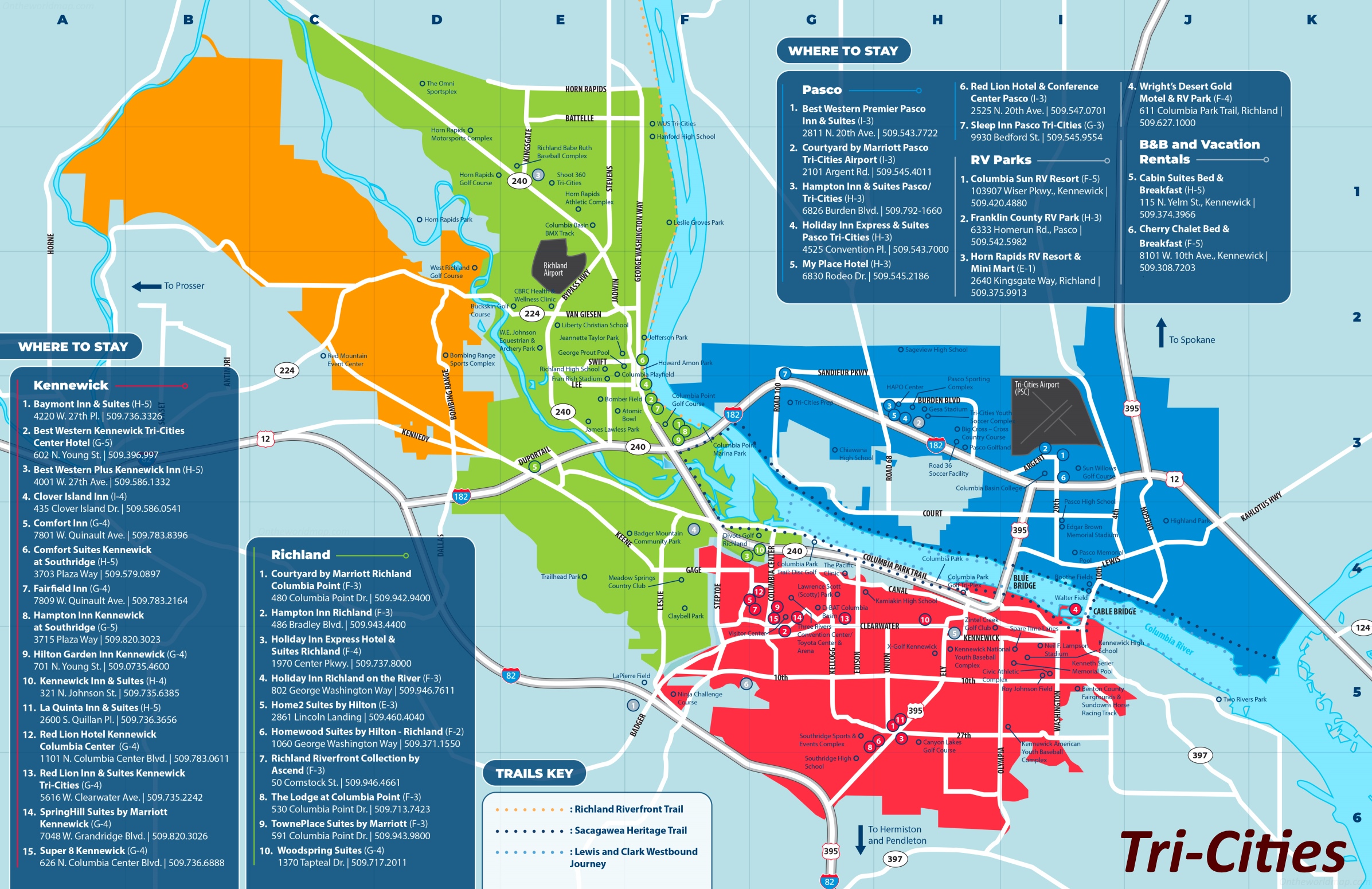
Tri-Cities Hotel Map
Description:
This map shows streets, trails, boardwalk, houses, buildings, cafes, bars, restaurants, hotels, monuments, parking lots, shops, churches, points of interest, and parks in Tri-Cities.
Size: 2393x1551px / 1.26 Mb
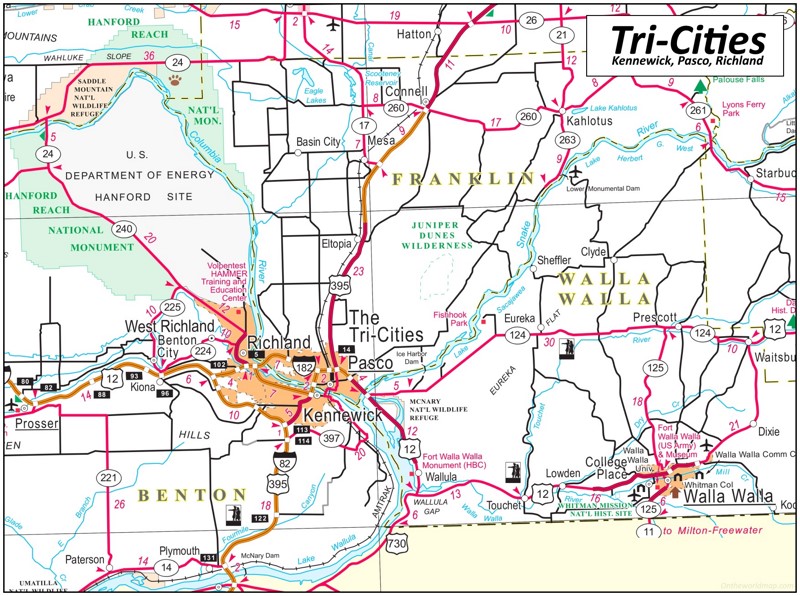
Tri-Cities Area Road Map
Description:
This map shows cities, towns, highways, roads, rivers, and parks in Tri-Cities Area.
Size: 1755x1308px / 927 Kb
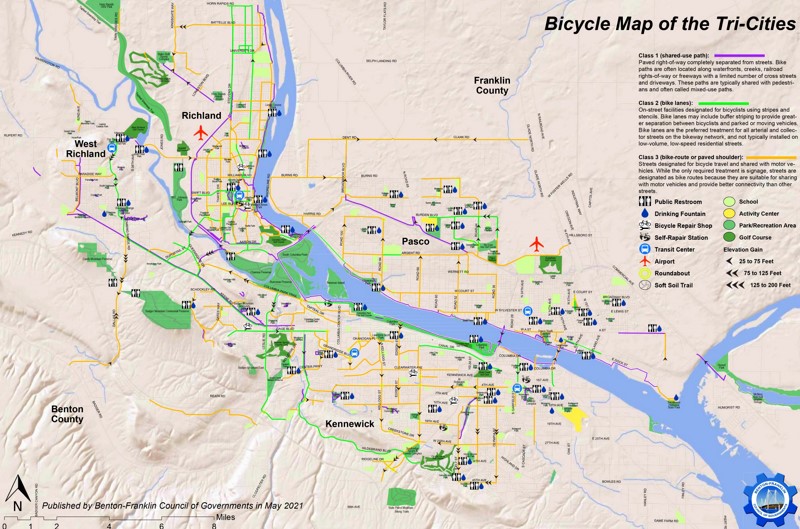
Tri-Cities Bike Map
Description:
This map shows cities, towns, highways, roads, rivers, and parks in Tri-Cities Area.
Size: 3265x2158px / 2.19 Mb

Online Map of Tri-Cities
Maps of Tri-Cities
Tri-Cities Wine Map

WSU Tri-Cities Campus Map

Tri-Cities Airport Map

Kennewick, Pasco, and Richland Maps
Kennewick Maps

Pasco Maps

Richland Maps

About Tri-Cities
The Tri-Cities is a metropolitan area in southeastern Washington State comprising three closely connected cities: Kennewick, Pasco, and Richland. Located at the confluence of the Yakima, Snake, and Columbia rivers, the region has a combined population exceeding 300,000 in the metropolitan statistical area. The Tri-Cities represents the largest metropolitan area in eastern Washington and serves as a regional center for commerce, healthcare, and education.
Geography and Climate
The Tri-Cities is situated in the Columbia Basin at approximately 400 feet elevation, where the Yakima River joins the Columbia River and the Snake River enters from the east. The area is characterized by a semi-arid climate with hot, dry summers and cool winters. Annual precipitation averages only about 7-8 inches, necessitating irrigation for agriculture and landscaping. The Columbia River provides water resources and recreational opportunities.
The landscape consists of desert terrain with sagebrush, native grasses, and areas transformed by irrigation into productive agricultural land. Surrounding hills and bluffs provide scenic vistas. Summer temperatures frequently exceed 90°F (32°C), while winter temperatures occasionally drop below freezing.
History
The area was inhabited by Native American tribes, including the Wanapum and Yakama, for thousands of years. European-American settlement began in the late 19th century, focused on agriculture and river transportation. The region remained relatively small until World War II, when the federal government selected the area for the Hanford Site, a secret facility for plutonium production as part of the Manhattan Project. This development transformed the Tri-Cities from agricultural communities into a significant urban area.
Richland was constructed as a government town to house Hanford workers. The population grew rapidly during and after the war. Following the war, Hanford continued operations during the Cold War, producing plutonium for nuclear weapons. The site employed tens of thousands of workers and drove regional economic development for decades.
Economy
The economy has historically been dominated by the Hanford Site and related federal government activities. Today, the site is primarily focused on environmental remediation, making it one of the largest nuclear cleanup efforts in the world. The Department of Energy, contractors, and related industries employ thousands.
Agriculture remains economically significant. The region produces wine grapes, potatoes, onions, cherries, apples, and other crops. The Columbia Valley wine region has expanded dramatically, with numerous wineries attracting tourism. Other economic sectors include healthcare, retail, food processing, and professional services. The Pacific Northwest National Laboratory (PNNL), a Department of Energy research facility in Richland, conducts scientific research and employs scientists and engineers.
Demographics
The Tri-Cities has a diverse population with a significant Hispanic and Latino community, comprising approximately 30% of residents. The area has experienced steady population growth, driven by employment opportunities and relatively affordable housing compared to Western Washington. The population is generally younger than the state average, influenced by employment in scientific and technical fields. Educational attainment levels are high, particularly in Richland, due to the concentration of scientists, engineers, and technical professionals associated with Hanford and PNNL.
Transportation and Infrastructure
Interstate 182 and U.S. Route 395 serve as major transportation routes. State Route 240 connects the three cities and provides access to the Hanford Site. The Tri-Cities Airport (PSC) offers commercial air service. The Columbia River is navigable and supports barge transportation for agricultural products and other cargo. Public transportation is provided by Ben Franklin Transit, which operates bus service throughout the area.
Recreation and Quality of Life
The region offers abundant outdoor recreation opportunities. The Columbia River provides boating, fishing, water skiing, and jet skiing. Parks line the riverfront, including the extensive Columbia Park in Kennewick and Howard Amon Park in Richland. The area features numerous golf courses, taking advantage of the dry climate. Wine tourism has grown substantially, with over 200 wineries in the greater Columbia Valley region. The Tri-Cities maintains a relatively low cost of living and experiences significant sunshine, averaging over 300 days per year.
Challenges
The region faces challenges related to Hanford Site cleanup, which will continue for decades. Environmental concerns include groundwater contamination and the management of radioactive waste. Economic diversification beyond government employment remains an ongoing objective. Water resources management is critical in the arid climate.
The Facts:| State: | Washington |
| County: | Benton, Franklin |
| Population (2023): | 244,036 |
| Metropolitan population (2023): | 314,253 |
| Area: | 109 sq mi (282.2 sq km) |
| Coordinates: | 46°13′25″N 119°08′09″W |
| ZIP Codes: | 99301, 99302, 99323, 99336, 99337, 99338, 99352, 99353, 99354 |
| Area code(s): | 509 |
| FIPS code: | 53-35275, 53-53545, 53-58235 |
| GNIS feature ID: | 2410184, 2411381, 2410937 |
| Tri-Cities Visitor and Convention Bureau Website: | www.visittri-cities.com |
List of Cities
KennewickPasco
Richland
Main sights in Tri-Cities
- Columbia River
- Sacagawea Heritage Trail
- REACH Museum
- Howard Amon Park
- Columbia Park
- Bateman Island
- Manhattan Project National Historical Park
- Chamna Natural Preserve
- Cable Bridge
- Badger Mountain
- Leslie Groves Park
- Toyota Center
- Gesa Stadium
- Hanford Reach National Monument
- Two Rivers Heritage Museum
- Columbia Center Mall
- Candy Mountain
- Chiawana Park
- Riverstone at Columbia Point
- Blue Bridge (Pioneer Memorial Bridge)
How to Get to Tri-Cities
By Air
The closest airport is Tri-Cities Airport (PSC) in Pasco, which offers flights from major cities.
- Direct flights available from Seattle, Portland, Denver, and Las Vegas
- Car rental services available at the airport
- Taxi and ride-sharing services to downtown areas
By Car
The Tri-Cities is accessible via several major highways:
- Interstate 82 - Primary north-south route
- US Highway 395 - Connects to Spokane and other eastern Washington cities
- State Route 240 - Local connector between the three cities
Driving distances:
- From Seattle: approximately 3.5 hours (214 miles)
- From Portland: approximately 3 hours (180 miles)
- From Spokane: approximately 2.5 hours (144 miles)
By Bus
Greyhound Lines provides bus service to the Tri-Cities area with stops in Pasco and Richland.
By Train
Currently, there is no passenger rail service directly to the Tri-Cities area.
U.S. Maps
Cities of USA
States of USA
States of USA