
Map of Alberta, Saskatchewan, and Manitoba
Description:
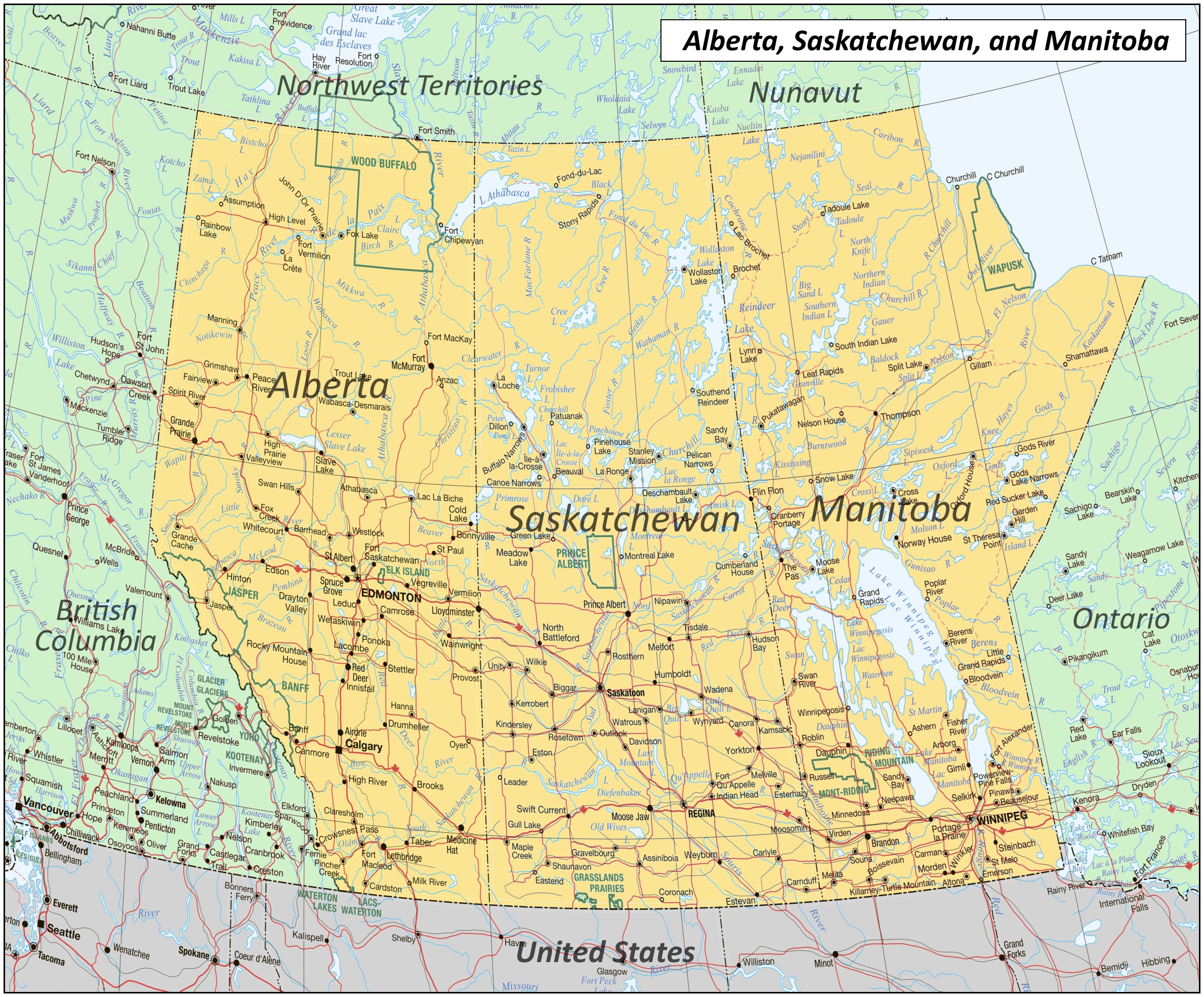
This map shows cities, towns, rivers, lakes, parks, highways, Trans-Canada highway, and main roads in Alberta, Saskatchewan, and Manitoba (Canadian Prairies).
Size: 2379x1969px / 2.17 Mb
Author: Ontheworldmap.com
The Prairie Provinces: Alberta, Saskatchewan, and Manitoba
The Prairie Provinces comprise three Canadian provinces located in the western region of the country: Alberta, Saskatchewan, and Manitoba. These provinces share similar geographic, economic, and cultural characteristics, forming a distinct region within Canada's confederation. Collectively, they cover approximately 1.96 million square kilometers and are home to over 7.8 million residents as of 2026.
Geographic Features
The region is characterized by vast flatlands, rolling hills, and extensive agricultural areas. The Canadian Prairies stretch from the Rocky Mountains in the west to the Canadian Shield in the east. Alberta, the westernmost province, contains both prairie land and significant mountainous terrain along its western border. Saskatchewan is predominantly flat with few natural boundaries. Manitoba features prairie land in the south and transitions to boreal forest and tundra in the north, with Hudson Bay forming its northeastern coastline.
The provinces share the 110th, 102nd, and 101st meridians as their mutual boundaries. Saskatchewan lies between Alberta to the west and Manitoba to the east.
Economic Development
Agriculture has historically been the economic foundation of the Prairie Provinces. The region produces significant quantities of wheat, canola, barley, and other grains, making Canada one of the world's leading agricultural exporters. Alberta's economy diversified significantly with the discovery of oil in Leduc in 1947, transforming it into Canada's energy capital. The province contains the vast Athabasca oil sands, one of the largest petroleum reserves globally.
Saskatchewan possesses substantial potash and uranium deposits. Manitoba's economy is more diversified, with manufacturing, transportation, and hydroelectric power playing significant roles alongside agriculture.
Historical Context
The three provinces entered Confederation at different times. Manitoba became a province in 1870, following the Red River Rebellion. Saskatchewan and Alberta were both established as provinces on September 1, 1905, carved from the Northwest Territories. Prior to European settlement, the region was inhabited by various First Nations peoples, including the Cree, Blackfoot, Assiniboine, and Ojibwa.
Immigration to the Prairie Provinces accelerated dramatically between 1896 and 1914. The Canadian government's promotional campaigns attracted settlers from Eastern Europe, the United States, and the British Isles. This wave of immigration fundamentally shaped the demographic and cultural landscape of the region.
You may download, print or use the above map for educational, personal and non-commercial purposes. Attribution is required. For any website, blog, scientific research or e-book, you must place a hyperlink (to this page) with an attribution next to the image used.
Maps of Canada
Provinces and Territories
Cities of Canada
Cities of Canada