
Bangladesh Map
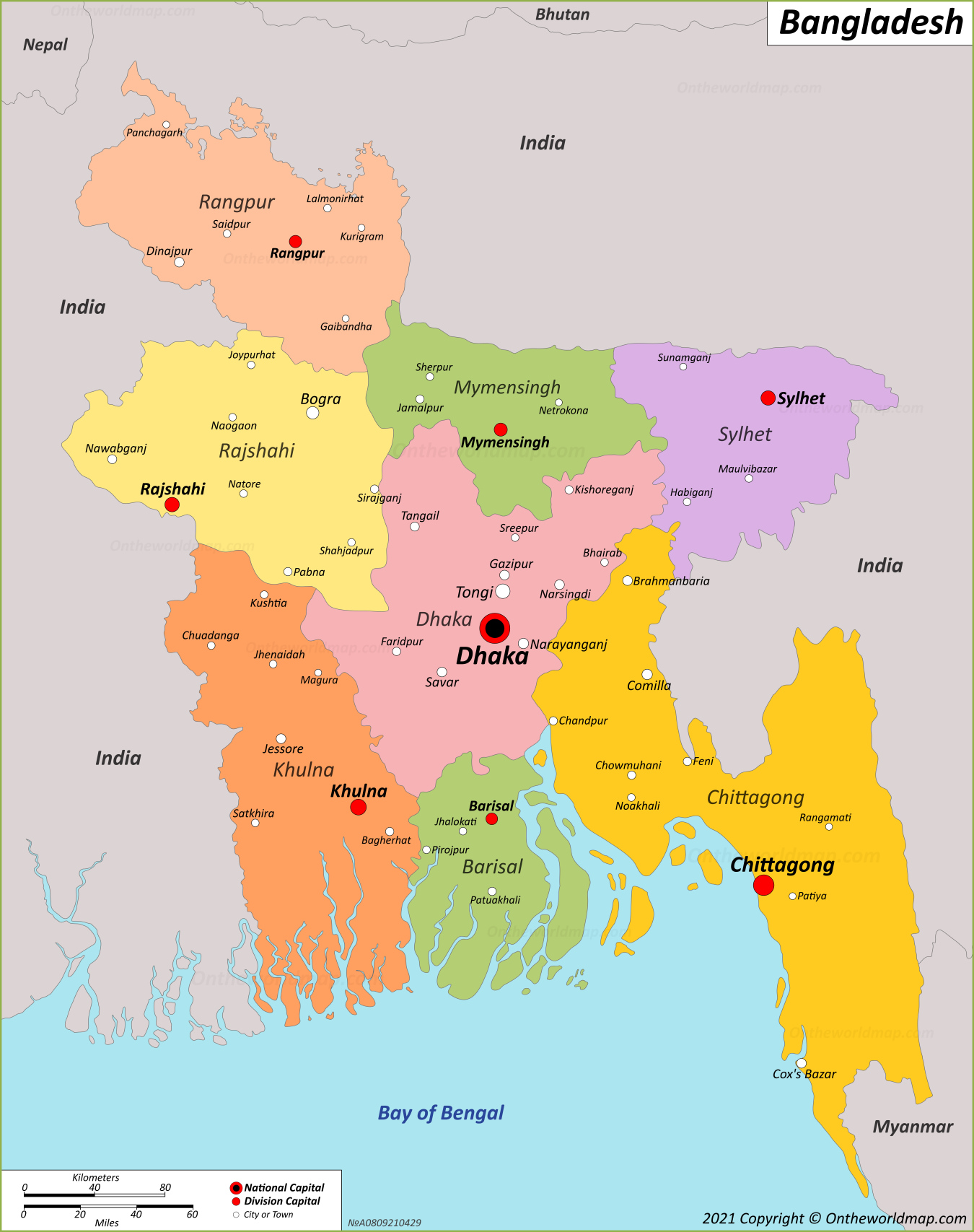
Description:
This map shows governmental boundaries of countries; divisions, division capital cities, and major cities and towns in Bangladesh.
You may download, print or use the above map for educational, personal and non-commercial purposes. Attribution is required. For any website, blog, scientific research or e-book, you must place a hyperlink (to this page) with an attribution next to the image used.

Online Map of Bangladesh


About Bangladesh
Bangladesh, officially the People's Republic of Bangladesh, is a country in South Asia. With a population of about 180 million, it is the eighth most populous country in the world and one of the most densely populated. It borders India to the west, north and east, and Myanmar to the southeast. The Bay of Bengal lies to the south. The capital and largest city is Dhaka. Chittagong is the second-largest city and the country's main seaport. The official language is Bengali.
The Facts:| Capital: | Dhaka |
| Area: | 57,320 sq mi (148,460 sq km) |
| Population: | ~ 180,000,000 (2026 estimate) |
| Official language: | Bengali |
| Largest Cities: | Dhaka, Chittagong, Khulna, Sylhet, Rajshahi, Mymensingh, Barisal, Rangpur, Comilla, Narayanganj, Gazipur, Tongi, Bogra, Savar, Siddhirganj, Jessore, Cox's Bazar, Kaliakair, Brahmanbaria, Dinajpur, Nawabganj, Tangail, Sirajganj, Chandpur, Feni, Tarabo, Jamalpur, Naogaon, Narsingdi, Pabna, Chowmuhani, Sreepur, Noakhali, Chuadanga, Saidpur, Faridpur, Bhairab, Comilla Sadar Dakshin, Jhenaidah, Satkhira, Kushtia, Kishoreganj. |
| Divisions of Bangladesh: | Barisal, Chittagong, Dhaka, Khulna, Mymensingh, Rajshahi, Rangpur, Sylhet. |
| Districts of Bangladesh: | Barguna, Barisal, Bhola, Jhalokati, Patuakhali, Pirojpur, Bandarban, Brahmanbaria, Chandpur, Chittagong, Comilla, Cox's Bazar, Feni, Khagrachhari, Lakshmipur, Noakhali, Rangamati, Dhaka, Faridpur, Gazipur, Gopalganj, Kishoreganj, Madaripur, Manikganj, Munshiganj, Narayanganj, Narsingdi, Rajbari, Shariatpur, Tangail, Bagerhat, Chuadanga, Jessore, Jhenaidah, Khulna, Kushtia, Magura, Meherpur, Narail, Satkhira, Jamalpur, Mymensingh, Netrokona, Sherpur, Bogra, Joypurhat, Naogaon, Natore, Chapainawabganj, Pabna, Rajshahi, Sirajganj, Dinajpur, Gaibandha, Kurigram, Lalmonirhat, Nilphamari, Panchagarh, Rangpur, Thakurgaon, Habiganj, Moulvibazar, Sunamganj, Sylhet. |
| Religion: |
|
| Currency: | Taka (৳) (BDT) |
| Driving side: | left |
| Calling code: | +880 |
| Internet TLD: | .bd |
| Time zone: | UTC+6 (BST) |
| Gross domestic product (PPP) (2026 estimate): |
|
| Gross domestic product (nominal) (2026 estimate): |
|
| Official government website: | bangladesh.gov.bd |
| Official tourism website: | beautifulbangladesh.gov.bd |
Geography
Most of the country lies on the Ganges–Brahmaputra delta, the largest river delta in the world. Its major rivers include the Padma, the Jamuna and the Meghna. The climate is tropical monsoon, and the country is highly exposed to floods and cyclones. In the southwest is the Sundarbans, the world's largest mangrove forest, which Bangladesh shares with India. The forest is a UNESCO World Heritage Site and home to the Bengal tiger. The Chittagong Hill Tracts in the southeast are the most significant hilly region. Cox's Bazar has one of the longest natural sea beaches in the world.
Brief History
Several kingdoms and empires ruled the region over time, including the Pala Empire, the Sena dynasty, the Bengal Sultanate and the Mughal Empire. After the Battle of Plassey in 1757, the British East India Company took control of Bengal. When British India was partitioned in 1947, the eastern part of Bengal became part of Pakistan and was later renamed East Pakistan. In 1952, the Bengali Language Movement campaigned for Bengali to be recognised as an official language. The day of the 21 February protests is now observed worldwide as International Mother Language Day.
Bangladesh declared independence on 26 March 1971, after the Pakistani army began a military crackdown known as Operation Searchlight. The Liberation War ended on 16 December 1971, when Pakistani forces surrendered in Dhaka after India intervened. Sheikh Mujibur Rahman, the country's founding leader, was assassinated in 1975. A period of military-dominated government followed under Ziaur Rahman and later Hussain Muhammad Ershad. Parliamentary democracy was restored in 1991. For the next three decades, Khaleda Zia of the Bangladesh Nationalist Party and Sheikh Hasina of the Awami League led most governments. Hasina had been in power since 2009, but she resigned and left the country in August 2024 after mass protests led by students. An interim government headed by Muhammad Yunus then took office.
Government, Politics, and Economy
Bangladesh is a unitary parliamentary republic. The president is the head of state and the prime minister is the head of government. The national parliament, the Jatiya Sangsad, has one chamber with 350 seats, 50 of which are reserved for women. The country is divided into eight divisions and 64 districts.
Bangladesh has a developing economy and has been one of the fastest-growing economies in Asia. Ready-made garments account for more than 80% of its exports, and it is among the largest clothing exporters in the world, second only to China. Money sent home by Bangladeshis working abroad and agriculture, especially rice and jute, are also important. The currency is the Bangladeshi taka. Major infrastructure projects include the Padma Bridge, which opened in 2022.
Bengalis make up about 98% of the population. According to the 2022 census, about 91% of people are Muslim and about 8% are Hindu. Since 2017, the country has hosted around one million Rohingya refugees from Myanmar, most of them living in camps in Cox's Bazar District.
The national anthem, "Amar Shonar Bangla", was written by Rabindranath Tagore. Kazi Nazrul Islam is the national poet. Pohela Boishakh, the Bengali New Year, is a major cultural festival. Cricket is the most popular sport, and the national team gained Test status in 2000.
Bangladesh is a member of the United Nations, the Commonwealth of Nations, the Organisation of Islamic Cooperation and BIMSTEC. It is also a founding member of SAARC, which was established in Dhaka in 1985.