
Barbados Map
Description:
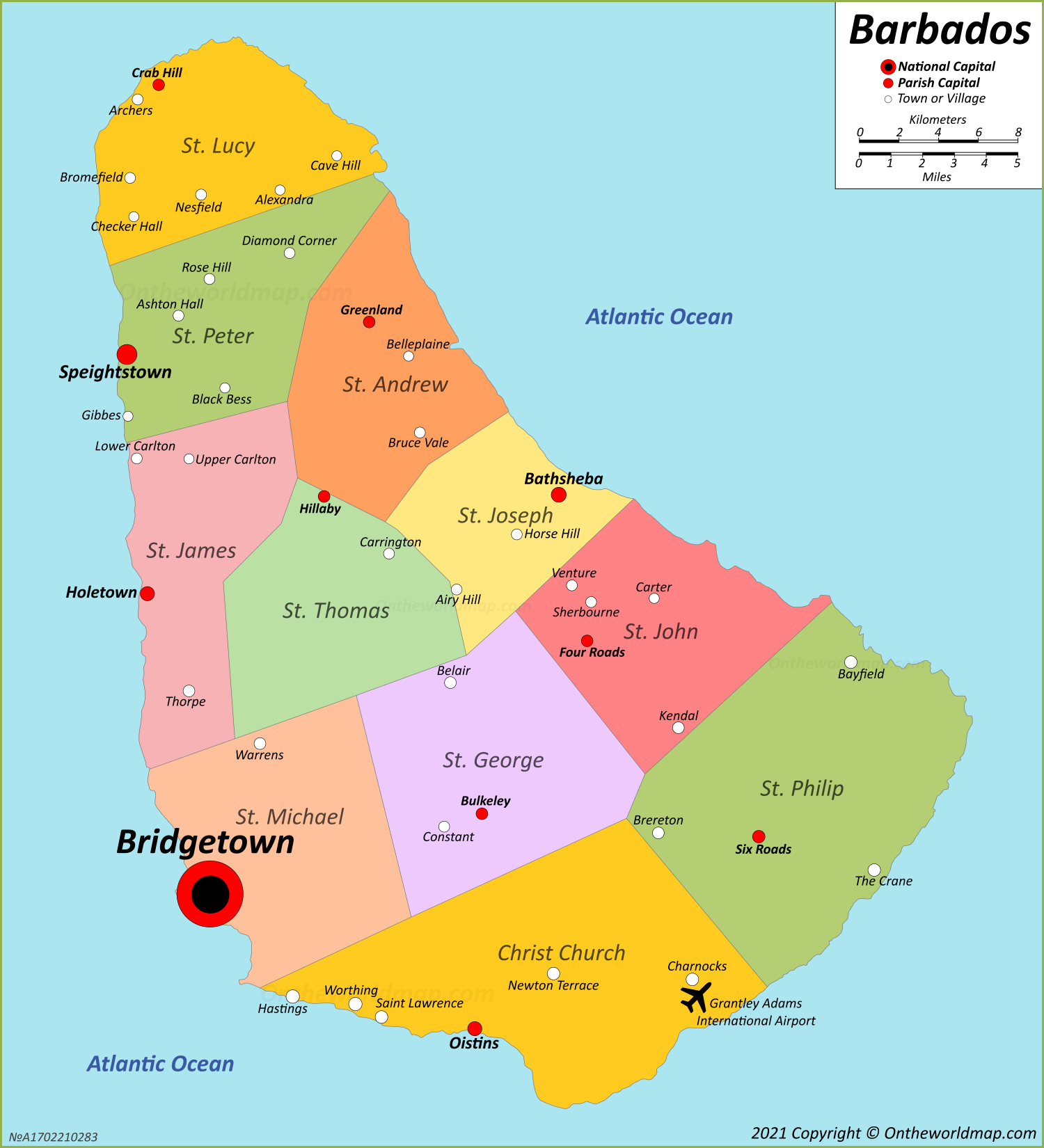
This map shows parishes, parish capital cities, airport, major cities, towns, and villages in Barbados.
You may download, print or use the above map for educational, personal and non-commercial purposes. Attribution is required. For any website, blog, scientific research or e-book, you must place a hyperlink (to this page) with an attribution next to the image used.

Online Map of Barbados


About Barbados
Barbados is an island country in the Lesser Antilles of the West Indies, in the Caribbean region of North America. It is the most easterly of the Caribbean islands and lies in the western Atlantic Ocean. The island covers about 439 square kilometres (169 sq mi) and had a population of 269,090 at the 2021 census. Its capital and largest city is Bridgetown. Barbados became independent from the United Kingdom in 1966 and has been a parliamentary republic since 2021. It remains a member of the Commonwealth of Nations.
The Facts:| Capital: | Bridgetown |
| Area: | 169 sq mi (439 sq km) |
| Population: | ~ 283,000 (2026 estimate) |
| Official language: | English |
| Largest Cities and Towns: | Bridgetown, Bathsheba, Speightstown, Holetown, Oistins |
| Parishes of Barbados: | Christ Church, St. Andrew, St. George, St. James, St. John, St. Joseph, St. Lucy, St. Michael, St. Peter, St. Philip, St. Thomas. |
| Religion: |
|
| Ethnic groups: |
|
| Currency: | Barbadian dollar ($) (BBD) |
| Driving side: | left |
| Calling code: | +1 |
| Internet TLD: | .bb |
| Time zone: | UTC−04:00 (AST) |
| Gross domestic product (PPP) (2023 estimate): |
|
| Gross domestic product (nominal) (2023 estimate): |
|
| Official government website: | www.gov.bb |
The name is generally attributed to Portuguese explorers, who called the island Os Barbados ("the bearded ones"). It may refer to the island's bearded fig trees, whose hanging aerial roots look like beards.
History
Indigenous peoples, including groups often called Arawaks and later the Kalinago, lived on the island before Europeans arrived. Spanish and Portuguese navigators visited in the late 15th and 16th centuries, but neither power set up a lasting settlement. English settlers arrived in 1627 and founded a settlement at what is now Holetown.
Barbados became one of England's most profitable colonies after sugar cane was introduced in the mid-17th century. The plantation economy depended on enslaved Africans brought through the Atlantic slave trade, and by the late 17th century they made up most of the population. In 1661 the colony adopted the Barbados Slave Code, which later became a model for slave laws in other English colonies. The island's House of Assembly first met in 1639, which makes it one of the oldest legislative bodies in the Western Hemisphere. In 1816 enslaved people led an uprising known as Bussa's Rebellion. Slavery was abolished across the British Empire under the Slavery Abolition Act 1833, which took effect in 1834. Full emancipation followed in 1838, after a period of so-called apprenticeship.
In 1751 George Washington visited Barbados with his half-brother Lawrence. It was the only time Washington travelled outside what became the United States.
Barbados gained independence on 30 November 1966, with Errol Barrow as its first prime minister. Exactly 55 years later, on 30 November 2021, it became a republic. The monarch was replaced as head of state by a president, and Dame Sandra Mason became the country's first president. In 2018 Mia Mottley became the first woman to serve as prime minister of Barbados.
Geography
The island is relatively flat compared with its volcanic neighbours. Most of it is made of coral limestone. The highest point is Mount Hillaby, at about 340 metres (1,115 ft) above sea level. In the north-east lies the Scotland District, an area of eroded hills where the older underlying rock is exposed. Harrison's Cave, a limestone cave system in the centre of the island, is a well-known natural landmark.
Barbados has a tropical climate with a dry season and a wet season. Its position east of the main island chain means it lies at the edge of the Atlantic hurricane belt, though it has occasionally been hit by major storms.
Government and administrative divisions
Barbados is a parliamentary republic. The president is head of state and the prime minister is head of government. Parliament has two chambers: the elected House of Assembly and the appointed Senate. The country is divided into eleven parishes: Christ Church, Saint Andrew, Saint George, Saint James, Saint John, Saint Joseph, Saint Lucy, Saint Michael, Saint Peter, Saint Philip and Saint Thomas.
Economy, Demographics and Culture
Sugar dominated the economy for centuries. Today, tourism and international business and financial services are the main sectors. Rum production has a long history on the island, and the Mount Gay brand dates its origins to 1703. The currency is the Barbadian dollar, which has been pegged to the United States dollar at a rate of two to one since 1975.
Most of the population is of African descent. There are smaller communities of European, South Asian and mixed ancestry. English is the official language, and Bajan Creole is widely spoken in everyday life. People from the island are called Barbadians or, informally, Bajans. Christianity is the main religion, and the Anglican Church has historically been the largest denomination.
Cricket is the most popular sport, and Barbados has produced many players for the West Indies team, including Sir Garfield Sobers. The main cultural event is the Crop Over festival, which began as a celebration of the end of the sugar cane harvest and ends with Grand Kadooment Day. The national dish is cou-cou and flying fish. In 2021 the singer Rihanna was named a National Hero of Barbados.
Historic Bridgetown and its Garrison were added to the UNESCO World Heritage List in 2011.